Best Event Attribution and ROI Software in 2027: The Buyer's Shortlist
By EventMarketingSoftware.com · Published October 18, 2026 · 10 tools compared
If you need to prove what events add to pipeline, start with the tool that matches where your event data lives. Vendelux leads for teams sponsoring third-party shows because it ties event choice and meetings to CRM revenue. HockeyStack, Dreamdata and Adobe Marketo Measure are full B2B marketing attribution software that count events alongside every other channel. hapily and Heeet keep attribution inside HubSpot or Salesforce.
Our top picks
- 1
 VendeluxBest for B2B teams that sponsor third-party events and need event pipeline and ROI tracked in the CRMQuote only
- 2
 HockeyStackBest for mid-market and enterprise teams that want events measured inside full-funnel, multi-channel attributionQuote only
- 3
 DreamdataBest for B2B teams that want account-level customer journeys and a free starting point before paying for attribution$0 (Free); Advanced is custom-priced
Key takeaways
- Event attribution only works if every event lead lands in the CRM as a campaign member with the right campaign type. Every tool here, from Adobe Marketo Measure to HockeyStack, depends on that CRM data, so fix lead capture and campaign hygiene before buying software.
- There are two kinds of tool. General B2B attribution platforms (HockeyStack, Dreamdata, Adobe Marketo Measure, Heeet, Factors.ai) weigh events against ads, web and email, while event-specific tools (Vendelux, Luminik, hapily, Certain) start from the event and write sourced and influenced pipeline back to the CRM.
- Published prices are scarce but useful. Luminik starts at $249 a month, hapily at $600 a month, Heeet at $790 a month, Bear Analytics at $900 a month and Factors.ai's Basic plan at $6,000 a year, while Dreamdata has a free plan but puts attribution in a custom-priced tier.
- Model choice matters less than consistency. Adobe Marketo Measure documents first touch, lead creation, U-shaped, W-shaped, full path and custom models, and the right answer for events is usually an influence view across the whole deal rather than first-touch credit.
- Low-volume, high-value programs like events often look weak in click-based models. HockeyStack's lift and incrementality reporting, which compares exposed and unexposed accounts, and account-level views in Dreamdata are better suited to showing what a trade show changed.
Free tool: Event ROI and pipeline target calculator. Work back from budget and target ROI to the pipeline, opportunities, meetings and leads an event needs, or forward from expected leads to ROI.
Side-by-side comparison
The same criteria for every pick: offline and event touchpoints, native salesforce or hubspot writeback, account-level reporting, published entry price, security documentation. A dash means the vendor doesn't publish it.
| Tool | Starting price | Free plan / trial | CRM | Capterra | App Store | Security |
|---|---|---|---|---|---|---|
| Vendelux | Quote only | Free plan | Salesforce, HubSpot | ★ 5.0 (4) | ★ 4.6 (10) | SOC 2 Type II, SAML SSO, DPA |
| HockeyStack | Quote only | – | Salesforce, HubSpot, Dynamics, Marketo | – | – | SOC 2 Type II, SAML SSO, DPA |
| Dreamdata | $0 (Free); Advanced is custom-priced | Free plan, Free trial | Salesforce, HubSpot, Dynamics, Marketo | – | – | SOC 2 Type II, SAML SSO, DPA |
| Adobe Marketo Measure (formerly Bizible) | Quote only | – | Salesforce, Marketo | – | – | – |
| Heeet | From $790/month | Free trial | Salesforce, HubSpot, Dynamics | – | – | – |
| Factors.ai | From $199/month | – | – | – | – | SOC 2 Type II, ISO 27001, DPA |
| hapily | From $417/month | – | HubSpot | – | – | SOC 2 Type II, DPA |
| Luminik | From $249/month | – | Salesforce, HubSpot | – | – | SAML SSO |
| Certain | Quote only | Free plan | Salesforce, HubSpot, Marketo | ★ 4.3 (6) | ★ 4.8 (8) | SOC 2 Type II |
| Bear Analytics | From $900/month | – | Salesforce, HubSpot | – | – | – |
Events are hard to attribute. Most touches happen offline, deals take months, and the people who met your team at a booth are rarely the ones who fill in a web form. This guide compares the tools B2B teams use to close that gap, from general multi-touch attribution platforms to event-specific pipeline tools, using vendor pages, published pricing and our own data. For dashboards on attendance, sessions and onsite behavior instead, see our guide to event analytics software.
Who this guide is for. This guide is for B2B event marketers, demand generation leaders and marketing operations teams who have to show how trade shows, conferences, field events and webinars contribute to pipeline and revenue. It suits teams on Salesforce or HubSpot that already log event leads as campaigns and now need credible influence and ROI reporting for finance and sales leadership.
Not sure which one fits your team?
Answer a few questions about your events, team and CRM and get a free shortlist of tools that fit, with pricing and security details side by side.
Get a free shortlistThe best event attribution and ROI software in 2027
Here are 10 tools for proving event pipeline and ROI, ordered by how directly they attribute revenue to events. The first picks are event-first or full B2B attribution platforms; later picks are CRM-native or organizer-focused options. For each one, check where it gets event data from and whether results land back in your CRM.
1. Vendelux, best for B2B teams that sponsor third-party events and need event pipeline and ROI tracked in the CRM
- Price
- Quote only
- Try it
- Free plan
- Capterra
- 5.0/5 from 4 reviews
- App Store
- 4.6/5 from 10 ratings
- Languages
- English
- Syncs with
- Salesforce, HubSpot
- Security
- SOC 2 Type II, SAML SSO, DPA
- Customers include
- TELUS Digital, Superhuman, Pecan AI
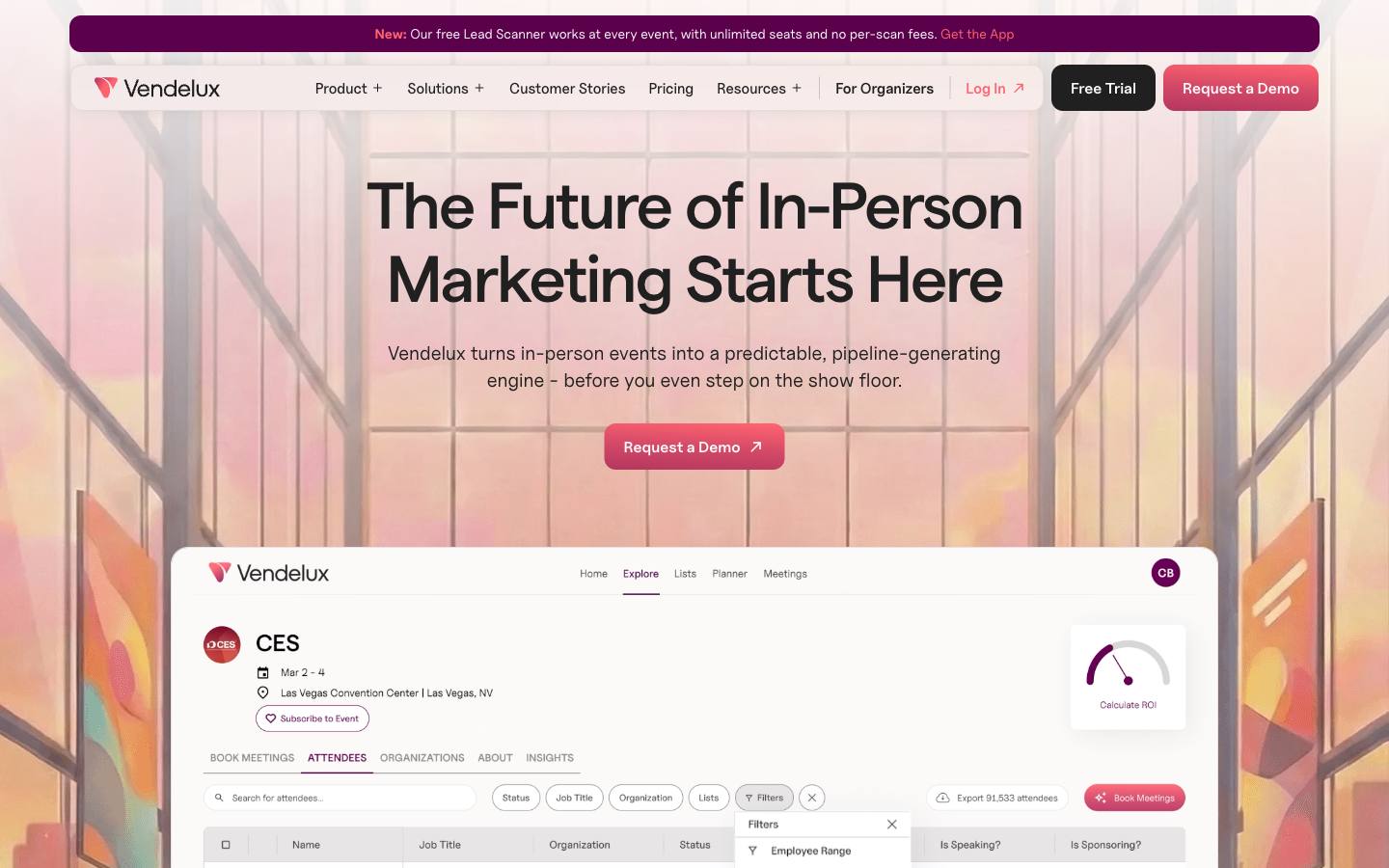
Vendelux is an event intelligence and pipeline platform for companies that attend or sponsor other organizers' conferences and trade shows. It maps CRM accounts and open deals onto upcoming events, books meetings with target accounts before the show and attributes pipeline and closed revenue back to each event.
More on VendeluxLess on Vendelux
Founded: 2021 · HQ: New York, US · Team: 51–200 people · Formats: In-person
Attribution starts before the event. Because Vendelux knows which target accounts, customers and open deals are tied to each event from its database of more than 250,000 B2B events, it can report pipeline against a list that was set before the show, rather than reconstructing it from badge scans afterward. It connects to Salesforce and HubSpot, with view-only CRM sync on Starter and pushes to lists and campaigns on Plus, and its free Lead Scanner app enriches scanned contacts and sends them to HubSpot. Vendelux reports on its own site that Voltage saw a 300% rise in late-stage pipeline year over year.
Pricing isn't published; Starter, Plus and Enterprise differ by lead credits, campaign credits and seats. Founded in 2021 in New York, Vendelux raised a $50 million Series B in July 2026 and documents SOC 2 Type II and SAML SSO. Named customers include Ramp, Glean, Coupa and AdRoll. It's a better fit for proving the return on sponsored events than for weighting events against paid search or social ads, which is where the general attribution platforms below come in.
- SOC 2 Type II and SAML SSO documented
What stands out
- Ties event selection, target accounts and meetings to CRM pipeline and revenue
- Salesforce and HubSpot integration
- Database of 250,000+ B2B events
Worth checking
- Doesn't weigh events against ads, web and email channels
- Prices aren't published and depend on credits
Best suited for. Vendelux fits demand generation and field marketing teams whose biggest event spend is sponsorships and booths at third-party shows. If you need to compare events with every other marketing channel in one model, add a platform such as HockeyStack or Dreamdata.
2. HockeyStack, best for mid-market and enterprise teams that want events measured inside full-funnel, multi-channel attribution
- Price
- Quote only
- Languages
- English
- Syncs with
- Salesforce, HubSpot, Dynamics, Marketo
- Security
- SOC 2 Type II, SAML SSO, DPA
- Customers include
- 8x8, DataRobot, Yext
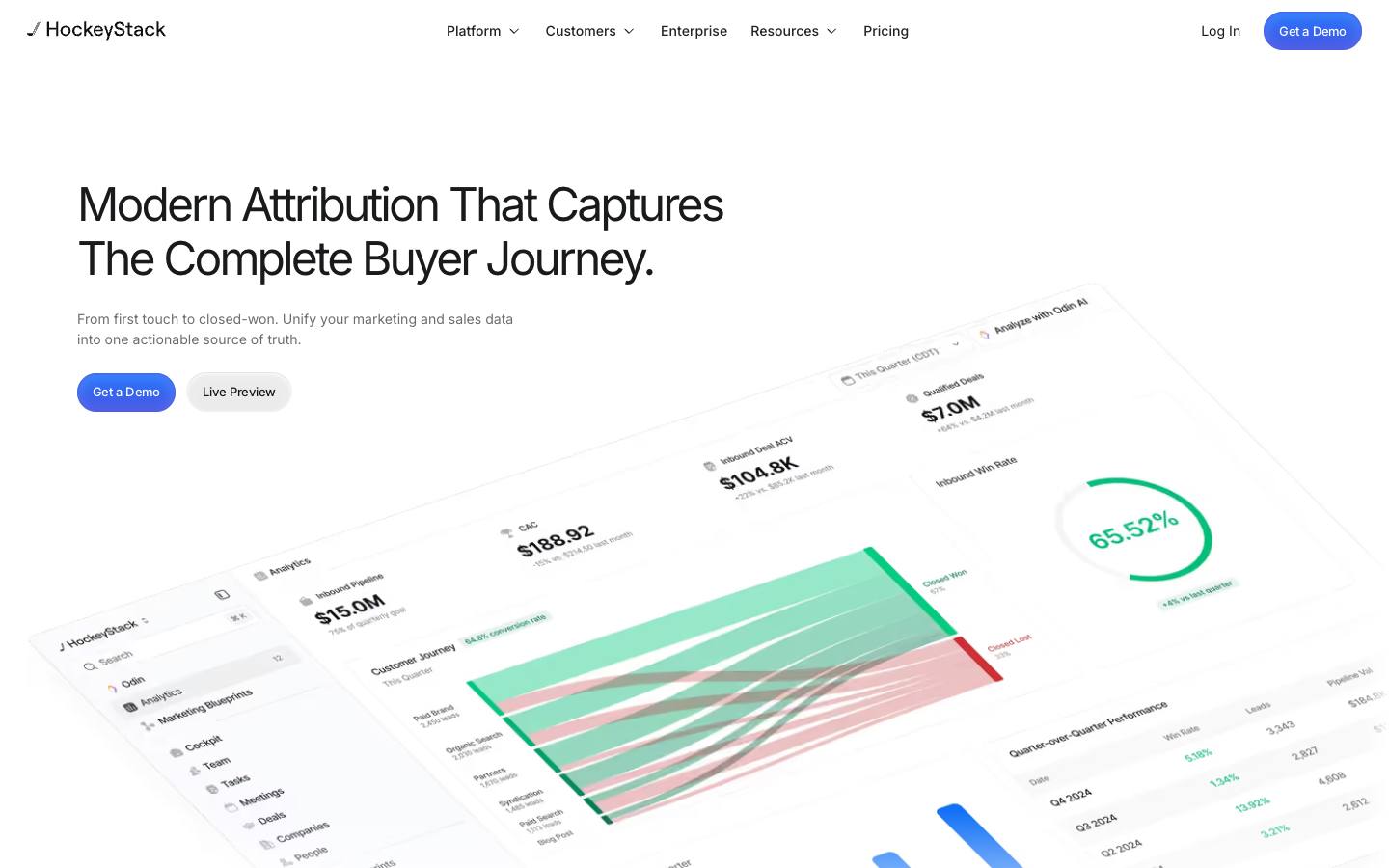
HockeyStack is a B2B go-to-market analytics and revenue data platform that unifies marketing, product and sales data to show how touchpoints lead to pipeline and revenue. It offers multi-touch attribution, account journeys, custom dashboards and AI agents that recommend next actions on priority accounts.
More on HockeyStackLess on HockeyStack
Founded: 2021 · HQ: San Francisco, California · Team: 51-200 people · Formats: Any format
For events, two features matter most. Multi-touch attribution connects online and offline touchpoints, including events, to opportunities and revenue. Lift and incrementality reporting compares accounts that were exposed to a program with similar accounts that weren't, which suits low-volume, high-value programs like trade shows where click-based models undercount. Its Atlas data layer ingests CRM, marketing automation, ad, website and warehouse data and syncs results back.
It connects natively to Salesforce, HubSpot, Microsoft Dynamics, Marketo and Pardot, plus ad platforms, intent providers such as 6sense, Demandbase and Bombora, and warehouses including Snowflake and BigQuery. Pricing is custom through sales. HockeyStack was founded in 2021 in San Francisco and says it has raised over $50 million. Named customers include Mastercard, Rakuten, RingCentral, 8x8 and ActiveCampaign. Like every attribution platform, it's only as good as the event data in your CRM, so registration and lead capture records need consistent campaign tagging before the reports become reliable. Its tracking is cookieless and first-party.
- Revenue agents that recommend next steps on priority accounts
What stands out
- Lift and incrementality reporting for low-volume programs like events
- Native connectors for CRMs, MAPs, ad platforms, intent data and warehouses
- Two-way sync of results back to source systems
Worth checking
- Not an event platform; event data must come from registration and CRM tools
- Pricing isn't published and targets mid-market and enterprise budgets
Best suited for. HockeyStack fits marketing operations teams that want events judged in the same model as paid, web and sales activity, with incrementality to back up the numbers. Teams that only need event-by-event pipeline reports can start with a lighter event-first tool.
3. Dreamdata, best for B2B teams that want account-level customer journeys and a free starting point before paying for attribution
- Price
- $0 (Free); Advanced is custom-priced
- Try it
- Free plan, Free trial
- Syncs with
- Salesforce, HubSpot, Dynamics, Marketo
- Security
- SOC 2 Type II, SAML SSO, DPA
- Customers include
- Finastra, insightsoftware, Clio
Dreamdata is a B2B attribution and revenue analytics platform that stitches ad, web, CRM and offline activity into account-level customer journeys. Marketers use it to see which channels and campaigns, including events and webinars, influence pipeline and revenue, and to push audiences back to ad platforms.
More on DreamdataLess on Dreamdata
Founded: 2018 · HQ: Copenhagen, Denmark · Formats: Any format
Customer journeys show every touchpoint across contacts, companies and deals on one timeline, and attribution offers multi-touch and AI-based models tied to pipeline and closed revenue. Dreamdata connects to Salesforce, HubSpot, Microsoft Dynamics and Pipedrive, to Marketo, Pardot and Eloqua, and to webinar sources including Livestorm, Zoom Events and Microsoft Teams Events. An MCP server lets assistants such as Claude and ChatGPT query governed attribution data.
Dreamdata publishes a free plan covering web analytics, company identification, an audience builder, two months of user history and five seats. Attribution and activation sit in a custom-priced tier with SSO, a dedicated CSM and full onboarding, and a guided trial is offered. Founded in 2018 in Copenhagen, it has raised $66.22 million according to CB Insights. Named customers include Finastra, BlackLine, Cognism, Sendoso and ElevenLabs. Offline event touchpoints depend on clean CRM campaign data, so plan to standardize how event leads are logged before rolling it out. Signals can also alert sales when target accounts engage.
- MCP server for querying attribution data from AI assistants
What stands out
- Account-level journeys across contacts, companies and deals
- Free plan for web analytics and company identification
- Webinar connectors for Livestorm, Zoom Events and Teams Events
Worth checking
- Attribution requires the custom-priced paid tier
- Measurement only; event data must come from registration or CRM tools
Best suited for. Dreamdata fits B2B teams that run webinars and events alongside heavy LinkedIn and paid programs and want account journeys across all of it. Teams that need a tool built around trade show workflows should look at Vendelux or Luminik.

4. Adobe Marketo Measure (formerly Bizible), best for Salesforce and Marketo shops that want established multi-touch models with offline event channels
- Price
- Quote only
- Syncs with
- Salesforce, Marketo
Adobe Marketo Measure, formerly Bizible, is a B2B revenue attribution product that combines behavioral and ad data with sales outcomes. It credits offline touches, including events and trade shows, alongside digital channels.
More on Adobe Marketo Measure (formerly Bizible)Less on Adobe Marketo Measure (formerly Bizible)
Founded: 1982 · Formats: Any format
Its documentation lists six attribution models: first touch, lead creation, U-shaped (50% each to first touch and lead creation), W-shaped (30% each to first touch, lead creation and opportunity creation), full path (22.5% each to those stages plus closed won) and a custom model where you set the stages and weights. Full path and W-shaped are the models most event marketers lean on, because they give credit to touches in the middle of a long B2B deal.
Offline channels are driven by the Salesforce campaign type. Each type, such as tradeshow, conference, dinner or webinar, maps to a channel and subchannel, and campaign types are imported only for campaigns with buyer touchpoints. Because each type maps to only one subchannel, events aimed at different audiences need separate campaign types, so plan your Salesforce campaign structure before rollout. Adobe doesn't publish pricing for Marketo Measure. It fits most naturally for teams already on Marketo and Salesforce, while teams on HubSpot alone have lighter options. Expect a setup project that involves marketing operations and the Salesforce admin.
- Designed for teams running Marketo and Salesforce
What stands out
- Six documented models, including W-shaped, full path and custom
- Offline event channels mapped from Salesforce campaign types
- Combines ad, behavioral and sales outcome data
Worth checking
- Offline tracking relies on a disciplined Salesforce campaign-type setup
- Pricing isn't published
Best suited for. Adobe Marketo Measure fits enterprise and mid-market teams running Marketo Engage and Salesforce that want standard, well-documented attribution models. HubSpot-only teams will find hapily or Heeet simpler to run.

5. Heeet, best for teams that want event and webinar attribution written natively into Salesforce or HubSpot at a published price
- Price
- From $790/month
- Try it
- Free trial
- Languages
- English, French
- Syncs with
- Salesforce, HubSpot, Dynamics
- Customers include
- Nel, Driver Defense Team, Red & Yellow
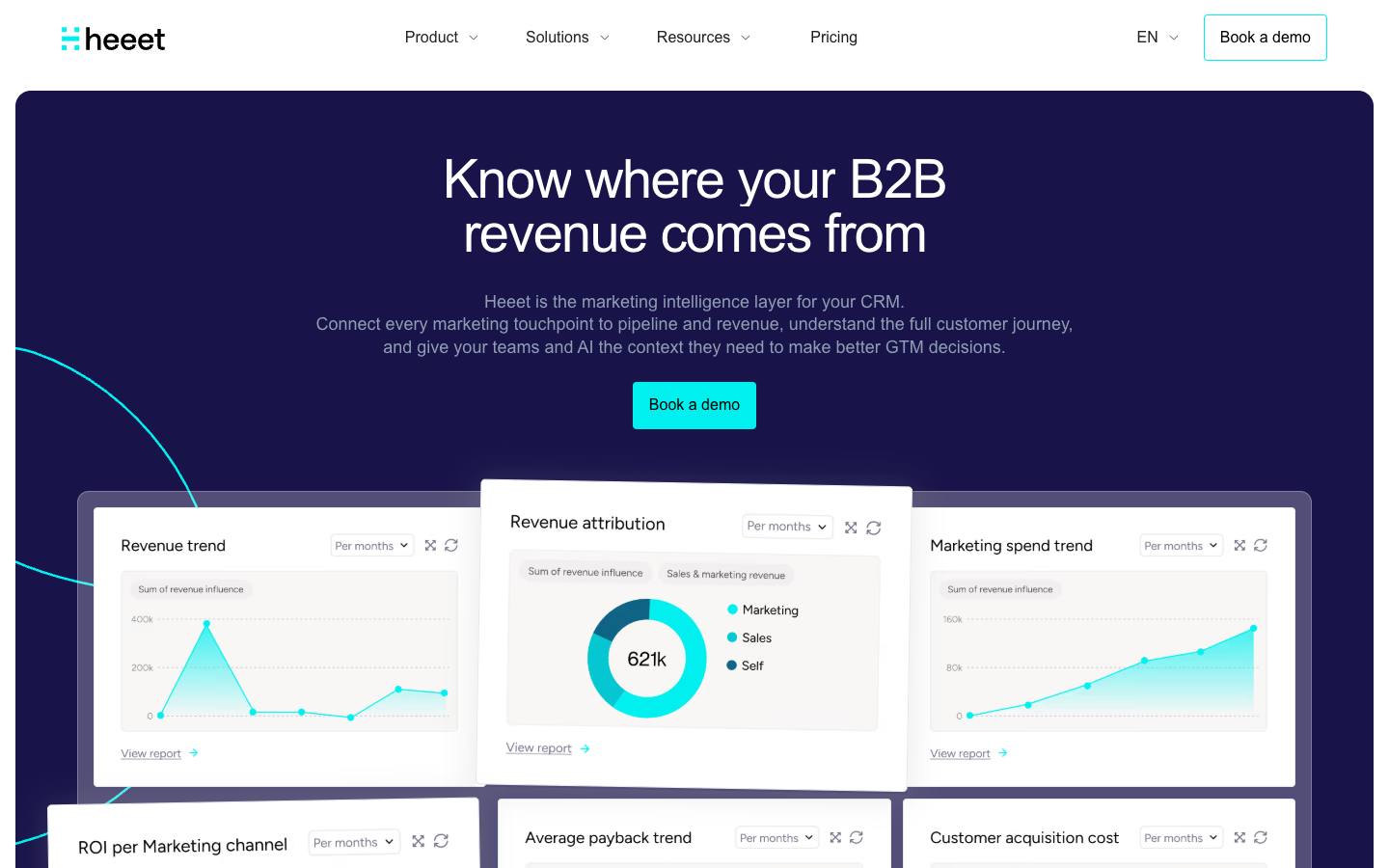
Heeet is a marketing attribution platform that writes multi-touch attribution data natively into Salesforce and HubSpot, with other CRMs supported through its hosted platform. It tracks paid media, SEO, email and LinkedIn alongside event and webinar touchpoints.
More on HeeetLess on Heeet
Founded: 2020 · HQ: Paris, France · Team: 2-10 people · Formats: Any format
Event interactions are logged as touchpoints, and reports compare event spend with influenced pipeline and revenue, so a field marketer can see cost per opportunity next to digital channels. Paid media spend syncs from Google, LinkedIn, Meta, Microsoft, TikTok and Reddit ads for CAC analysis, and event attendees can be reused as first-party audiences for retargeting. An Analyst Agent built on Salesforce Agentforce summarizes attribution data and sends alerts. Heeet uses cookieless tracking and says it stores no personal data, and its Salesforce package passed the AppExchange security review.
Heeet publishes pricing, checked October 2026. The Platform plan is $790 a month billed yearly for any CRM, with 3,000 new digital leads a year, unlimited seats and a 30-day trial. The Native plan for Salesforce and HubSpot is $1,490 a month with 6,000 leads a year and dedicated onboarding, and Enterprise is custom. Extra leads cost $95 per 100, and historical imports start at $2,500. Heeet was founded in 2020 in Paris, and named customers include Ringover, Malvern Panalytical, Align Technology and Culligan.
- Passed the Salesforce AppExchange security review
What stands out
- Attribution stored as native objects in Salesforce or HubSpot
- Event spend compared directly with influenced pipeline
- Published pricing from $790 a month with a 30-day trial
Worth checking
- Event data must already be in the CRM; no event platform integrations are named
- The native CRM tier is a significant annual commitment
Best suited for. Heeet fits mid-market teams that want attribution to live inside their own CRM with a known price and a trial. Teams that need deep ad-platform audience activation or warehouse modeling should compare Dreamdata or HockeyStack.

6. Factors.ai, best for startups and mid-market teams that want account identification, intent and influence attribution at a published price
From $199/month
- Price
- From $199/month
- Security
- SOC 2 Type II, ISO 27001, DPA
- Customers include
- Sprinklr, AudienceView, ClearFeed
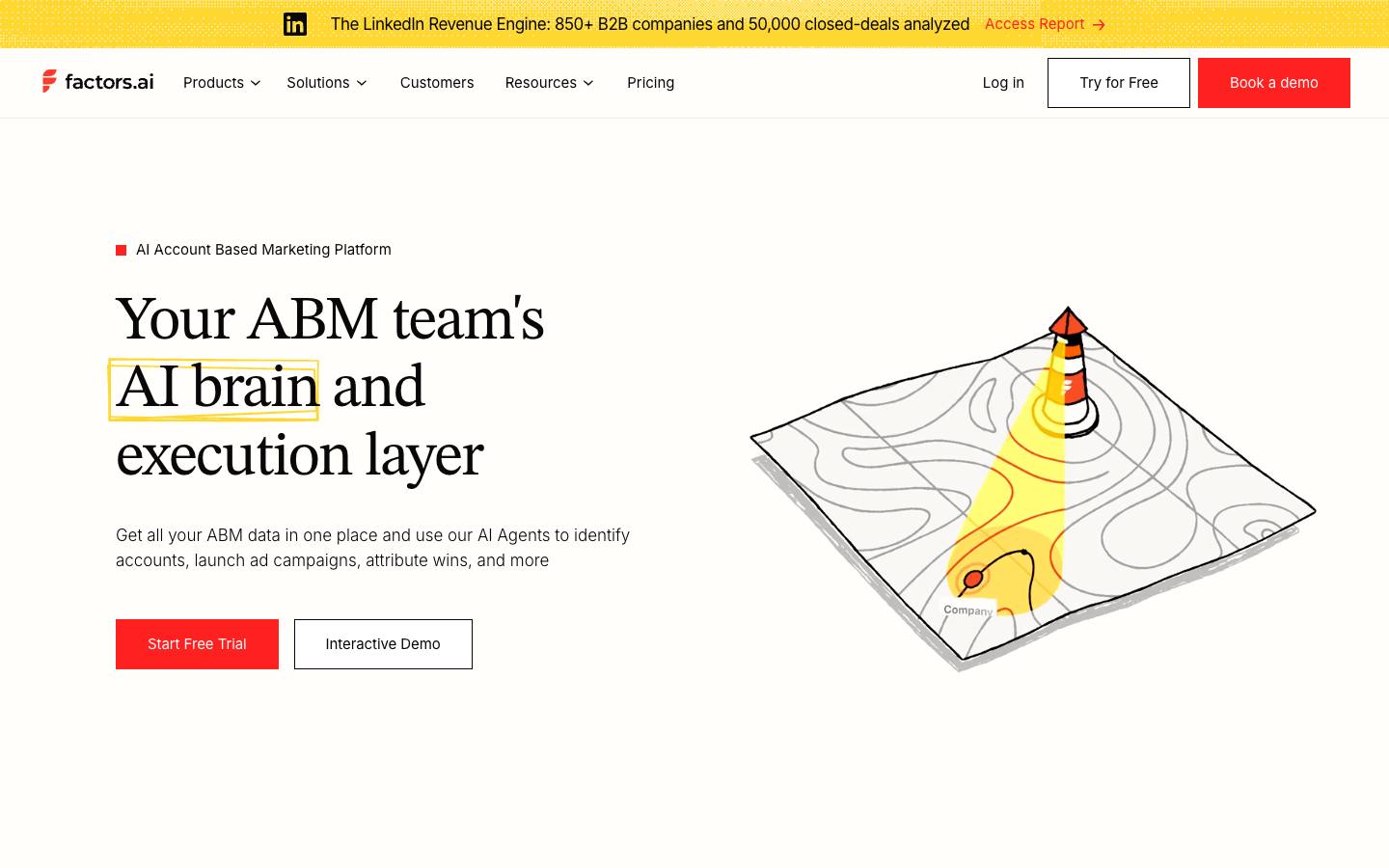
Factors.ai is an AI account-based marketing and attribution platform for go-to-market teams. It identifies companies visiting your website, scores accounts on website, ad and third-party intent signals and tracks first touch, last touch and influenced attribution together.
More on Factors.aiLess on Factors.ai
Formats: Any format
For event marketers, the useful parts are account identification and the influence model. Accounts that attended an event and then visit your site can be spotted and routed to sales, and influenced attribution shows which programs touched an account before a deal. Factors.ai lists HubSpot (companies and deals) and Salesforce (accounts and opportunities) as full integrations, pushes account lists to LinkedIn and Meta as matched audiences and offers an MCP server for ChatGPT, Claude and Gemini. Its help center lists offline marketing events such as webinars and field events among the touchpoints an attribution report can include, with setup in a separate guide, so confirm how trade show leads reach it.
Factors.ai publishes pricing, checked October 2026: Lite is $199 a month after a free trial with no card required, Basic is $6,000 a year with CRM sync and up to 50 reports, Growth is $20,000 a year with custom account scoring, and Enterprise starts at $30,000 a year with predictive scoring and ad audience sync. Start-up discounts are mentioned. It documents SOC 2 Type II, and named customers include Rocketlane, Descope, Akeyless and Sprinklr.
- SOC 2 Type II
What stands out
- Published plans from $199 a month
- Account identification and intent scoring
- HubSpot and Salesforce integrations
Worth checking
- Offline event touchpoints need their own setup
- Account-level ABM focus can be more than an event-only team needs
Best suited for. Factors.ai fits startups and mid-market teams that want ABM signals and attribution together without an enterprise contract. Teams whose main question is the ROI of specific trade shows should start with an event-first tool such as Vendelux or Luminik.

7. hapily, best for HubSpot-based teams that want deal attribution for hosted events and trade shows inside HubSpot
From $417/month
- Price
- From $417/month
- Languages
- English
- Syncs with
- HubSpot
- Security
- SOC 2 Type II, DPA
- Customers include
- Duke Corporate Education, Imperial PFS, Pearagon
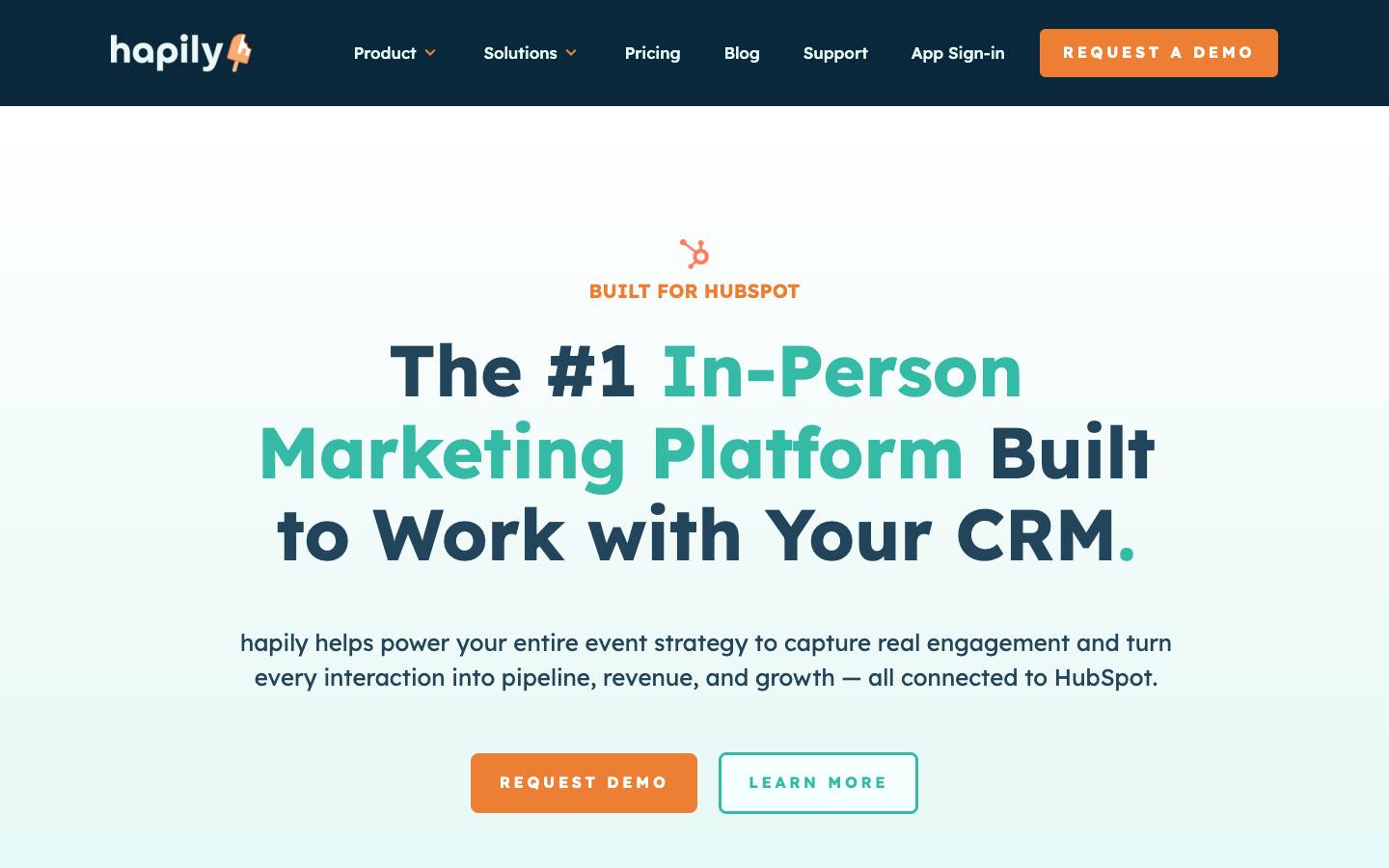
hapily is an event platform built for HubSpot that keeps registration, check-in, lead capture, meetings and attribution data in the CRM as native records. Its attribution and reporting tools show deal attribution and ROI in HubSpot dashboards.
More on hapilyLess on hapily
Founded: 2025 · HQ: New York, NY · Team: 11-50 people · Formats: In-person, Virtual, Hybrid, Webinar
Because registrations, attendance and lead scans are created as HubSpot records from the start, there's no sync layer to break and no import to wait for. That's the main reason event attribution is easier here than with tools that bolt onto the CRM. hapily covers hosted events (pages, invites, registration, QR check-in, badges) and lead capture at third-party shows with an AI-assisted mobile app, so both owned and sponsored events show up in the same deal reports.
Pricing is published and billed annually, checked October 2026. Hosted Events or Lead Capture each cost $600 a month with 1,000 credits, the Core Bundle is $833 a month with 2,000 credits, unlimited seats and events, and the meetings or paid-events add-ons are $417 a month each. One registration or scan uses one credit, and 4,000 extra credits cost $2,500. Founded in 2025, hapily lists SOC 2 Type II, and named customers include Arizona State University, Edelman and OUTFRONT Media. It's a narrower tool than a full attribution platform, but for HubSpot teams it removes most of the data plumbing.
- Published pricing from $600 a month
What stands out
- Event data stored natively in HubSpot
- Deal attribution and ROI in HubSpot dashboards
- Covers hosted events and third-party trade shows
Worth checking
- Only works for HubSpot customers
- Doesn't weigh events against ads or web channels
Best suited for. hapily fits HubSpot teams that want event ROI reports without a separate attribution platform. Salesforce shops, or teams that need multi-channel models, should compare Heeet or Adobe Marketo Measure.

8. Luminik, best for startups that sponsor trade shows and want sourced and influenced pipeline per event written back to the CRM
From $249/month
- Price
- From $249/month
- Syncs with
- Salesforce, HubSpot
- Security
- SAML SSO
Luminik is a sponsor-side event pipeline tool. It scores third-party event attendees against your ICP, pushes priority contacts into your sequencer, captures booth conversations on mobile and writes sourced and influenced pipeline back to Salesforce or HubSpot after each event.
More on LuminikLess on Luminik
Formats: In-person
Attribution is the last step of a workflow Luminik runs end to end. Target lists are built weeks before an event from event platforms, speaker lists and exhibitor directories, enriched through your own Apollo or ZoomInfo contract and handed to Apollo, Salesloft, Amplemarket or Lemlist. The offline-first booth app captures badges, cards, QR codes and voice notes, with AI pulling next steps from the notes. After the event, pipeline is written to the CRM by event, rep and account, and the Growth plan includes a report after each event.
Luminik publishes pricing, checked October 2026: Starter is $249 a month billed annually ($299 month to month) for six events and 15,000 enriched matches a year, Growth is $665 a month for 12 events, and Scale starts at $1,665 a month for 30 events with SSO and directory sync. Every plan includes unlimited booth reps. Case studies are anonymized and there are no named customer logos, and a SOC 2 report is offered on request on Scale. It's built for teams attending other organizers' events, not for hosting registration.
- Unlimited booth reps on every plan
What stands out
- Sourced and influenced pipeline per event, rep and account
- Published pricing from $249 a month
- Uses your existing enrichment and sequencer contracts
Worth checking
- No named customers; case studies are anonymized
- Not for hosting your own events
Best suited for. Luminik fits Series A to C startups with a pipeline target tied to six to 30 sponsored shows a year. Larger teams that want a bigger event database and managed meeting outreach should compare Vendelux.

9. Certain, best for enterprise teams hosting branded events that want in-event engagement scored as buying signals in the CRM
Quote only
- Price
- Quote only
- Try it
- Free plan
- Capterra
- 4.3/5 from 6 reviews
- App Store
- 4.8/5 from 8 ratings
- Syncs with
- Salesforce, HubSpot, Marketo
- Security
- SOC 2 Type II
- Customers include
- Analog Devices, Deloitte, National Instruments
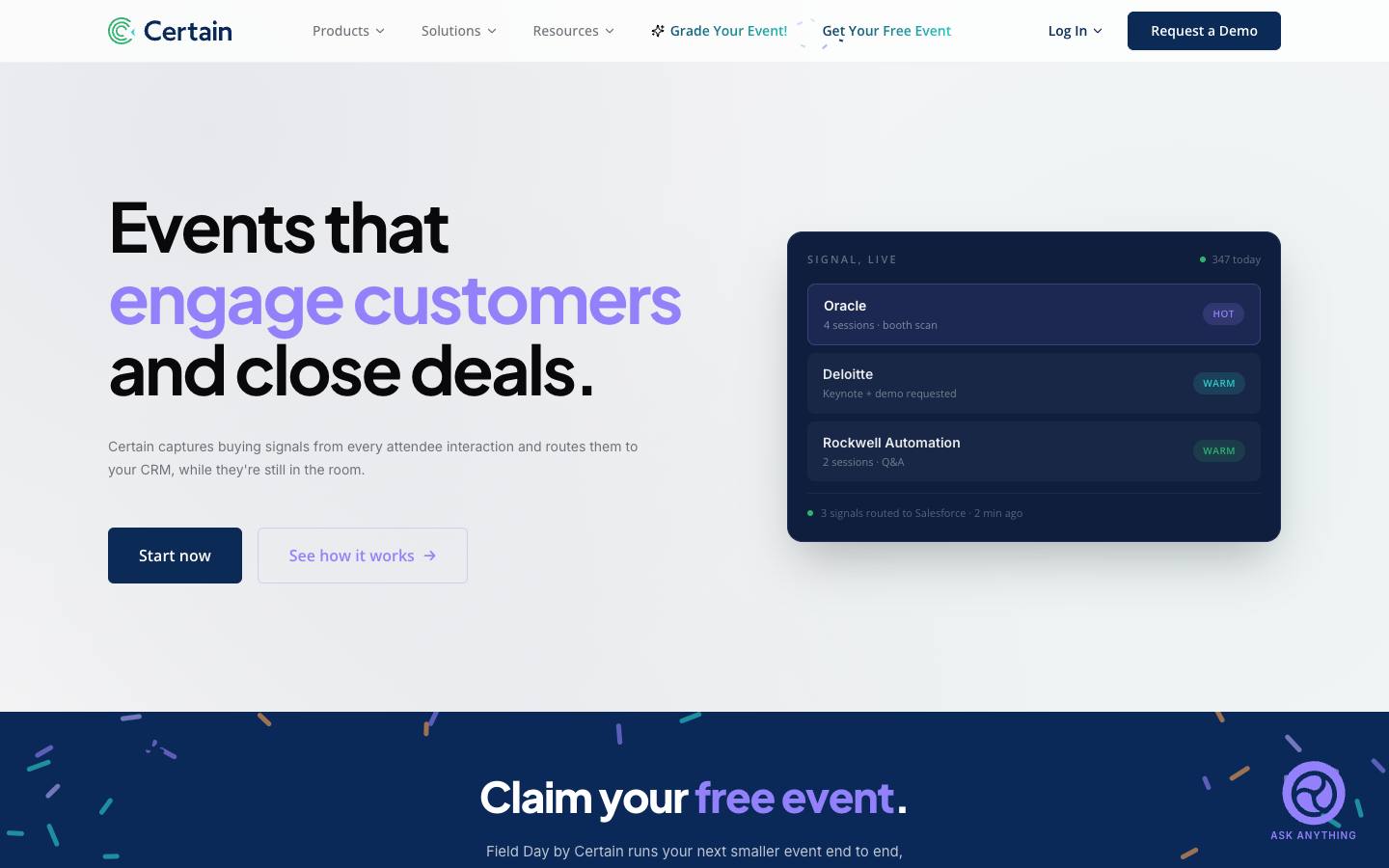
Certain is a long-running enterprise event management platform now positioned as event intelligence. It tracks session, booth and content engagement at events you host, scores attendee intent with AI and routes those signals to CRM and marketing automation while the event runs.
More on CertainLess on Certain
Founded: 1994 · HQ: San Francisco, United States · Formats: In-person, Virtual, Hybrid
Its live event dashboard shows attendees, captured signals, hot leads synced and pipeline influenced during the event, not weeks later. Behavior-based follow-up triggers messages based on which sessions and content each attendee engaged with, and no-code data flows move data between Certain and the marketing stack. Named integrations are Salesforce, HubSpot, Marketo and a public API. The platform also covers registration, the Touchpoint mobile app and Greet check-in, and a free Field Day offer covers registration to badge printing for smaller events.
Pricing is custom and based on portfolio size and modules. Certain was founded in 1994, has raised $38.64 million according to CB Insights and holds a 4.33 rating from six Capterra reviews. Named customers include Oracle, Thomson Reuters, Deloitte, Rockwell Automation and Analog Devices. It's the right shape for teams that want attribution to start from what attendees did at their own events, but the published integration list is short, so confirm connectors for anything beyond Salesforce, HubSpot and Marketo.
- Free Field Day offer for smaller events
What stands out
- In-event engagement scored as buying intent
- Live dashboard with pipeline influenced during the event
- Salesforce, HubSpot and Marketo connections
Worth checking
- Pricing is fully custom
- Short published integration list
Best suited for. Certain fits enterprise teams running a portfolio of their own branded events who want engagement turned into sales signals in real time. Teams that mostly sponsor other organizers' shows should look at Vendelux or Luminik.

10. Bear Analytics, best for associations and trade show organizers that need audience, exhibitor ROI and attribution reporting across a portfolio
From $900/month
- Price
- From $900/month
- Syncs with
- Salesforce, HubSpot
- Customers include
- RE+ Events, Biotechnology Innovation Organization, National Business Aviation Association
Bear Analytics sells Bear IQ, an analytics platform that pulls registration, exhibitor, association management and marketing data into one set of dashboards for event organizers. A marketing attribution module is sold as an add-on alongside persona and post-event report modules.
More on Bear AnalyticsLess on Bear Analytics
Founded: 2013 · HQ: Arlington, Virginia · Team: 11-50 people · Formats: In-person, Virtual, Hybrid
Bear is built for the organizer's version of the ROI question: which campaigns drove registrations, how audiences flow between events in a portfolio and what exhibitors got out of the show. Its prebuilt connectors cover registration, exhibitor and housing systems that general BI tools lack, including Cvent, Swoogo, Swapcard, Map Your Show, A2Z Events, Convention Data Services and Expocad, plus HubSpot, Pardot, Salesforce Marketing Cloud and several AMS platforms. Predictive registration forecasting tracks pacing against goal, and exhibitor reporting gives sales teams ranked prospect lists.
Bear publishes pricing, checked October 2026: Starter from $900 a month for 2,000 attendees and exhibitors a year, one module and one connector; Growth from $1,900 a month; Business from $2,900 a month; Enterprise by quote. Every plan includes unlimited events and users, and add-on modules run from free to $7,500. Founded in 2013 in Arlington, Virginia, Bear names the National Association of Home Builders, the Biotechnology Innovation Organization and RE+ Events as customers. Its security page doesn't name a certification such as SOC 2.
- Predictive registration forecasting
What stands out
- Connectors for registration, exhibitor, housing and AMS systems
- Marketing attribution module alongside exhibitor ROI reporting
- Published pricing from $900 a month with unlimited users
Worth checking
- Built for organizers, not for sponsors measuring pipeline
- No named security certification
Best suited for. Bear Analytics fits associations and trade show producers that need to prove marketing and exhibitor ROI across a portfolio of events. Corporate B2B teams measuring their own deal pipeline will get more from HockeyStack, Dreamdata or Vendelux.
Picks 6 to 10 are folded to keep the list short. Open any of them, or compare them all in the table above.
Also worth considering
Attribution, Vivastream, RainFocus, Demandbase, Circa (formerly EventGeek)
The best event attribution and ROI software by use case
| If you need | Company size | Look at |
|---|---|---|
| Field marketing team proving ROI on 20+ sponsored conferences | Mid-market, Enterprise | VendeluxPipeline tracked against target accounts set before each show |
| Marketing ops comparing events with paid, web and sales channels | Mid-market, Enterprise | HockeyStackMulti-touch plus lift and incrementality reporting |
| Salesforce and Marketo shop standardizing attribution models | Mid-market, Enterprise | Adobe Marketo Measure (formerly Bizible)W-shaped and full path models with offline campaign types |
| HubSpot team that wants event ROI without a separate tool | Startup, Mid-market | hapilyEvent records and deal attribution native in HubSpot |
| Mid-market team wanting attribution inside its CRM at a known price | Startup, Mid-market | HeeetNative Salesforce or HubSpot objects from $790 a month |
| Startup with a pipeline target from six to 12 trade shows | Startup | LuminikEvent-level sourced and influenced pipeline from $249 a month |
| Association measuring marketing and exhibitor ROI across shows | Mid-market, Enterprise | Bear AnalyticsOrganizer-specific connectors and attribution module |
What results look like
Figures customers report in the vendors' own published case studies. They describe one customer each, not what every buyer should expect.
50%
Cut in ad spend
ActiveCampaign with HockeyStack · Case study
over 10%
Paid media ROI gain
Finastra with Dreamdata · Case study
3x
Return on ad spend
Driver Defense Team with Heeet · Case study
15%
Enterprise pipeline influenced by LinkedIn
Sprinklr with Factors.ai · Case study
45%
Increase in total registrations
RE+ Events with Bear Analytics · Case study
How to choose
Background on what these tools do, how we ranked them and what to check before you buy. Open any topic.
What event attribution and ROI software actually is (and what it isn't)
Event attribution and ROI software connects event activity (registrations, attendance, booth scans, meetings, sessions) to opportunities and revenue in the CRM, then assigns credit so marketers can compare an event's cost with the pipeline it sourced or influenced. Some tools are general marketing attribution software that treat events as one channel among many; others are built around events and handle the offline data that general tools struggle with.
It isn't the same as event analytics software, which reports on what happened at the event itself (attendance, session popularity, engagement). It isn't event intelligence either, which helps decide which events to attend, though some products, such as Vendelux, do both. And it doesn't replace lead capture: if scans and conversations never reach the CRM, there's nothing to attribute. See our guides to event analytics software, event intelligence platforms and event lead capture software for those jobs.
For B2B event teams the jobs are clear: report sourced and influenced pipeline per event, compare cost per opportunity across shows, decide which events to renew or cut and give sales leadership and finance numbers they trust. Good tools also make the data reusable, so the same event touches feed lead scoring, sales follow-up and next year's budget plan.
How we ranked these event attribution and ROI software tools
We compared 10 attribution and ROI tools on the criteria below, using vendor product pages, documentation and pricing pages checked in October 2026, plus our own vendor data.
1. Offline and event touchpoints
Whether the vendor's own pages or documentation describe how events, trade shows or webinars are captured as touchpoints.
2. Native Salesforce or HubSpot writeback
Named CRM integrations and whether attribution data is written back into the CRM, from integration pages and docs.
3. Account-level reporting
Whether the product reports on accounts and buying groups, which B2B events need, not only on individual leads.
4. Published entry price
The lowest price on the vendor's pricing page and what it includes, checked October 2026.
5. Security documentation
SOC 2 or ISO 27001 documented on the vendor's trust or security pages, from our procurement research.
More on our process in the methodology.
How event attribution works
Every tool here needs the same raw material: each event lead in the CRM as a campaign member, tied to the right campaign, with a date and a status such as registered, attended or met. Attribution software then looks at the opportunities those contacts or accounts are linked to and assigns credit using a model. First-touch and last-touch models rarely favor events, because events usually happen in the middle of a long deal. Multi-touch models such as W-shaped or full path, and account-level influence reports, show events more fairly.
If your booth scans sit in spreadsheets for two weeks, fix that first. A good lead capture app and a clear campaign naming convention will do more for event ROI reporting than any model choice.
Sourced vs influenced pipeline
Sourced pipeline is an opportunity created after the event from a contact or account you met there. Influenced pipeline is any opportunity where someone from the account touched the event, before or during the deal. Finance usually trusts sourced numbers more, while influenced numbers show events' role in accelerating existing deals. Report both, define them in writing with sales, and keep the definitions stable from year to year so you can compare shows.
What event attribution software costs
Published prices in this guide start at $249 a month for Luminik's Starter plan, $600 a month for hapily, $790 a month for Heeet's Platform plan and $900 a month for Bear Analytics. Factors.ai runs from $199 a month for Lite to $6,000, $20,000 and $30,000+ a year for its fuller tiers. Dreamdata has a free plan, but attribution is in a custom-priced tier. HockeyStack, Adobe Marketo Measure, Certain and Vendelux quote every deal. Budget for implementation too: historical imports, campaign cleanup and CRM admin time are real costs.
Questions to ask vendors
Ask exactly how an offline event touch is created: from a CRM campaign, a file upload, an API or a direct event platform integration. Ask whether results are written back to the CRM or stay in the vendor's dashboard. Ask which models are available and whether you can report on accounts as well as contacts. Ask how the tool handles events where you didn't collect badge scans, such as dinners or meetings booked in advance. Ask for a sample event ROI report from a customer with a similar sales cycle.
Attribution software vs event analytics and intelligence
Event analytics software reports on what happened at the event: attendance, session popularity, engagement and survey scores. Event intelligence helps decide which events to attend and who will be there. Attribution software answers what the event was worth in pipeline and revenue. Some tools straddle two categories (Vendelux covers intelligence and attribution, Certain covers analytics and signals), so map each product to the question you actually need answered.
Where this fits in your event tech stack
Attribution sits at the end of the event data chain. Registration platforms, lead capture apps and event intelligence tools feed contacts and touches into Salesforce or HubSpot as campaigns and campaign members; the attribution tool reads those records alongside opportunities, ad spend and web activity, then writes credit back to the CRM or a dashboard that finance and sales leadership can see.
FAQ
What is marketing attribution software?
How do you measure event ROI?
What's the best attribution model for events?
How much does B2B attribution software cost?
How do attribution tools track offline events like trade shows?
What's the difference between sourced and influenced pipeline?
Which attribution tool is best for HubSpot users?
Get a free event attribution and ROI software shortlist
Reading reviews only gets you so far. The right pick depends on your events, your team and the systems it has to sync with.
Our shortlist finder asks a few questions and matches you with tools that fit, using the same verified data as this guide.
You'll see published prices, security documents and CRM integrations side by side, and you can save tools to compare later.
It's free, there's no sign-up, and no vendor gets your details.
Ready? Build your shortlist in two minutes, or try the free event ROI and pipeline target calculator.
Get a free shortlistKeep reading
Ratings link to their source and are shown as published on the date of our last check. Read our methodology.