Best AI Tools for Event Marketers in 2027: The Buyer's Shortlist
By EventMarketingSoftware.com · Published October 18, 2026 · 13 tools compared
The AI tools for events that B2B teams actually use fall into five jobs: picking events and accounts (Vendelux), building and running events faster (CventIQ, Zuddl), matching attendees for meetings (Grip, Brella), answering attendee questions (Bizzy, Erleah, Sena, 42Chat) and translating or recapping sessions (Wordly, Snapsight). Vendelux leads for marketers because its AI matches events to your target accounts and ties the results to pipeline.
Our top picks
- 1
 VendeluxBest for B2B marketers who want AI to pick the right third-party events and target accounts and book meetings thereQuote only
- 2
 CventIQBest for Cvent customers that want AI across registration, content, attendee matching and reportingQuote only
- 3
 ZuddlBest for mid-market teams that want conversational AI agents to build and check events on an all-in-one platformFrom $10,000/year
Key takeaways
- Most useful event AI is built into a product you'd buy anyway, not sold on its own. CventIQ, Zuddl's agents, Bizzabo's Bizzy and Grip's assistant all come with their platforms, so check what your current vendor already includes before adding a separate tool.
- Matchmaking is the most mature AI use case at events. Grip and Brella have run AI matchmaking for years and match attendees on stated goals and interests, which matters most at trade shows and conferences that sell meetings to sponsors.
- Translation and recaps are the easiest wins with published prices. Snapsight offers free live text translation for up to 10 languages per session, and Wordly sells annual hour packages starting at about $1,500 for 10 hours.
- Attendee chatbots split into two designs: open generative assistants and curated ones. 42Chat answers only from a library of approved responses to avoid made-up answers, while Erleah and Sena hold open conversations to learn why each attendee is coming, priced per event from £7,900 and $3,000.
- For pipeline, the AI that matters runs before and after the event. Vendelux matches events to ideal-customer accounts and times outreach, and Luminik scores attendee lists against your ICP and drafts outreach, then both write results back to Salesforce or HubSpot.
Free tool: Audit Your Event Tech Stack. A free AI skill for Claude or ChatGPT that maps the event tools you pay for, finds overlaps, gaps and broken CRM syncs, and builds a renewal calendar.
Side-by-side comparison
The same criteria for every pick: documented ai capability, fit for a b2b event job, works with your stack, published price, data controls. A dash means the vendor doesn't publish it.
| Tool | Starting price | Free plan / trial | CRM | Capterra | App Store | Security |
|---|---|---|---|---|---|---|
| Vendelux | Quote only | Free plan | Salesforce, HubSpot | ★ 5.0 (4) | ★ 4.6 (10) | SOC 2 Type II, SAML SSO, DPA |
| CventIQ | Quote only | – | – | ★ 4.5 (1099) | ★ 4.8 (40,670) | – |
| Zuddl | From $10,000/year | – | Salesforce, HubSpot, Marketo | ★ 4.5 (11) | ★ 3.0 (2) | SOC 2 Type II, ISO 27001, SAML SSO, DPA |
| Grip | Quote only | – | Salesforce, HubSpot, Dynamics, Marketo | ★ 4.8 (6) | ★ 3.0 (2) | SAML SSO, DPA |
| Brella | Quote only | – | Salesforce, HubSpot | – | ★ 4.1 (46) | ISO 27001, DPA |
| Bizzy (Bizzabo) | From $499/user | – | – | ★ 4.4 (171) | ★ 4.6 (14) | – |
| Luminik | From $249/month | – | Salesforce, HubSpot | – | – | SAML SSO |
| Wordly | From $1,500/package | – | – | – | – | SOC 2 Type II, ISO 27001 |
| Snapsight | From $249/session | Free plan | – | – | – | SOC 2 Type II, ISO 27001, SAML SSO, DPA |
| Erleah | From £7,900/event | – | – | – | – | – |
| Sena | From €3,000/event | – | – | – | – | DPA |
| 42Chat | Quote only | – | – | – | – | DPA |
| Explori | Quote only | – | – | – | – | – |
Every product here is in our directory and documents its AI features on its own pages. We left out general chatbots and consumer party planners, and focused on what B2B event marketers can buy today: what each AI feature does, what it costs where prices are published and what it still can't do.
Who this guide is for. This guide is for B2B event marketers, field marketing teams and conference organizers who want to know which AI features are worth paying for in 2027. It suits teams evaluating AI inside their existing event platform as well as teams adding standalone AI tools for matchmaking, attendee support, translation, content or lead enrichment.
Not sure which one fits your team?
Answer a few questions about your events, team and CRM and get a free shortlist of tools that fit, with pricing and security details side by side.
Get a free shortlistThe best AI tools for event marketers in 2027
Here are 13 AI tools for B2B events, ordered by how directly they help event marketers turn events into pipeline. The first picks cover event intelligence and AI inside full event platforms; the rest are specialist tools for matchmaking, attendee assistants, translation, content and lead enrichment. For each one, check what the AI does on its own pages, what data it needs and whether it comes with a platform you already pay for.
1. Vendelux, best for B2B marketers who want AI to pick the right third-party events and target accounts and book meetings there
- Price
- Quote only
- Try it
- Free plan
- Capterra
- 5.0/5 from 4 reviews
- App Store
- 4.6/5 from 10 ratings
- Languages
- English
- Syncs with
- Salesforce, HubSpot
- Security
- SOC 2 Type II, SAML SSO, DPA
- Customers include
- TELUS Digital, Superhuman, Pecan AI
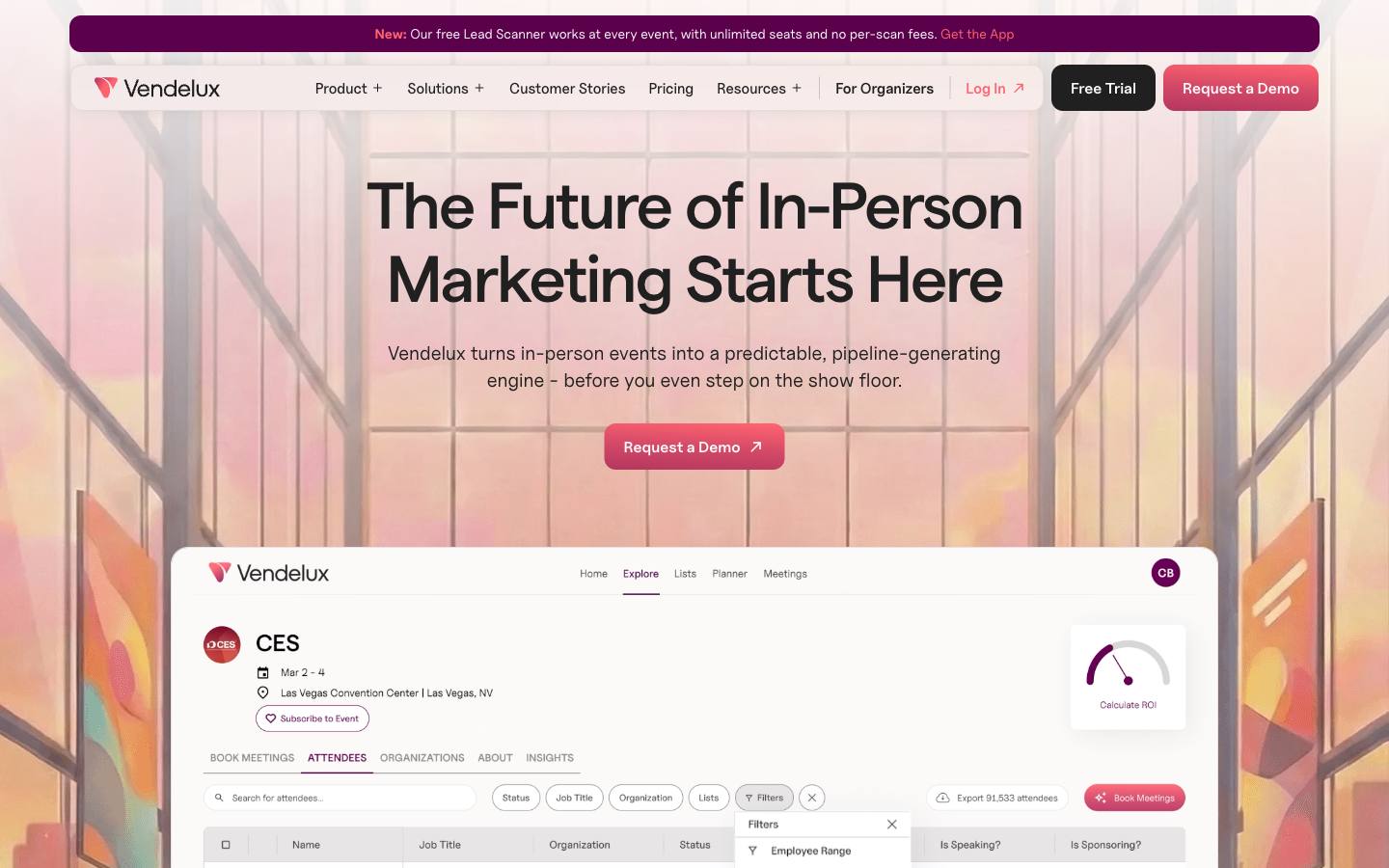
Vendelux is an event intelligence and pipeline platform that describes its approach as AI-native. Its AI matches events to your ideal-customer accounts based on who is attending, speaking or sponsoring, and times prospect outreach before the show.
More on VendeluxLess on Vendelux
Founded: 2021 · HQ: New York, US · Team: 51–200 people · Formats: In-person
The starting point is a database of more than 250,000 B2B events. Teams upload or connect their ICP and CRM, and Vendelux shows where target accounts, customers, partners and competitors will be. List Builder filters attendees by role and title, and Campaigns combine AI-timed outreach with human-led campaign management to book meetings with the highest-value prospects. After the event, pipeline and revenue are attributed back to it in Salesforce or HubSpot. The free Lead Scanner app, with unlimited users and no per-scan fees, enriches badge and business card scans and pushes them to HubSpot. Vendelux reports that Seqera cut the time to assess whether a conference fits its goals by 75% and doubled booked meetings.
Pricing isn't published; Starter, Plus and Enterprise tiers differ by lead credits, campaign credits and seats. Founded in 2021 in New York, Vendelux raised a $50 million Series B in July 2026 and documents SOC 2 Type II and SAML SSO. Named customers include Ramp, Glean, Coupa and AdRoll.
- Free AI-enriched Lead Scanner app
What stands out
- AI matching of 250,000+ events to your ICP accounts
- AI-timed outreach combined with human-led meeting campaigns
- Pipeline and revenue tracked in Salesforce or HubSpot
Worth checking
- Not a platform for running your own event
- Prices aren't published
Best suited for. Vendelux fits demand generation and field marketing teams that spend heavily on sponsoring and attending other organizers' events. Teams that want AI to help run their own conference should look at CventIQ or Zuddl.
2. CventIQ, best for Cvent customers that want AI across registration, content, attendee matching and reporting
- Price
- Quote only
- Capterra
- 4.5/5 from 1,099 reviews
- App Store
- 4.8/5 from 40,670 ratings
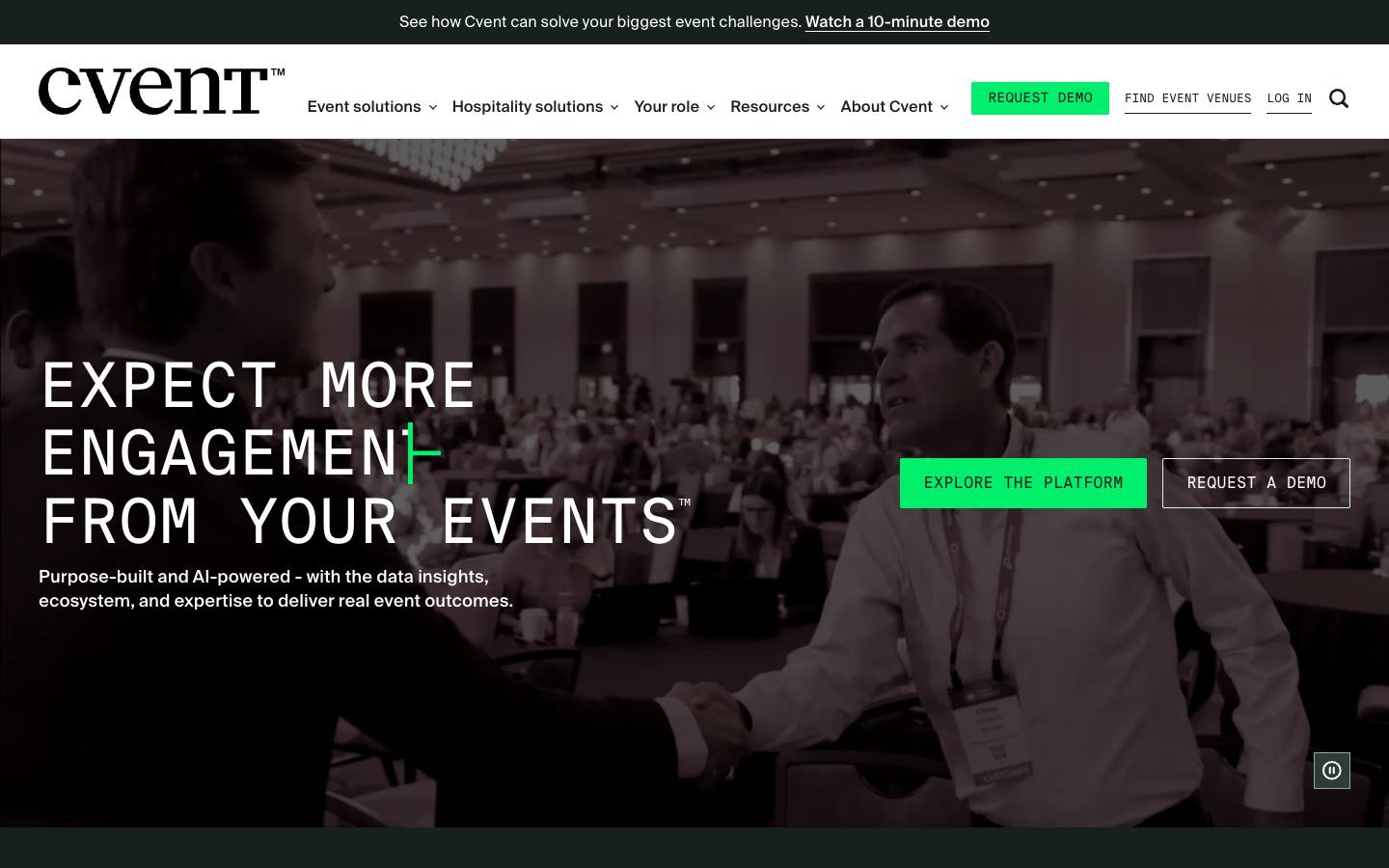
CventIQ is Cvent's AI layer, applied across its event cloud from planning and onsite work to marketing and reporting. Its features are aimed at event professionals, marketers and the hotels and venues that respond to group requests.
More on CventIQLess on CventIQ
Founded: 1999 · HQ: Tysons Corner, VA · Team: 5,001-10,000 people · Formats: Any format
For event teams, Cvent's page lists help with registration updates and attendee requests, capturing session notes and takeaways, summarizing survey comments and building event diagrams faster. For marketers, it turns event content into follow-up content for other channels, answers questions about event data without building a report, matches attendees to relevant people and sessions and shows where attendee interest is building. On the hospitality side it drafts RFP responses and improves venue content for planner searches. Platform features include smart intent routing, CventIQ Skills for connected workflows and enterprise guardrails.
CventIQ comes with Cvent, which is priced by quote: products are licensed under Professional (15 users) or Enterprise tiers with add-ons. Cvent holds a 4.48 rating from 1,099 Capterra reviews, was founded in 1999 and documents SOC 2, ISO 27001 and PCI DSS. Its ownership of Goldcast and ON24 adds deeper webinar and video content for the AI to work with. Because it's built into Cvent, it's only an option if Cvent is, or will be, your platform.
- Attendee matching to people and sessions
What stands out
- Summaries of session notes and survey comments
- Event content turned into follow-up content
- Plain-language questions about event data without reports
Worth checking
- Only available inside Cvent
- Cvent pricing is quote-based with many add-ons
Best suited for. CventIQ fits enterprise teams already on Cvent that want AI across planning, marketing and reporting without another vendor. Teams on other platforms should check what their own platform includes first.
3. Zuddl, best for mid-market teams that want conversational AI agents to build and check events on an all-in-one platform
- Price
- From $10,000/year
- Capterra
- 4.5/5 from 11 reviews
- App Store
- 3.0/5 from 2 ratings
- Syncs with
- Salesforce, HubSpot, Marketo
- Security
- SOC 2 Type II, ISO 27001, SAML SSO, DPA
- Customers include
- Motive, NASSCOM, Google
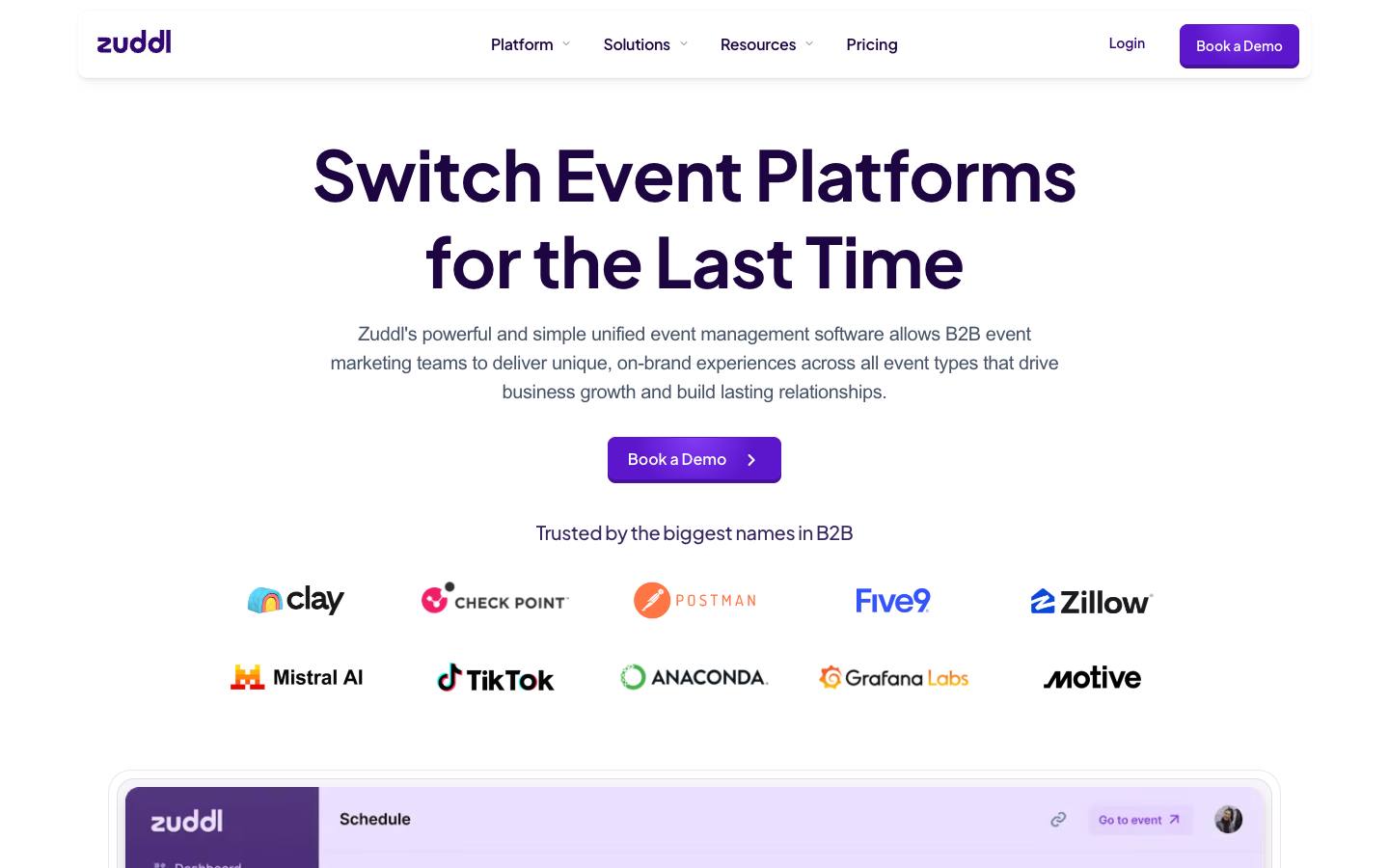
Zuddl is a modular B2B event platform for webinars, field events and conferences that positions itself as AI-native. It lists conversational agents built for event teams, guided AI event creation, a QA agent that checks event setups and an AI Content Hub for webinars.
More on ZuddlLess on Zuddl
Founded: 2020 · HQ: San Francisco, California · Team: 51–200 people · Formats: In-person, Virtual, Hybrid, Webinar
The agents are meant to cut the time event marketers spend waiting on others to configure events: an organizer describes what they need and the platform helps build it, then the QA agent reviews the setup before launch. A content repurposing add-on turns webinar recordings into other content. Underneath, Zuddl covers registration and ticketing, speaker and exhibitor portals, a mobile app, streaming, onsite check-in, lead capture at owned and sponsored events and revenue dashboards. It integrates with Salesforce, HubSpot, Marketo, Oracle Eloqua and others, and documents SOC 2 Type II, ISO 27001 and ISO 27701.
Pricing starts at $10,000 a year for two organizer licenses with unlimited check-in and lead capture users, published on its pricing page and checked October 2026. A platform fee and add-ons, including AI repurposing, the mobile app and portals, come on top, but there are no per-event fees. Zuddl was founded in 2020 and holds a 4.45 rating from 11 Capterra reviews. Named customers include BigCommerce, Tricentis and Motive.
- Published entry price of $10,000 a year
What stands out
- Conversational agents for building events
- QA agent that checks event setups
- AI Content Hub and repurposing add-on for webinars
Worth checking
- AI repurposing is a paid add-on
- Agents are new, so ask for current scope in a demo
Best suited for. Zuddl fits mid-market B2B marketing teams that run many webinars and field events and want AI to speed up setup. Teams that only need AI for matchmaking or translation can add a specialist tool to their current platform instead.

4. Grip, best for trade show and conference organizers whose business depends on AI matchmaking and booked meetings
- Price
- Quote only
- Capterra
- 4.8/5 from 6 reviews
- App Store
- 3.0/5 from 2 ratings
- Syncs with
- Salesforce, HubSpot, Dynamics, Marketo
- Security
- SAML SSO, DPA
- Customers include
- Clarion Events, General Dynamics Information Technology, Messe Frankfurt
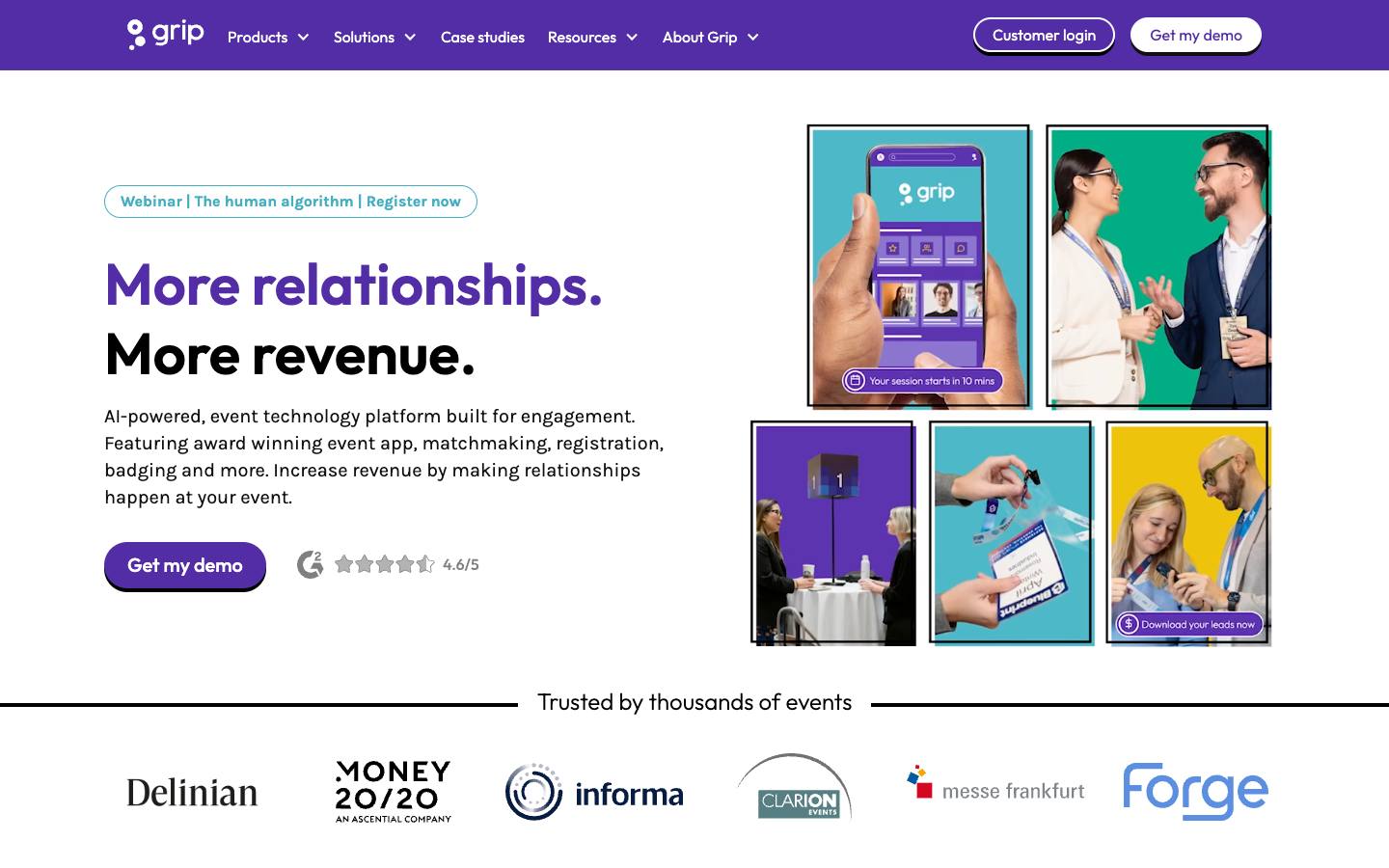
Grip is an event platform centered on AI-driven matchmaking and meeting scheduling, with an event app, registration, exhibitor and sponsor management, lead retrieval and onsite badging. Its AI generates mutual attendee recommendations and, since 2026, an assistant answers attendee, exhibitor and sponsor questions from Grip event data.
More on GripLess on Grip
Founded: 2016 · HQ: London, UK · Team: 51-200 people · Formats: In-person, Virtual, Hybrid
Mutual recommendations mean both sides of a suggested meeting are likely to want it, which matters for hosted buyer programs, investor meetings and roundtables where meeting volume is the product being sold to sponsors. Grip MCP connects large language models to Grip event data. The integration catalog is long: Salesforce, HubSpot, Marketo and Microsoft Dynamics on the CRM side, and registration systems including Cvent, Swoogo, Bizzabo, Stova, Map Your Show and Convention Data Services, plus Snöball for referrals.
Pricing isn't published and sales are demo-led. Grip was founded in 2016 in the UK and holds a 4.83 rating from six Capterra reviews. Named customers include Informa, Clarion Events, Messe Frankfurt and Money20/20. It's built mainly for organizers, so corporate marketing teams benefit from it as exhibitors and sponsors at shows that use it rather than as buyers. Organizers should ask how recommendations are generated from registration data and how meeting outcomes are reported back to sponsors, since that report is often what wins the renewal.
- Large catalog of registration and CRM integrations
What stands out
- Mutual AI matchmaking recommendations
- AI assistant for attendees, exhibitors and sponsors
- Grip MCP for connecting language models to event data
Worth checking
- Pricing isn't published
- Built for organizers rather than corporate event marketers
Best suited for. Grip fits exhibition groups and conference organizers that sell meetings to sponsors and buyers. Smaller conferences that mainly want networking in an app can compare Brella.

5. Brella, best for B2B conferences that want intent-based AI matchmaking and AI sponsor prospecting in a branded app
- Price
- Quote only
- App Store
- 4.1/5 from 46 ratings
- Languages
- English
- Syncs with
- Salesforce, HubSpot
- Security
- ISO 27001, DPA
- Customers include
- TechCrunch Disrupt, Aero Engines Americas, European Commission
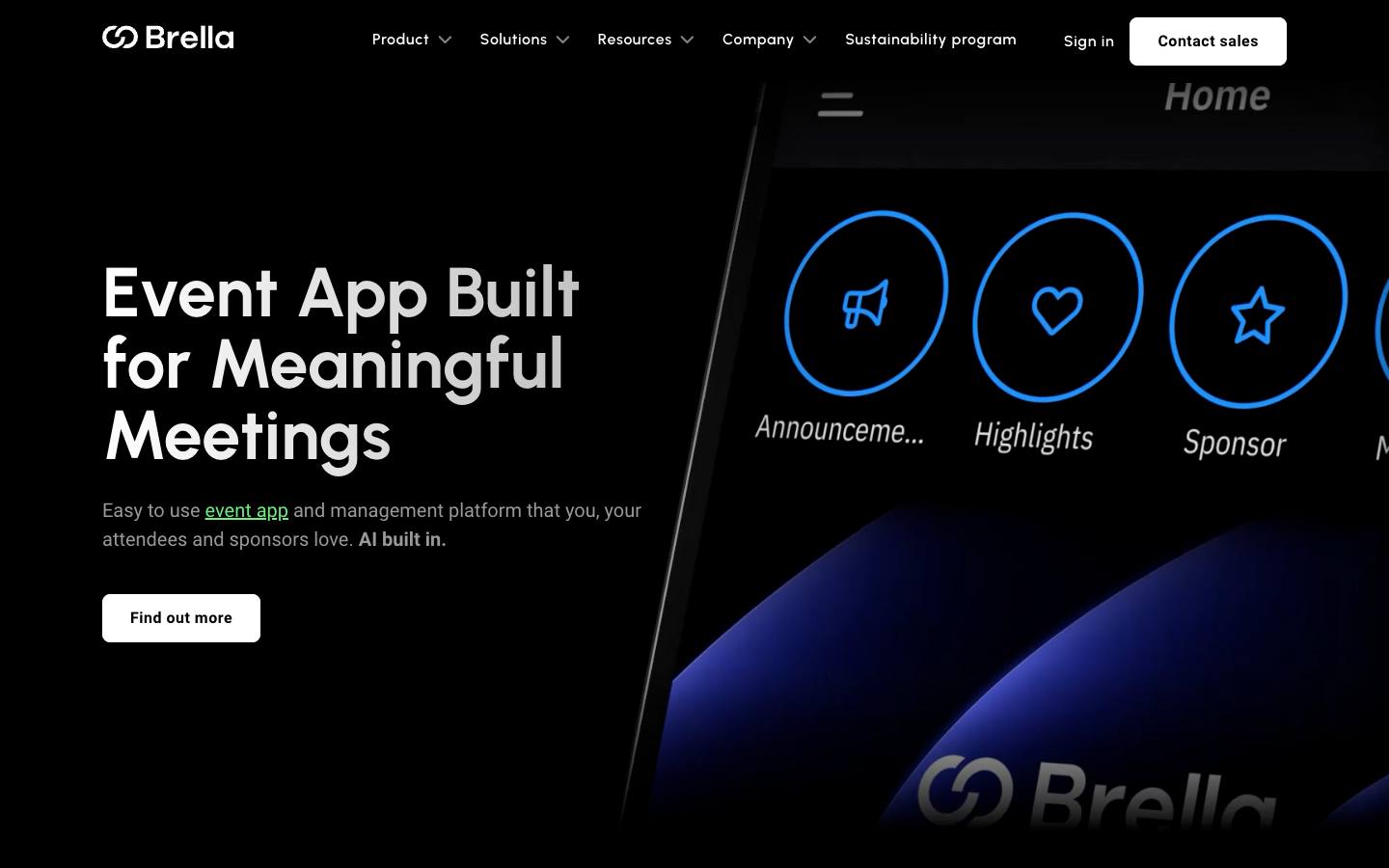
Brella is an event app and platform for in-person, virtual and hybrid events, best known for networking and meeting booking. Its AI matchmaking pairs attendees on their stated goals and interests, and AI-powered prospecting helps sponsors find relevant attendees.
More on BrellaLess on Brella
Founded: 2016 · HQ: Helsinki, Finland · Team: 50-100 people · Formats: In-person, Virtual, Hybrid
Brella describes its matchmaking as intent-based and customizable: attendees state what they want from the event, and the app highlights people with matching interests and goals. Matchmaking runs alongside one-to-one and group meetings, lead scanning and meeting ratings, and sponsors get booths and sponsor matchmaking so they can reach attendees who fit their buyer profile. It integrates with Salesforce, HubSpot, Swoogo, Eventbrite, Tito, WooCommerce and Zapier.
Pricing isn't published; the pricing page lists modules and routes everything through sales. Brella was founded in 2016 in Helsinki, and its app holds a 4.11 App Store rating from 46 reviews. Named customers include SaaStr, Informa Markets, RX, Forbes, the FT and SXSW Sydney. The page doesn't explain how its AI features work or what data they use, so ask in a demo how matches are generated, how attendee privacy is handled and how meeting outcomes are reported to sponsors. For B2B marketers, Brella is most relevant as the networking layer of a conference you host, or as a sponsor at shows that use it.
- Salesforce and HubSpot integrations
What stands out
- Intent-based AI matchmaking on goals and interests
- AI-powered sponsor prospecting
- Meeting ratings and lead scanning in the same app
Worth checking
- Pricing isn't published
- Little public detail on how the AI works
Best suited for. Brella fits B2B conference organizers and startup or tech events where networking and sponsor meetings drive value. Large exhibitions with hosted buyer programs should compare Grip.

6. Bizzy (Bizzabo), best for Bizzabo customers that want an attendee copilot answering session, speaker and logistics questions in the app
From $499/user
- Price
- From $499/user
- Capterra
- 4.4/5 from 171 reviews
- App Store
- 4.6/5 from 14 ratings
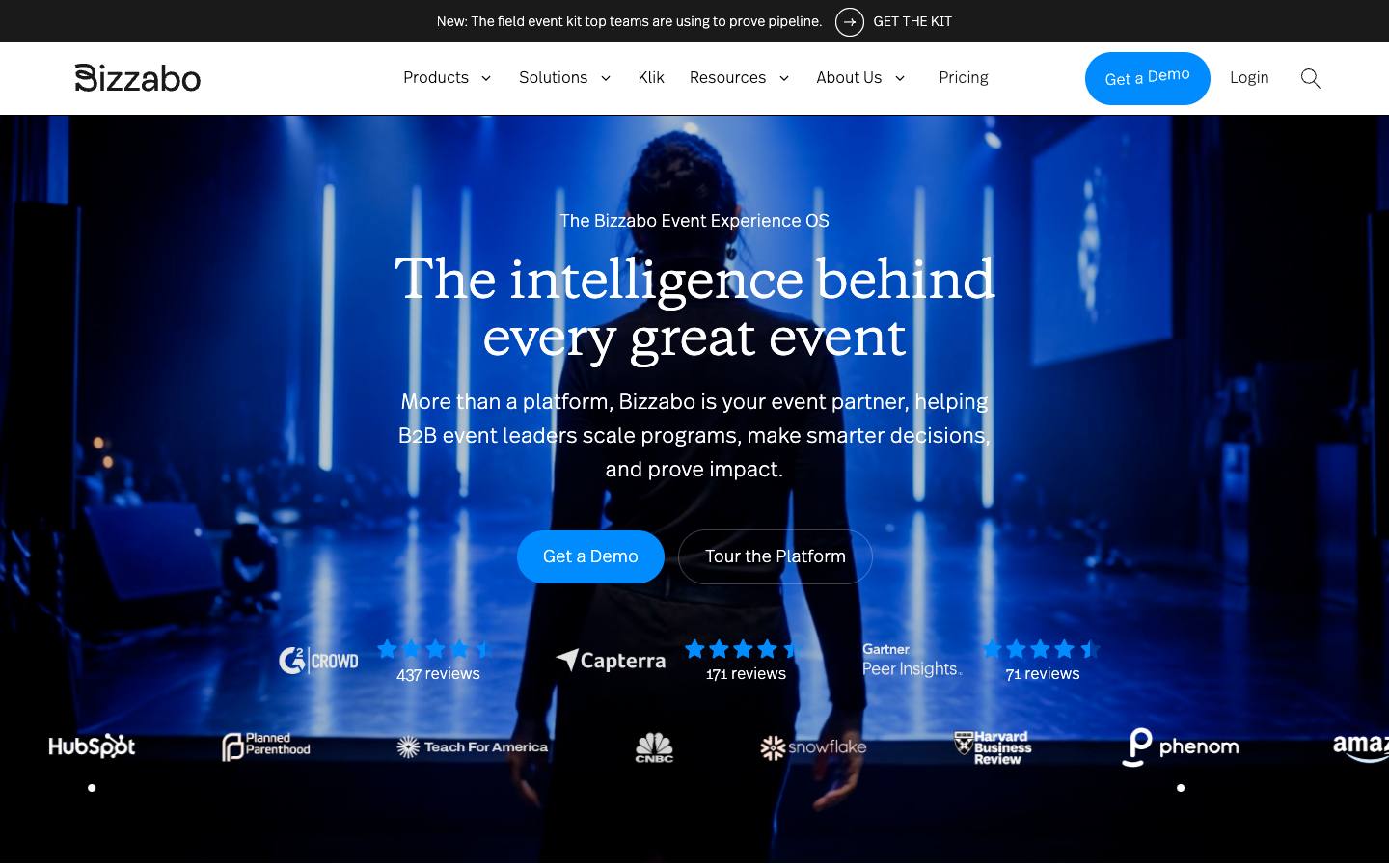
Bizzy is the attendee copilot built into the Bizzabo mobile event app for in-person events. It answers questions about sessions, speakers, networking and logistics, and is available to all customers running events on the Bizzabo app.
More on Bizzy (Bizzabo)Less on Bizzy (Bizzabo)
Founded: 2011 · Formats: Any format
Bizzy searches session descriptions by meaning rather than exact words, explains speaker backgrounds, suggests up to three attendees to meet from those who opted into the event community and answers logistics questions about Wi-Fi, food, transport and safety. Organizers don't set it up twice: it pulls the agenda, speakers and directory from Bizzabo, and teams can add a Markdown knowledge base for FAQs. After the event, organizers can review every question attendees asked, which shows what people were interested in, confused by or couldn't find. Bizzabo says event data is isolated per event and isn't used to train AI models. Bizzy doesn't book meetings or reserve seats, and it needs a connection to work.
Bizzy comes with Bizzabo, which publishes pricing of $499 per user a month billed annually with a three-user minimum, or from $17,999 a year. Bizzabo holds a 4.37 rating from 171 Capterra reviews and documents SOC 2 Type II and ISO 27001. Named customers include HubSpot, which runs its INBOUND conference on Bizzabo.
- No training of AI models on customer content
What stands out
- Semantic search across sessions and speakers
- Opt-in networking suggestions
- Post-event chat logs showing what attendees asked
Worth checking
- Only available inside the Bizzabo app
- Can't take actions such as booking meetings
Best suited for. Bizzy fits teams already running conferences on Bizzabo that want to cut attendee support questions. Organizers on other platforms can get a similar assistant from Erleah, Sena or 42Chat.

7. Luminik, best for startups that want AI to score trade show attendee lists, draft outreach and turn booth notes into CRM follow-ups
From $249/month
- Price
- From $249/month
- Syncs with
- Salesforce, HubSpot
- Security
- SAML SSO
Luminik is a sponsor-side event pipeline tool that uses AI at each step: scoring third-party event attendees against your ICP, drafting event-specific outreach angles and extracting next steps from booth notes and voice memos.
More on LuminikLess on Luminik
Formats: In-person
Target lists are built weeks before a show from event platforms, speaker lists and exhibitor directories, enriched through your own Apollo or ZoomInfo contract and ranked by the AI model. Priority contacts go into Apollo, Salesloft, Amplemarket or Lemlist with drafted messaging. At the booth, an offline-first app captures badges, cards, QR codes and voice notes, and AI pulls out next steps the same day. Results are written back to Salesforce or HubSpot. It also offers conversational onboarding, an MCP interface for asking about pipeline from Claude or ChatGPT and bring-your-own model keys for Anthropic, OpenAI, Azure OpenAI or Google.
Luminik publishes pricing, checked October 2026: Starter is $249 a month billed annually for six events and 15,000 enriched matches a year, Growth is $665 a month for 12 events, and Scale starts at $1,665 a month for 30 events. Every plan includes unlimited booth reps. Case studies are anonymized with no named logos, and a SOC 2 report is offered on request on Scale. SSO is a $199 monthly add-on on Growth.
- Published pricing from $249 a month
What stands out
- AI scoring of attendee lists against your ICP
- AI-drafted outreach and next steps from voice notes
- Bring-your-own model keys
Worth checking
- No named customers
- Not for hosting your own events
Best suited for. Luminik fits venture-backed startups that sponsor a handful of shows a year and want AI to handle list building and follow-up. Larger teams that want a bigger event database and managed outreach should compare Vendelux.

8. Wordly, best for conferences that need AI translation and captions in many languages without interpreters
From $1,500/package
- Price
- From $1,500/package
- Languages
- 61 speaker languages and 67 attendee languages listed
- Security
- SOC 2 Type II, ISO 27001
- Customers include
- University of Southern California, City of Sunnyvale, City of Modesto
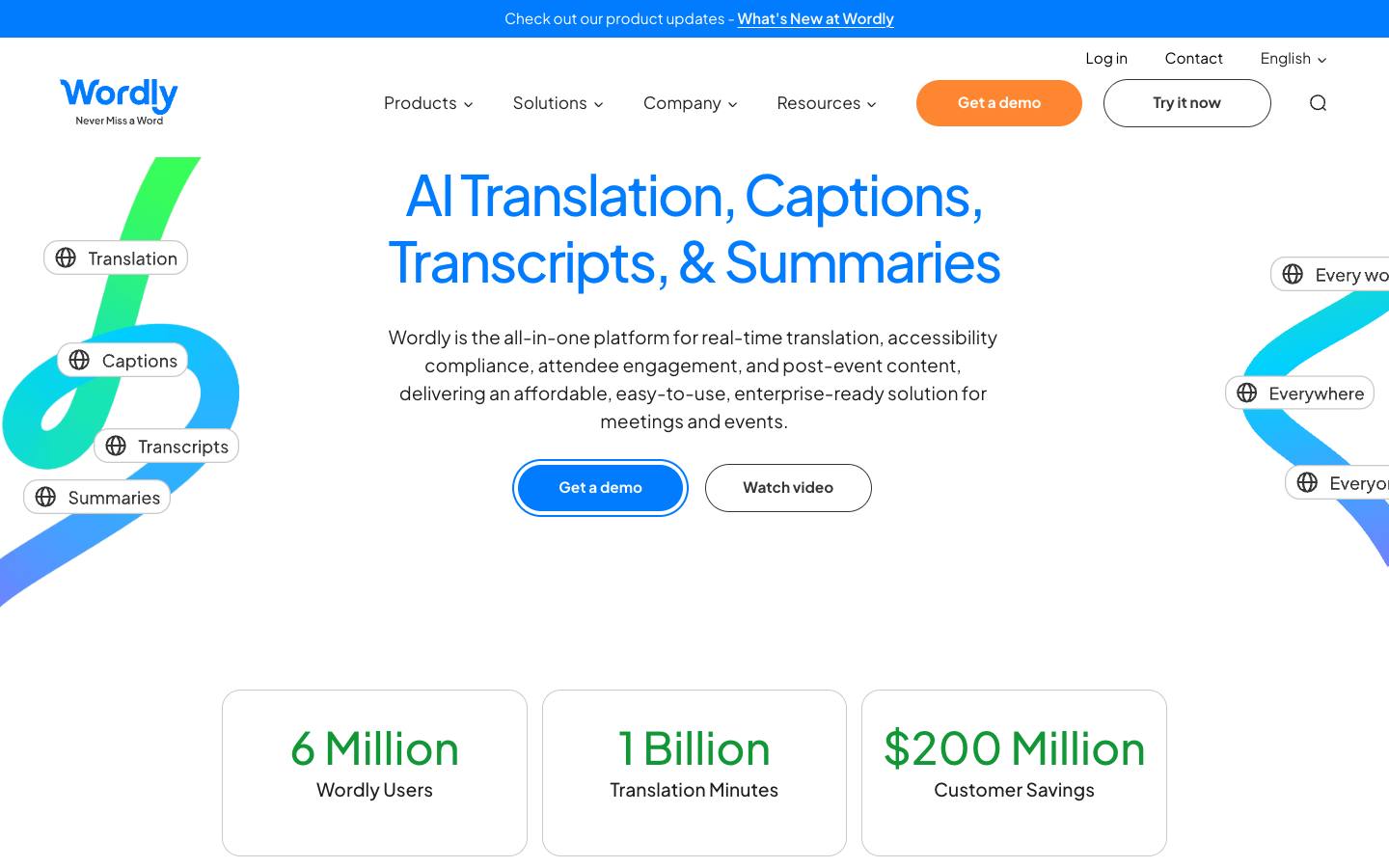
Wordly provides AI real-time translation, captions and transcripts that attendees open on their own phones or laptops through a QR code or link, with no interpreters or app download. It covers more than 60 languages and thousands of language pairs.
More on WordlyLess on Wordly
Founded: 2017 · HQ: Los Altos, CA · Team: 51-200 people · Formats: In-person, Virtual, Hybrid, Webinar
Beyond live sessions, Wordly generates AI session summaries and offers AI voice dubbing for recorded video, which helps marketers reuse conference content for international audiences. It integrates with Zoom, Microsoft Teams, Google Meet and Webex and with event platforms including Cvent, Bizzabo, RainFocus, Stova, Swoogo, vFairs and Whova. Shared glossaries on higher packages keep product names and industry terms consistent. Named customers include Adobe, Autodesk, IMEX Group, MPI and ICCA.
Wordly sells prepaid annual hour packages, billed by the minutes you actually use. Its Starter package is about $1,500 for 10 hours a year with all languages, captions, audio and transcripts on a 12-month term, published on its pricing page and checked October 2026. Larger packages of 25, 50, 100, 250 and 500+ hours are priced through sales, with volume, nonprofit and education discounts. Wordly was founded in 2017. Machine translation won't match a human interpreter for every situation, so for high-stakes sessions such as legal or medical content, test accuracy with your own speakers and glossary first.
- Published starter package of about $1,500
What stands out
- 60+ languages with captions, audio and transcripts
- AI session summaries and voice dubbing
- Integrations with Cvent, Bizzabo, RainFocus, Swoogo and Whova
Worth checking
- Prepaid hour packages expire after 12 months
- Larger package prices go through sales
Best suited for. Wordly fits conference organizers and corporate event teams with international audiences that need translation across many sessions a year. For occasional events, Snapsight's free text translation tier is a cheaper place to start.
9. Snapsight, best for organizers that want free live translation plus AI takeaways and post-event content from sessions
From $249/session
- Price
- From $249/session
- Try it
- Free plan
- Languages
- 99 languages for live text (per a case study); free plan allows 10 per session
- Security
- SOC 2 Type II, ISO 27001, SAML SSO, DPA
- Customers include
- Economist Impact, Freeman, Informa Tech
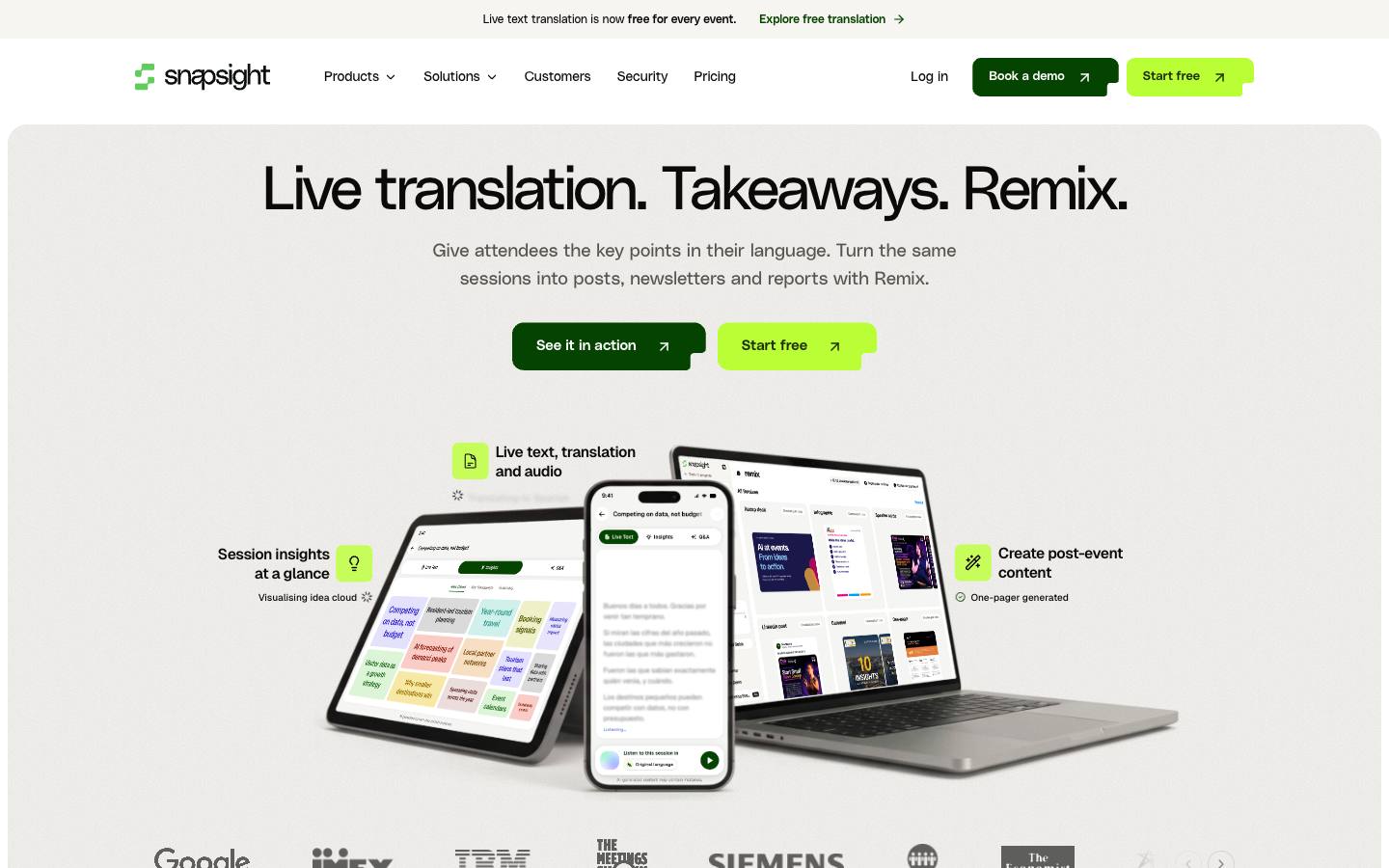
Snapsight takes a session's audio feed and delivers live text, translation and key takeaways to attendees' phones through a QR code, with no app download. After sessions, its Remix feature drafts recaps, decks, social posts and speaker cards from the same content.
More on SnapsightLess on Snapsight
Founded: 2024 · HQ: Singapore · Formats: In-person, Hybrid, Virtual
For event marketers, Remix is the part that saves time: session content becomes post-event reports, social posts and decks without a writer starting from scratch. Live features include speech-to-text, speech-to-speech translation, AI takeaways, summaries and idea clouds. Snapsight integrates with Swapcard, Cvent, Bizzabo, Whova, Grip, Brella, EventsAir and Stova, plus Zoom, Teams and Google Meet. It was launched in 2024 by Singapore-based Gevme, and named customers include Freeman, Economist Impact, IMEX and Informa Tech.
Snapsight publishes pricing, checked October 2026. The free plan covers live transcription and text translation for up to 10 languages per session and 100 sessions a year, with basic Q&A and polls. Voice translation is $10 per language per session. Engage is $299 per event with branding, sponsor logos and engagement analytics, and Pro is $249 per session for summaries, transcripts and MCP and API access, with packs from $99 a session. Enterprise is custom. Its free tier makes it easy to test on a single session before committing.
- Published per-session and per-event pricing
What stands out
- Free live text translation for up to 10 languages per session
- Remix drafts recaps, decks and social posts
- Integrations with Cvent, Bizzabo, Swapcard and Whova
Worth checking
- Young product, launched in 2024
- Voice translation is charged per language per session
Best suited for. Snapsight fits organizers who want accessible sessions and a fast supply of post-event content without a big upfront commitment. Teams that need many hours of voice translation across an annual program should compare Wordly's packages.

10. Erleah, best for trade show organizers that want a managed AI assistant to personalize the attendee journey and score leads for exhibitors
From £7,900/event
- Price
- From £7,900/event
- Languages
- English
- Customers include
- Clarion Events, Event Tech Live, ICE
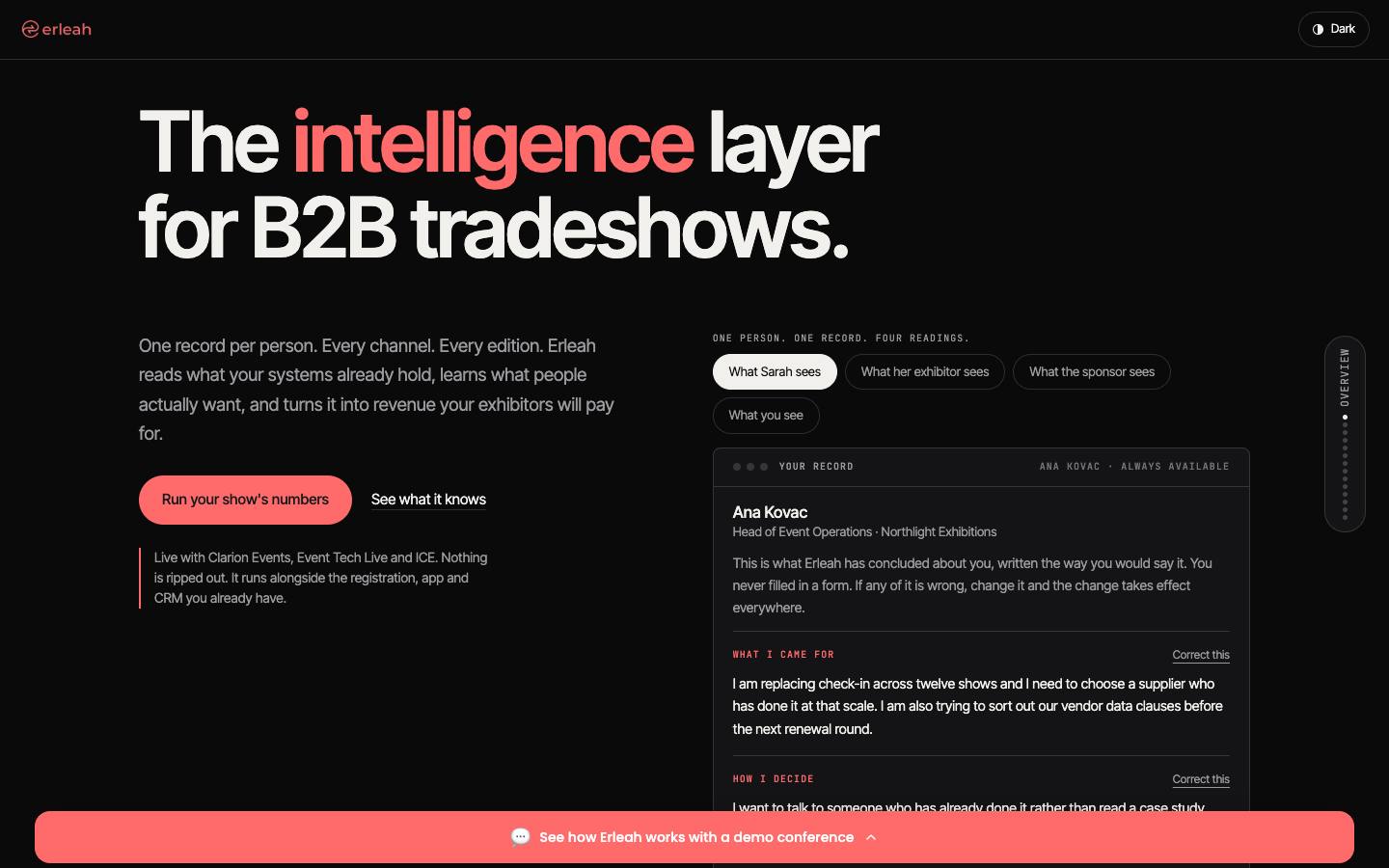
Erleah, from Visual Hive, is a managed AI service for B2B trade show organizers. It unifies registration, app, lead capture, CRM and agenda data into one profile per person, then talks to attendees over web chat, WhatsApp, email and the event app to recommend exhibitors, sessions and meetings.
More on ErleahLess on Erleah
Formats: In-person
The assistant is branded as the event's own, and it matches people on interests learned in conversation rather than only on registration fields. Exhibitors and sponsors get AI-scored leads and activation reports, and sessions get AI summaries. Erleah sits alongside platforms such as Swapcard, Grip, Cvent and Eventbrite rather than replacing them. Named customers include Clarion Events, Event Tech Live and ICE.
Erleah publishes per-event pricing, checked October 2026: Essentials is £7,900 per event for up to 2,500 attendees, Professional £12,900 for up to 6,000 and Enterprise £18,900 for up to 15,000. There's no setup fee or seat license, and the price includes a workshop, data work, all channels and three months of pre-event work with a findings call. Portfolios of three or more events are priced on size, single campaigns start at £3,500, and a revenue-share option is offered. Because it's a managed service, it needs less in-house effort than a self-serve tool, but plan for the data work: the quality of recommendations depends on how much clean registration and exhibitor data you can share.
- Works alongside Swapcard, Grip and Cvent
What stands out
- Branded conversational assistant across chat, WhatsApp, email and app
- AI-scored leads for exhibitors and sponsors
- Published per-event pricing with no setup fee
Worth checking
- Priced for mid-size and large shows
- Results depend on the data the organizer can share
Best suited for. Erleah fits trade show organizers with thousands of attendees who want AI to improve the visitor experience and exhibitor results without building it themselves. Smaller conferences can start with Sena's lower per-event price.

11. Sena, best for B2B conferences of up to 1,500 people that want a WhatsApp AI concierge and a sponsor-ready intent report
From €3,000/event
- Price
- From €3,000/event
- Languages
- Any language (stated)
- Security
- DPA
- Customers include
- FOST, Hub Institute, Les Entrepreneurs Haute-Garonne
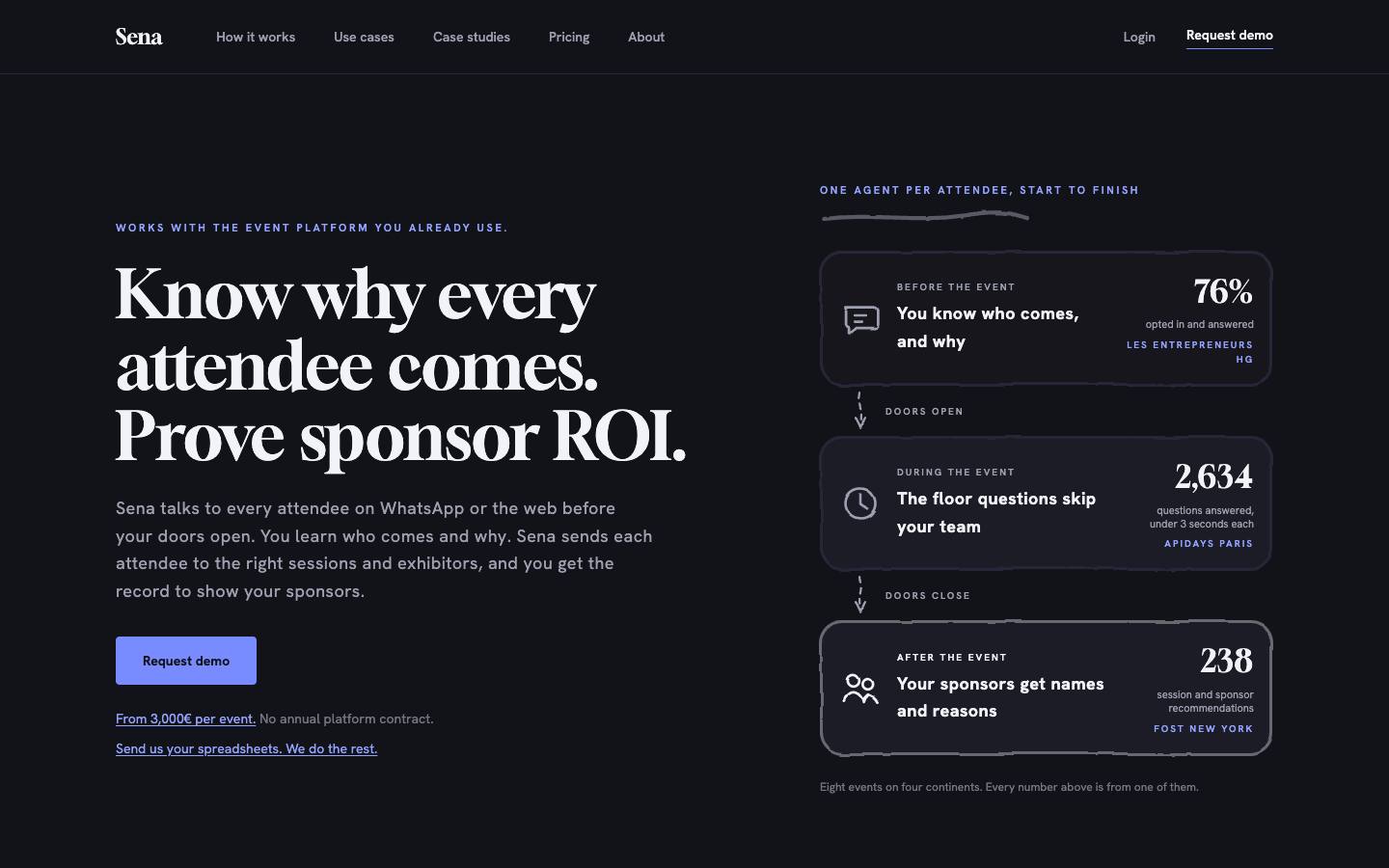
Sena messages registrants on WhatsApp or the web before an event to learn why they're coming, then recommends sessions, sponsors and people and answers questions on the floor. After the event it delivers a report on attendee intent and the recommendations made.
More on SenaLess on Sena
HQ: Remote (Sena Technologies, Inc. · Team: 2-10 people · Formats: In-person
Intent is extracted from text and voice notes in any language, which suits international conferences where attendees don't share one language. The post-event report is aimed at sponsors: it shows what attendees said they wanted and which sponsors were recommended to them, which helps organizers prove sponsor value. Sena runs alongside an existing registration platform, with data imported from tools such as Cvent, Eventbrite and Swapcard. Named customers include Apidays Paris, FOST and VivaTech with Hub Institute.
Sena publishes pricing, checked October 2026: €3,000 or $3,000 per event for up to 500 registrants and €5,000 or $5,000 for up to 1,500, with WhatsApp messages, a live attendee helpdesk and the post-event report included. Larger or multi-city programs are quoted, and there's no annual contract or seat fee. The price excludes registration, badging and lead retrieval, so it adds to rather than replaces your event platform. Organizers should check attendee consent for WhatsApp messaging in each market before launch.
- Published per-event pricing with no annual contract
What stands out
- WhatsApp and web concierge before, during and after the event
- Intent extraction from text and voice in any language
- Sponsor-ready post-event intent report
Worth checking
- Doesn't cover registration, badging or lead retrieval
- Relies on attendees engaging over WhatsApp or web chat
Best suited for. Sena fits B2B conference organizers running events of a few hundred to 1,500 people who want an AI concierge without a long contract. Large trade shows with tens of thousands of visitors should compare Erleah.
12. 42Chat, best for associations and organizers that want an event chatbot answering only from pre-approved responses
Quote only
- Price
- Quote only
- Languages
- English
- Security
- DPA
- Customers include
- Arizona State University, National Safety Council, WVC
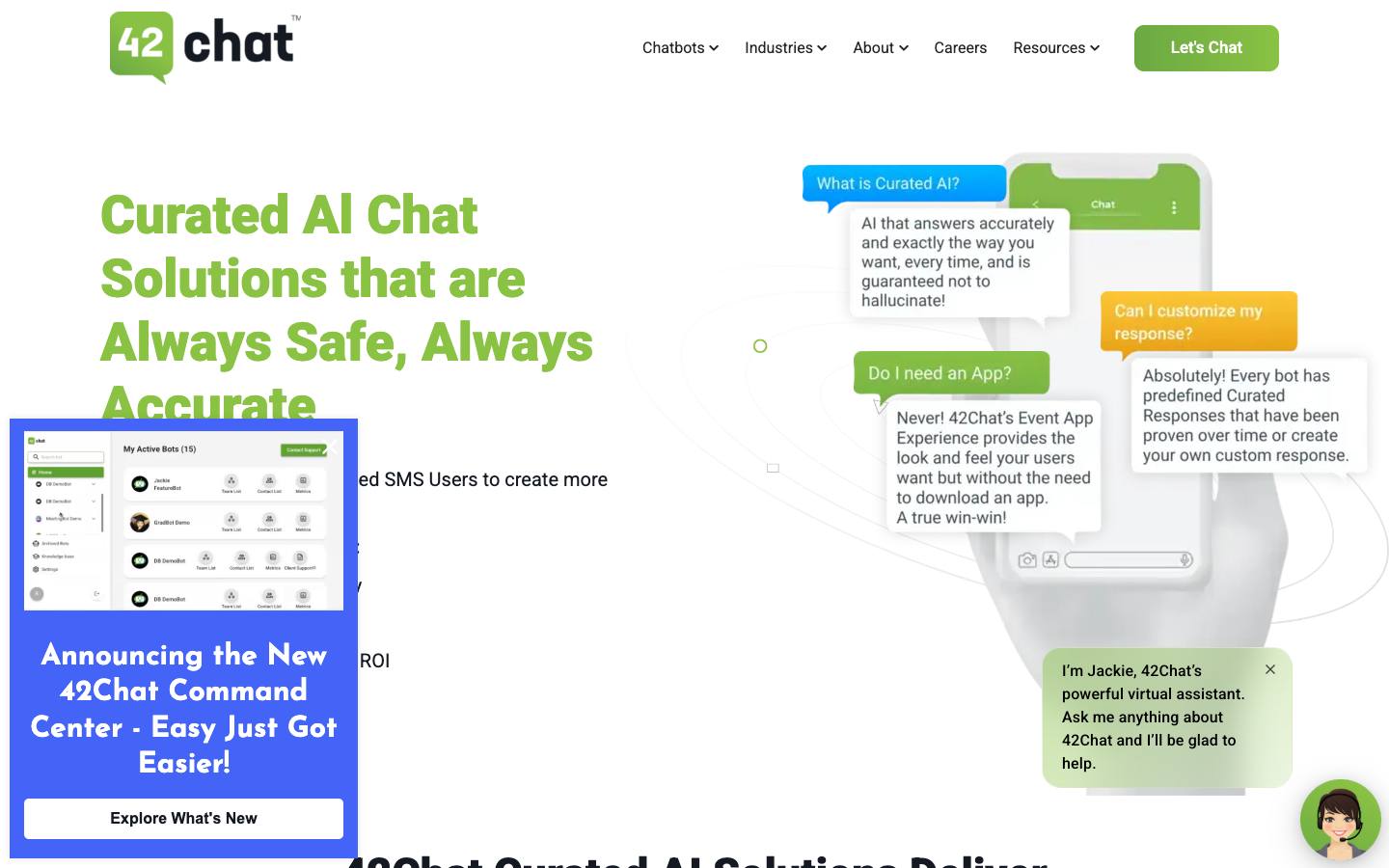
42Chat builds pre-trained chatbots for conferences, trade shows, virtual events and associations that answer attendee questions by text message, web chat or WhatsApp. Its curated AI matches each question to a library of approved answers instead of generating open-ended responses.
More on 42ChatLess on 42Chat
Founded: 2016 · HQ: Draper, Utah · Team: 11-50 people · Formats: In-person, Virtual
That design is the main reason to choose it: the bot is built to avoid made-up answers about agendas, venues, Wi-Fi and logistics, which matters when wrong information creates real problems onsite. Organizers use it to deflect repetitive support questions and to build an SMS opt-in audience they can message during the event. A Command Center manages content and responses. It's a point solution that sits beside an existing registration platform and event app. Named customers include the National Safety Council, IAEE, Informa, Tarsus and ASAE.
42Chat doesn't publish pricing; setup is done with its team. It was founded in 2016. Its public DPA includes EU standard contractual clauses and a commitment to obtain SOC 2 Type II, with the first report period ending by the end of 2027, and its privacy policy says data is processed and stored in the USA with no EU hosting option. A public list of 13 sub-processors is available. For European attendees, review data residency before launch.
- Used by associations such as ASAE and IAEE
What stands out
- Curated answers designed to avoid hallucinations
- SMS, web chat and WhatsApp channels
- Builds an SMS opt-in audience for event updates
Worth checking
- SOC 2 Type II isn't in place yet
- Data is stored in the US with no EU option
Best suited for. 42Chat fits associations and organizers who want a predictable attendee helpdesk bot with tightly controlled answers. Organizers who want the AI to recommend people and sessions should compare Erleah or Sena.

13. Explori, best for event teams that want AI to analyze survey feedback and summarize results against benchmarks
Quote only
- Price
- Quote only
- Customers include
- Clarion Events, Zendesk, IMEX Group
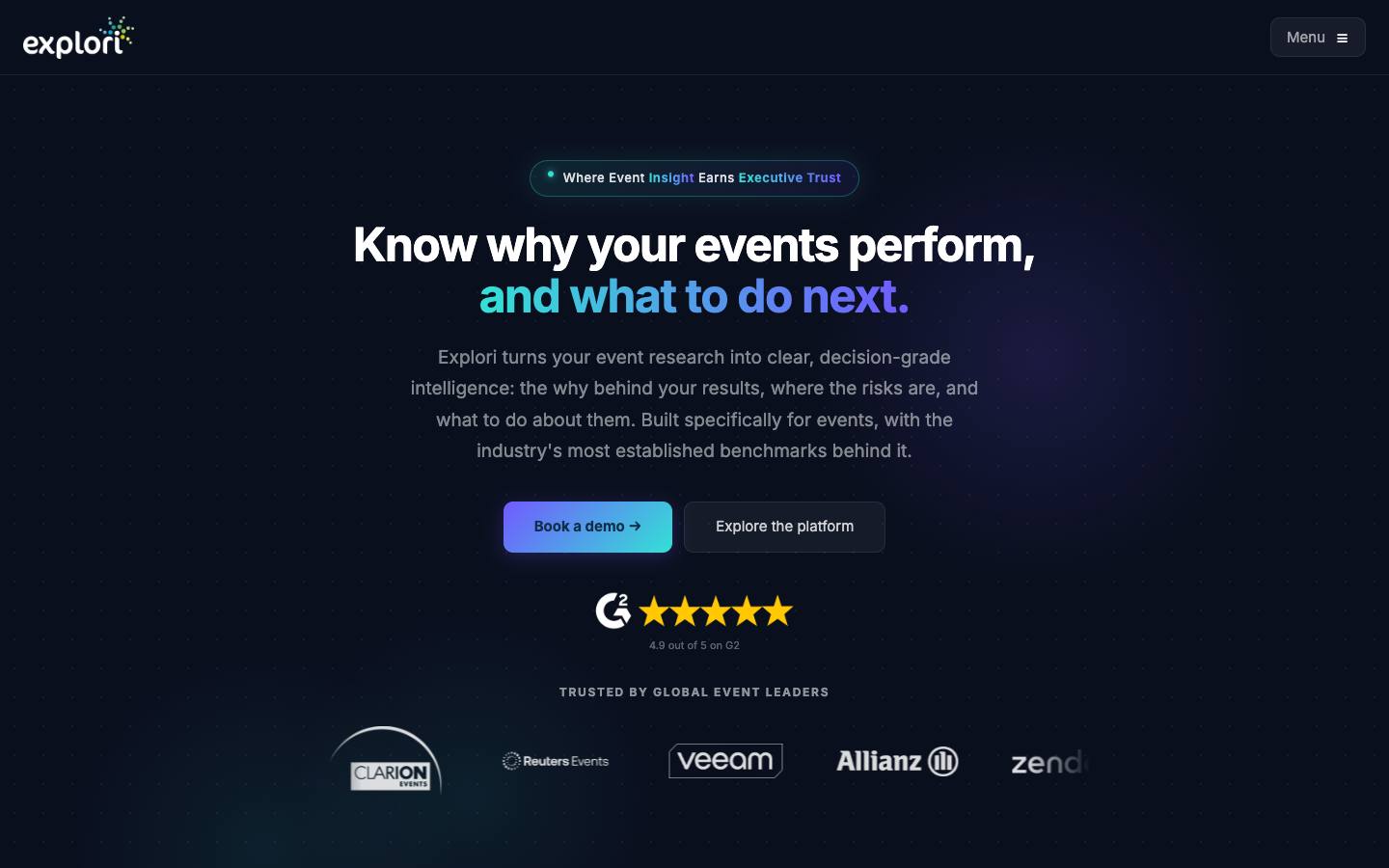
Explori is an event measurement platform that runs attendee, exhibitor and sponsor research. Its AI produces survey summaries with KPIs, findings and recommended actions read against benchmarks, groups open-text answers into themes with sentiment and answers questions about results through a conversational agent.
More on ExploriLess on Explori
Founded: 2012 · HQ: UK · Formats: Any format
Open-text comments are where most post-event surveys go to waste, because nobody has time to read thousands of them. Explori's AI theme and sentiment analysis turns them into something a team can act on, and the benchmark database, built from more than 10,000 events measured since 2012, puts each score in context by sector and portfolio. Results cover experience and advocacy, brand perception, attitudinal shift, commercial impact and portfolio performance, and branded PowerPoint reports can be generated in one click as an add-on.
AI analysis is included in the Pro plan, alongside all five measurement dimensions and unlimited custom questions; Lite and Enterprise sit either side, and all plans are priced on request. Explori was founded in 2012 in the UK, and named customers include Zendesk, Siemens, Dell, Informa and IMEX Group. Integrations beyond registration data import aren't named publicly, so confirm how results reach your CRM or BI tools. For teams that already run surveys and drown in comments, it's the most direct AI time-saver in this list.
- Attendee, exhibitor and sponsor research
What stands out
- AI theme and sentiment analysis of open-text answers
- AI summaries read against 10,000+ benchmarked events
- Conversational agent for querying results
Worth checking
- Prices aren't published
- Few named integrations
Best suited for. Explori fits organizers and corporate teams that run large post-event surveys and need AI to turn comments into findings for leadership and sponsors. Teams running small events can get by with the survey module in their event platform.
Picks 6 to 13 are folded to keep the list short. Open any of them, or compare them all in the table above.
Also worth considering
RainFocus Nexus, Swoogo MCP Server, Zuno AI (Nunify), Markus AI, Message Matrix, Agent Analog, Ailias, Certain
The best AI tools for event marketers by use case
| If you need | Company size | Look at |
|---|---|---|
| Field marketing team choosing which conferences to sponsor | Mid-market, Enterprise | VendeluxAI matches events to ICP accounts and tracks pipeline |
| Enterprise event team on Cvent wanting AI across the program | Enterprise | CventIQAI built into the platform they already run |
| Exhibition organizer selling meetings to sponsors and buyers | Mid-market, Enterprise | GripMutual AI matchmaking plus an attendee assistant |
| International conference needing sessions in many languages | Startup, Mid-market, Enterprise | Wordly60+ languages with captions and transcripts |
| Marketer turning conference sessions into follow-up content | Startup, Mid-market | SnapsightRemix drafts recaps, decks and social posts |
| Large trade show cutting attendee support load | Mid-market, Enterprise | ErleahManaged AI assistant across chat, WhatsApp and app |
| Startup sponsoring six shows that needs scored lists and follow-ups | Startup | LuminikAI scoring and outreach from $249 a month |
| Association wanting a chatbot that never improvises | Mid-market, Enterprise | 42ChatAnswers only from approved responses |
What results look like
Figures customers report in the vendors' own published case studies. They describe one customer each, not what every buyer should expect.
75+
Annual events
Motive with Zuddl · Case study
44%
Meetings year-on-year increase
Clarion Events with Grip · Case study
8,500
Meetings over 3 years
TechCrunch Disrupt with Brella · Case study
25%+
International students share
University of Southern California with Wordly · Case study
1,762
Recommendations made at FOST London
FOST with Sena · Case study
79%
Graduating class opting in
Arizona State University with 42Chat · Case study
How to choose
Background on what these tools do, how we ranked them and what to check before you buy. Open any topic.
What AI tools for event marketers actually are (and what they aren't)
AI tools for event marketers use machine learning and large language models to do event work that used to take people hours: choosing which events matter, matching attendees for meetings, answering attendee questions, translating and summarizing sessions, drafting event content and enriching and scoring leads. Some are features inside event platforms; others are standalone tools that connect to the platform you already use.
This isn't a list of general AI assistants, AI party planners or AI floor plan generators, and it isn't a category of its own so much as a layer across categories. Each job has a specialist guide: our guides to event matchmaking software, event intelligence platforms, event management software and event analytics software cover the full products behind many of these features. Look at AI as one criterion when you choose those products, not as the reason to buy them.
For B2B event teams the practical jobs are: spend event budget where target accounts will be, book more qualified meetings, cut attendee support load, make sessions accessible in more languages, turn session content into follow-up material and get scored leads to sales faster. If an AI feature doesn't help with one of those, it probably isn't worth paying extra for.
How we ranked these AI tools for event marketers
We included only products in our directory whose AI capabilities are documented on the vendor's own pages, checked in October 2026, and compared them on the criteria below.
1. Documented AI capability
What the AI actually does, taken from the vendor's product pages or documentation, not from marketing claims elsewhere.
2. Fit for a B2B event job
Whether the feature serves a concrete B2B event task such as matchmaking, attendee support, translation, content or lead scoring.
3. Works with your stack
Named integrations with event platforms and CRMs, or MCP access for AI assistants, from the vendor's integration pages.
4. Published price
Whether the AI product or the plan that includes it has a published price, checked on the vendor's pricing page.
5. Data controls
Documented guardrails such as approved-answer libraries, data isolation per event, no model training on customer data or SOC 2.
More on our process in the methodology.
What AI can and can't do for B2B events today
AI is reliable today at matching people on stated interests, translating and summarizing speech, drafting content from session material, answering common attendee questions and scoring leads against a profile you define. It's weaker at anything that depends on data you don't have: it can't recommend the right meetings if registration questions are vague, and it can't prove ROI if leads never reach the CRM.
Treat AI claims like any other feature claim. Ask to see it working on an event like yours, ask what data it uses and ask what happens when it's wrong.
Built-in AI vs standalone AI tools
If your event platform already includes AI, as Cvent, Zuddl, Bizzabo and Grip do, start there: there's no extra integration, contract or security review. Standalone tools make sense when they do one job much better (Wordly for translation, Explori for survey analysis, Vendelux for event selection and account targeting) or when they work across platforms, as Erleah and Sena do for organizers that use several registration systems.
What AI event tools cost
Published prices vary by job. Snapsight's live text translation is free for up to 100 sessions a year, with Pro from $249 a session, and Wordly's packages start at about $1,500 for 10 hours. Per-event AI concierges cost $3,000 to $5,000 at Sena and £7,900 to £18,900 at Erleah. Luminik starts at $249 a month. AI built into platforms comes with the platform price, such as Zuddl from $10,000 a year and Bizzabo from $17,999 a year, while Vendelux, Cvent, Grip, Brella, 42Chat and Explori quote on request.
Questions to ask AI vendors
Ask whether customer and attendee data is used to train models, and whether data is isolated per event, as Bizzabo states for Bizzy. Ask how the AI handles questions it can't answer and whether answers can be restricted to approved content, as 42Chat does. Ask where data is hosted and whether a DPA and SOC 2 report are available. Ask which language model providers sit underneath and whether you can bring your own keys, as Luminik allows. Finally, ask for a customer who has used the feature at a live event, not just in a demo.
Data privacy and attendee consent
AI assistants that message attendees on WhatsApp or SMS need clear opt-in, and matchmaking tools should only suggest people who agreed to be discoverable, as Bizzy does with its opt-in community. For European attendees, check data residency: 42Chat, for example, stores data in the US with no EU option. Add AI tools to your vendor security review like any other system that touches attendee personal data.
Where this fits in your event tech stack
AI tools sit on top of your event data rather than replacing it. Registration and app platforms supply the profiles and agendas that matchmaking and assistants need, event intelligence tools supply account context, and outputs such as scored leads, meeting outcomes and survey themes should flow back to Salesforce or HubSpot. MCP connections, offered by Grip, Snapsight, Luminik and others, are making it easier to query event data from general assistants such as Claude or ChatGPT.
FAQ
What are the best AI tools for events?
How is AI used in event management?
Can AI replace an event planner?
How much do AI event tools cost?
What's the best event chatbot for conferences?
Is it safe to put attendee data into AI event tools?
What AI tools help event marketers prove ROI?
Get a free AI tools for event marketers shortlist
Reading reviews only gets you so far. The right pick depends on your events, your team and the systems it has to sync with.
Our shortlist finder asks a few questions and matches you with tools that fit, using the same verified data as this guide.
You'll see published prices, security documents and CRM integrations side by side, and you can save tools to compare later.
It's free, there's no sign-up, and no vendor gets your details.
Ready? Build your shortlist in two minutes, or try the free audit Your Event Tech Stack.
Get a free shortlistKeep reading
Ratings link to their source and are shown as published on the date of our last check. Read our methodology.