Best Event Marketing Software in 2027: The Buyer's Shortlist
By EventMarketingSoftware.com · Published October 18, 2026 · 13 tools compared
The best event marketing software for B2B teams depends on which job you need done: choosing the right events and booking meetings there (Vendelux), running and promoting your own events (Bizzabo, Cvent, RainFocus, Zuddl), growing registrations through speakers and exhibitors (Snöball, Gleanin, InGo) or proving pipeline in the CRM (hapily, Demandbase). Vendelux leads this list because it ties event choice, target accounts and revenue together.
Our top picks
- 1
 VendeluxBest for B2B teams deciding which conferences to sponsor or attend and booking meetings with target accounts thereQuote only
- 2
 BizzaboBest for B2B marketing teams that want registration, event websites, email and onsite engagement data on one platformFrom $499/user
- 3
 CventBest for large organizations that want one vendor for event marketing, venues, webinars and onsite across a big programQuote only
Key takeaways
- Event marketing software splits into four jobs: picking events and accounts, hosting and promoting your own events, driving registrations through advocates, and measuring pipeline. Few products do all four, so most B2B teams combine a platform with one or two specialist tools.
- Seven of the 13 picks publish a price. Entry points run from $29 a month for AddEvent and $249 a month for Luminik to $10,000 a year for Zuddl and $17,999 a year for Bizzabo, while Vendelux, Cvent, RainFocus and Demandbase quote every deal.
- CRM sync is the feature that decides whether event marketing shows up in revenue reports. Vendelux, Bizzabo, Cvent, RainFocus and Zuddl all connect to Salesforce and HubSpot, while hapily works only inside HubSpot and stores event data as native HubSpot records.
- Referral tools are the cheapest way to grow attendance from the right companies. Snöball, Gleanin and InGo turn speakers, sponsors and attendees into promoters and track which advocate drove each registration, and Gleanin publishes a $523 monthly plan with a 14-day trial.
- If you mostly sponsor or exhibit at other organizers' shows, a registration platform won't help much. Event intelligence tools such as Vendelux and Luminik show which shows your target accounts attend, book meetings before the event and write sourced pipeline back to the CRM.
Free tool: Event UTM builder. Generate consistently tagged links for every channel of one event at once, so you can see which email, speaker, sponsor or social post drove registrations.
Side-by-side comparison
The same criteria for every pick: pipeline focus, native salesforce or hubspot sync, published entry price, promotion tools, security documentation, buyer ratings. A dash means the vendor doesn't publish it.
| Tool | Starting price | Free plan / trial | CRM | Capterra | App Store | Security |
|---|---|---|---|---|---|---|
| Vendelux | Quote only | Free plan | Salesforce, HubSpot | ★ 5.0 (4) | ★ 4.6 (10) | SOC 2 Type II, SAML SSO, DPA |
| Bizzabo | From $499/user | – | Salesforce, HubSpot, Marketo | ★ 4.4 (171) | ★ 4.6 (14) | SOC 2 Type II, ISO 27001 |
| Cvent | Quote only | – | Salesforce, HubSpot, Dynamics, Marketo | ★ 4.5 (1099) | ★ 4.8 (40,670) | SOC 2 Type II, ISO 27001, DPA |
| RainFocus | Quote only | – | Salesforce, HubSpot, Marketo | ★ 4.0 (1) | ★ 5.0 (5) | SOC 2 Type II, ISO 27001 |
| Zuddl | From $10,000/year | – | Salesforce, HubSpot, Marketo | ★ 4.5 (11) | ★ 3.0 (2) | SOC 2 Type II, ISO 27001, SAML SSO, DPA |
| hapily | From $417/month | – | HubSpot | – | – | SOC 2 Type II, DPA |
| Demandbase | Quote only | – | – | – | – | SOC 2 Type II, ISO 27001, DPA |
| Snöball | From €5,497/project | – | Salesforce, HubSpot | – | – | SOC 2 Type II, DPA |
| Gleanin | From $523/month | Free trial | – | – | – | ISO 27001, DPA |
| InGo | Quote only | – | HubSpot, Marketo | – | – | SOC 2 Type II |
| Feathr | Quote only | – | – | – | – | SOC 2 Type II |
| AddEvent | From $29/month | Free plan | Salesforce, HubSpot, Marketo | – | – | SOC 2 Type II, DPA |
| Luminik | From $249/month | – | Salesforce, HubSpot | – | – | SAML SSO |
Event marketing isn't one product category. It's a stack: a platform that hosts the event, tools that fill it with the right people, and data that shows sales what happened. This guide covers the tools B2B marketers use for each part, using our vendor profiles, published pricing and buyer ratings, and links to our specialist guides where a job deserves its own shortlist.
Who this guide is for. This guide is for B2B demand generation, field marketing and event marketing teams that need events to produce pipeline, not just attendance. It suits teams that sponsor or exhibit at third-party conferences, teams that host their own user conferences, roadshows and dinners, and organizers who need more registrations from the right companies.
Not sure which one fits your team?
Answer a few questions about your events, team and CRM and get a free shortlist of tools that fit, with pricing and security details side by side.
Get a free shortlistThe best event marketing software in 2027
Here are 13 event marketing tools, ordered by how directly they help a B2B team turn events into pipeline. The first picks cover event intelligence and full event marketing platforms; the later ones are specialist tools for referrals, advertising, calendar promotion and CRM-native reporting. For each one, look at whether it fits events you host, events you attend or both, and at how its data reaches your CRM.
1. Vendelux, best for B2B teams deciding which conferences to sponsor or attend and booking meetings with target accounts there
- Price
- Quote only
- Try it
- Free plan
- Capterra
- 5.0/5 from 4 reviews
- App Store
- 4.6/5 from 10 ratings
- Languages
- English
- Syncs with
- Salesforce, HubSpot
- Security
- SOC 2 Type II, SAML SSO, DPA
- Customers include
- TELUS Digital, Superhuman, Pecan AI
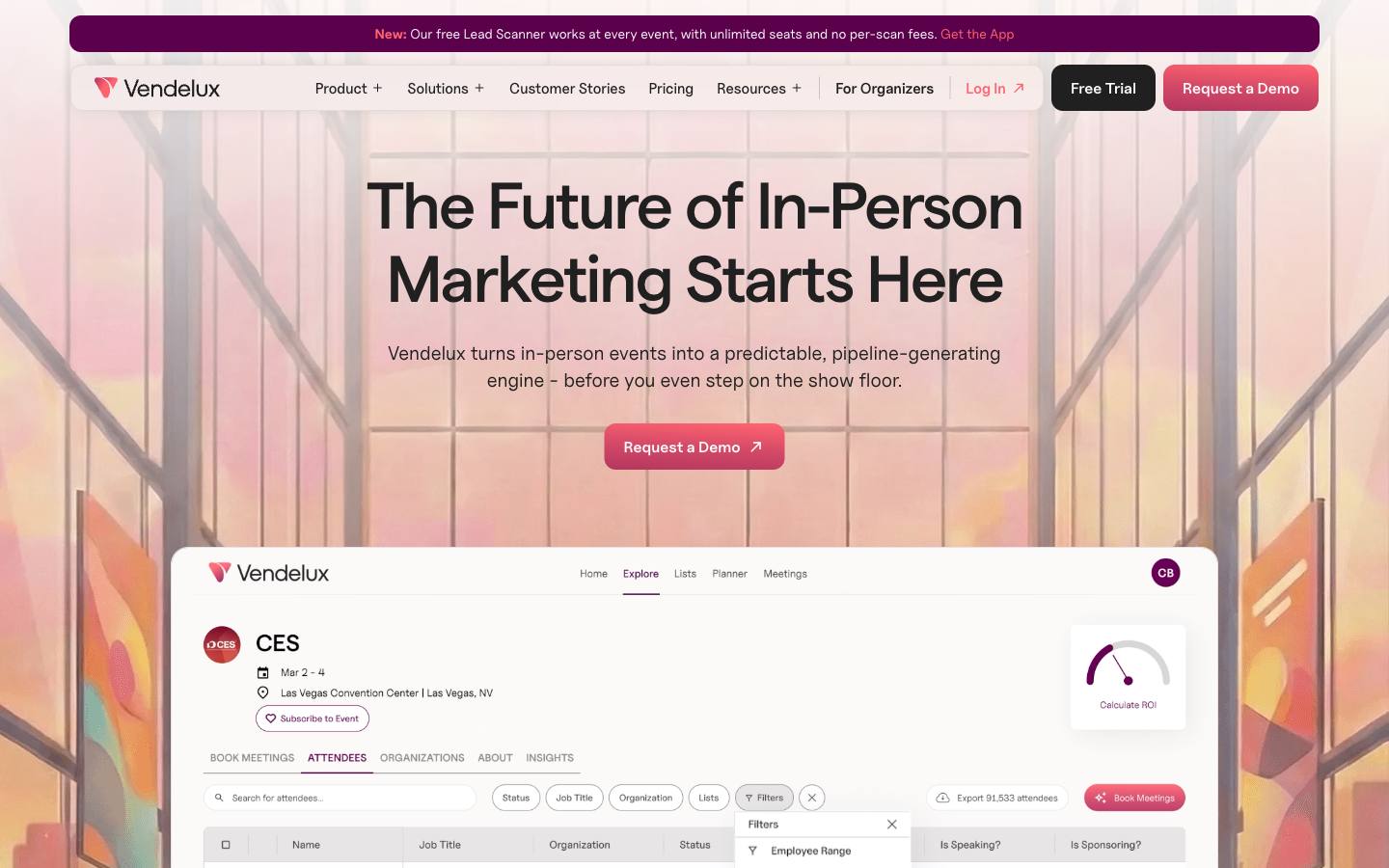
Vendelux is an event intelligence and pipeline platform for companies that attend or sponsor third-party conferences and trade shows. It searches a database of more than 250,000 B2B events to show where your target accounts, customers and competitors will be, then helps book meetings with them and tracks the pipeline that follows.
More on VendeluxLess on Vendelux
Founded: 2021 · HQ: New York, US · Team: 51–200 people · Formats: In-person
Teams upload or connect their ideal customer profile and CRM, and Vendelux maps accounts and open deals onto upcoming events. List Builder filters attendees by role and title, and Campaigns combine AI-timed outreach with outreach run partly by Vendelux staff to book meetings before the show. Event participation is then tied to pipeline and closed revenue in Salesforce or HubSpot. On its own site Vendelux reports that Contentful booked 60 meetings with high-priority accounts, and it names Ramp, Glean, Coupa, AdRoll and Workvivo as customers.
Pricing isn't published. Plans (Starter, Plus and Enterprise) differ by lead credits, campaign credits and seats. The Lead Scanner app is free on its own, with unlimited users and no per-scan fees. Founded in 2021 in New York, Vendelux raised a $50 million Series B in July 2026, and our procurement research found SOC 2 Type II and SAML SSO documented.
- Free Lead Scanner app with unlimited users and no per-scan fees
What stands out
- Database of 250,000+ B2B events matched against your accounts and open deals
- Pre-event meeting campaigns that mix software with staff-run outreach
- Pipeline and revenue attribution in Salesforce or HubSpot
Worth checking
- Not a registration or event production platform for hosting your own conference
- Prices aren't published and depend on lead and campaign credits
Best suited for. Vendelux fits B2B demand generation and field marketing teams that spend a large share of budget sponsoring and exhibiting at other organizers' events. If you mainly host your own conference and need registration, an app and onsite tools, pair it with or pick a platform such as Bizzabo or Cvent.
2. Bizzabo, best for B2B marketing teams that want registration, event websites, email and onsite engagement data on one platform
- Price
- From $499/user
- Capterra
- 4.4/5 from 171 reviews
- App Store
- 4.6/5 from 14 ratings
- Languages
- English
- Syncs with
- Salesforce, HubSpot, Marketo
- Security
- SOC 2 Type II, ISO 27001
- Customers include
- Compass, DJI, HubSpot
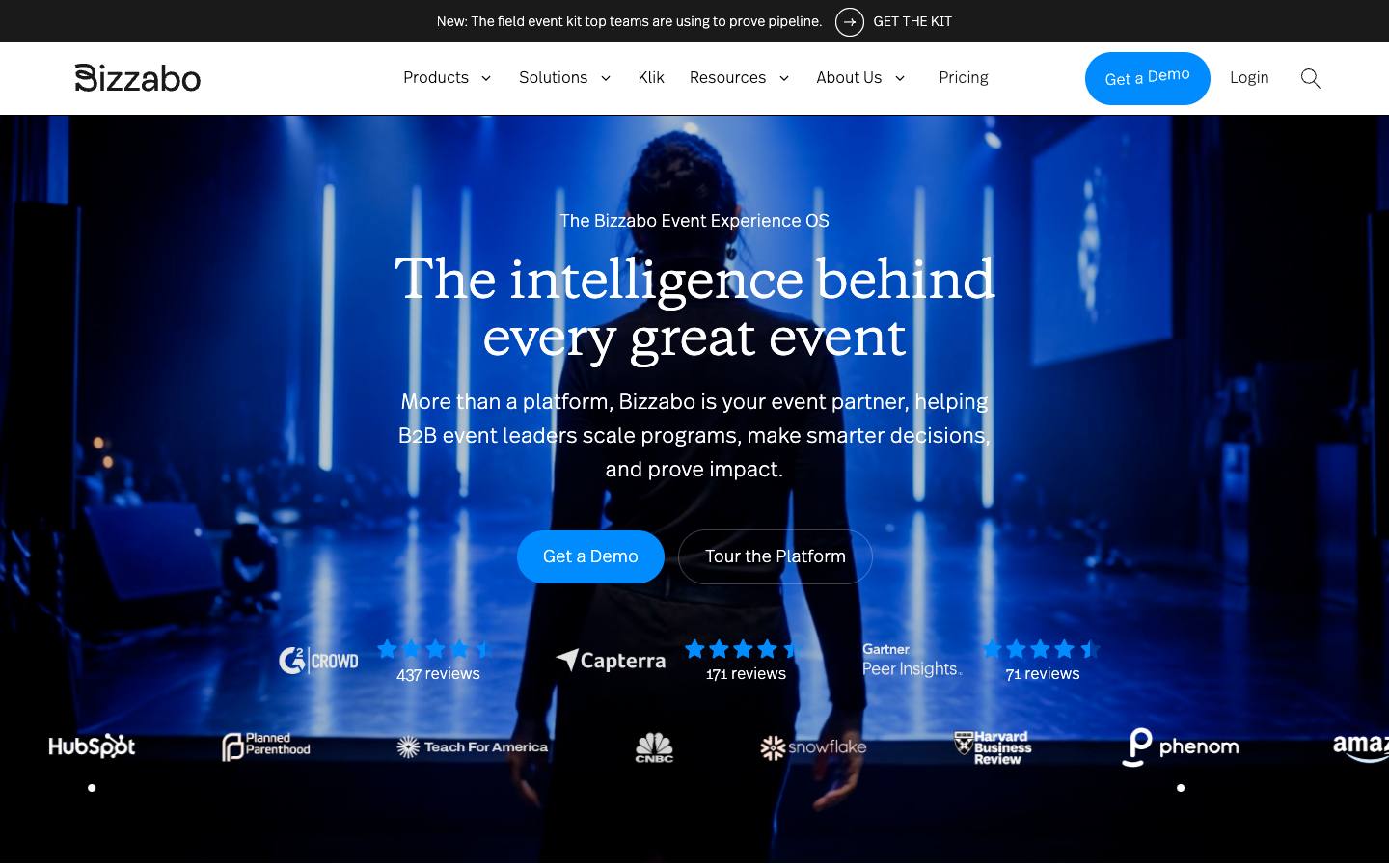
Bizzabo calls its platform the Event Experience OS. It covers registration, event websites, built-in email marketing, a mobile app, sponsor and speaker portals, streaming and reporting for corporate, agency and association teams running conferences and field events.
More on BizzaboLess on Bizzabo
Founded: 2011 · HQ: New York, United States · Formats: In-person, Virtual, Hybrid, Webinar
For event marketers the useful parts are the email campaign tools, the website and agenda editor and the Klik SmartBadge wearables, which capture onsite interactions and contactless lead retrieval and can be bought separately. Bizzabo connects to Salesforce, HubSpot, Marketo, Pardot and Oracle Eloqua, though CRM integrations are a premium add-on. HubSpot runs INBOUND on it. Its in-app copilot, Bizzy, answers attendee questions about sessions, speakers and logistics.
Bizzabo publishes per-seat pricing: $499 per user a month billed annually with a three-user minimum, or from $17,999 a year, with unlimited events and registrations. Virtual events, portals, SSO, API access and Klik are priced separately, and there's no single-event option. It holds a 4.37 rating from 171 Capterra reviews, was founded in 2011 and documents SOC 2 Type II and ISO 27001. For event marketing specifically, the case for Bizzabo is that promotion, registration and onsite behavior sit in one data set. Email campaigns go out from the same system that holds registrations, and Klik badge data shows which sessions and booths each attendee visited, which gives sales more to act on than a simple attended flag.
- Published entry price from $17,999 a year
What stands out
- Built-in email campaigns, event websites and registration with unlimited events
- Klik SmartBadge wearables for onsite interaction data
- Salesforce, HubSpot, Marketo, Pardot and Eloqua connectors
Worth checking
- CRM integrations, portals, SSO and API access are paid add-ons
- Annual contract only, with no single-event option
Best suited for. Bizzabo fits mid-market and enterprise B2B teams hosting several branded conferences and field events a year that want marketing, registration and onsite data in one system. Teams that only sponsor other organizers' shows will get more from an event intelligence tool.
3. Cvent, best for large organizations that want one vendor for event marketing, venues, webinars and onsite across a big program
- Price
- Quote only
- Capterra
- 4.5/5 from 1,099 reviews
- App Store
- 4.8/5 from 40,670 ratings
- Languages
- Support offered in 12 languages; event sites support multiple languages via language management
- Syncs with
- Salesforce, HubSpot, Dynamics, Marketo
- Security
- SOC 2 Type II, ISO 27001, DPA
- Customers include
- 6sense, Cognizant, Purdue University
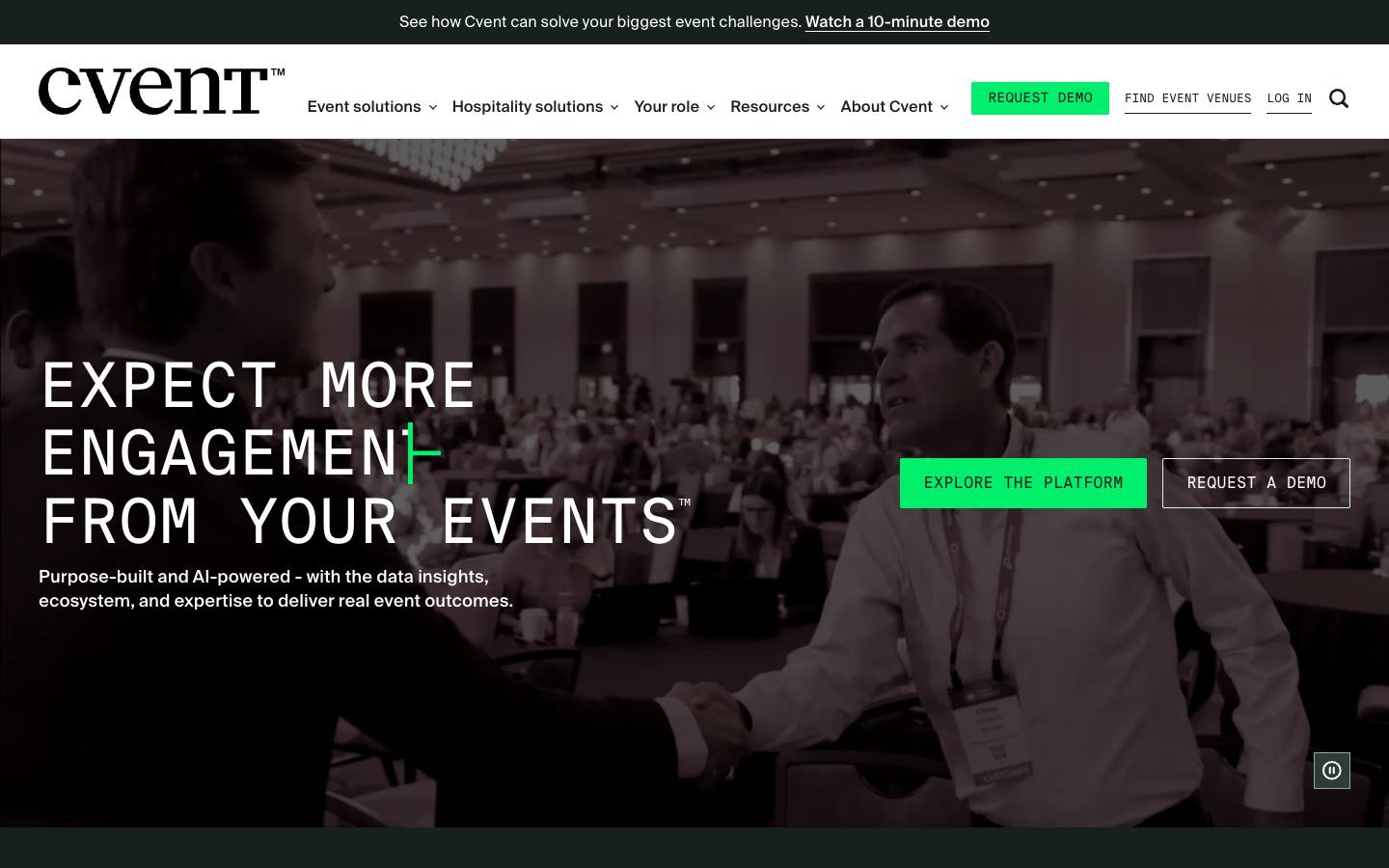
Cvent's event cloud covers the full lifecycle: registration and event marketing, venue and hotel sourcing, attendee apps, onsite check-in, lead capture, webinars and reporting. Its event marketing tools include event websites, registration paths, email campaigns and approvals for repeatable events.
More on CventLess on Cvent
Founded: 1999 · HQ: Tysons Corner, Virginia · Team: 5,001-10,000 people · Formats: In-person, Virtual, Hybrid, Webinar
Cvent has grown its marketing footprint through acquisitions: Splash in 2024 for branded field marketing events, Goldcast in late 2025 and ON24 in April 2026 for webinars and video content. CventIQ, its AI layer, matches attendees to people and sessions and answers questions about event data. Cvent connects natively to Salesforce, Marketo Engage, HubSpot, Microsoft Dynamics and Oracle Eloqua and publishes a REST API and webhooks.
Cvent doesn't publish prices. Products are licensed individually under Professional (15 users) or Enterprise platform tiers, with add-ons quoted separately. It holds a 4.48 rating from 1,099 Capterra reviews, was founded in 1999, has been owned by Blackstone since 2023 and documents SOC 2, ISO 27001 and PCI DSS. Named customers include 6sense, Cognizant and Optimizely. For a marketing team, the main reason to choose Cvent is consolidation. One contract can cover the event website, invitations, registration, the attendee app, onsite badging, lead capture at trade shows and the webinar program, with one set of CRM connectors. The trade-off is cost and setup time, so it suits teams with a dedicated event operations owner.
- 4.48 rating from 1,099 Capterra reviews
What stands out
- Broadest suite, from event websites and email to venues, webinars and onsite
- Native Salesforce, Marketo, HubSpot, Dynamics and Eloqua integrations
- Owns Splash, Goldcast and ON24 for field events and webinar content
Worth checking
- No published pricing; modules and add-ons are licensed separately
- Breadth can mean longer implementation than lighter tools
Best suited for. Cvent fits enterprise event and marketing teams that want a single vendor across in-person, virtual and webinar programs and have the admin capacity to run it. Smaller teams running a handful of events a year usually find lighter, published-price tools easier to adopt.

4. RainFocus, best for enterprise tech companies running large flagship user conferences with a focus on attendee data and pipeline
- Price
- Quote only
- Capterra
- 4.0/5 from 1 reviews
- App Store
- 5.0/5 from 5 ratings
- Syncs with
- Salesforce, HubSpot, Marketo
- Security
- SOC 2 Type II, ISO 27001
- Customers include
- Autodesk, Trimble, Ellucian
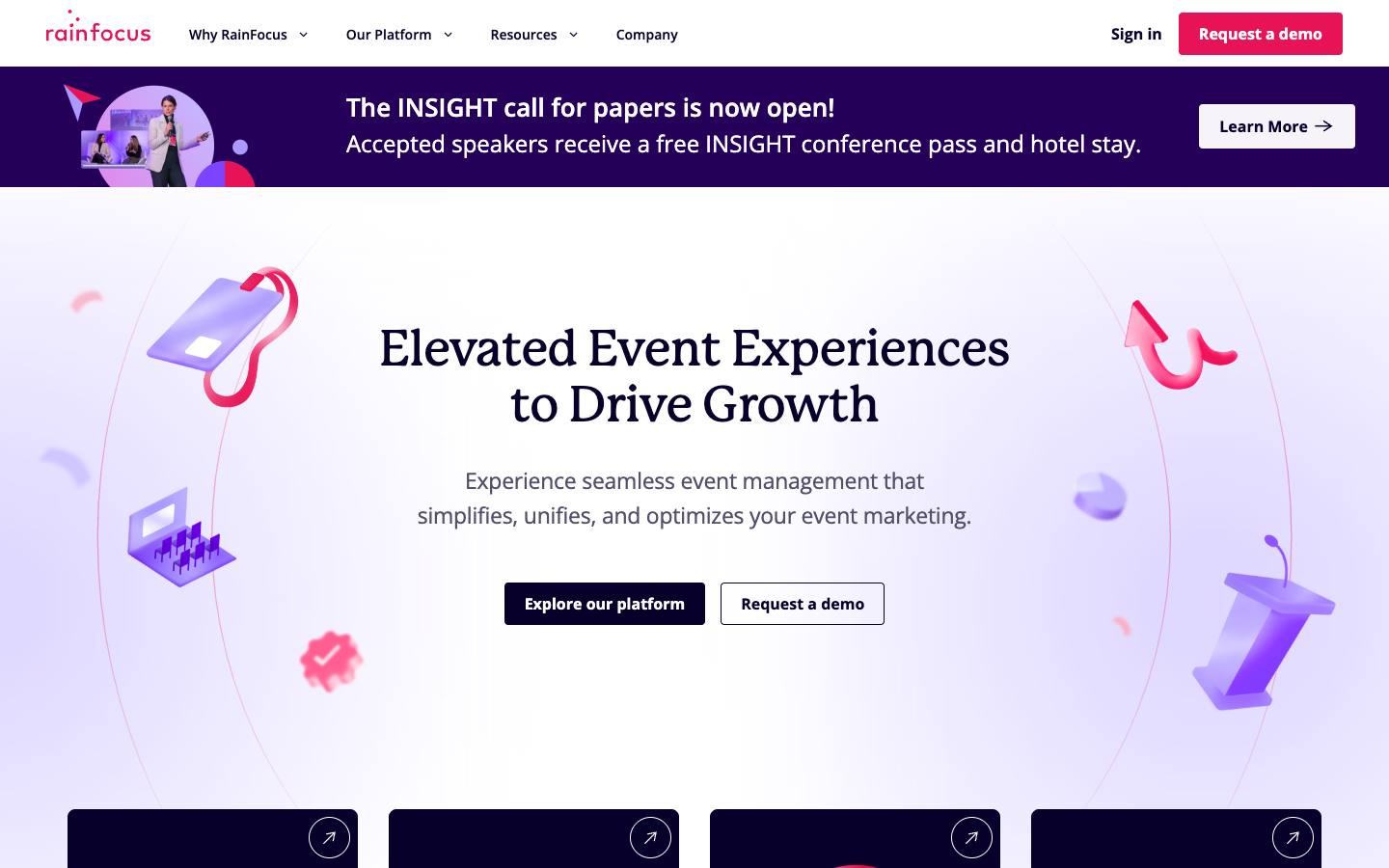
RainFocus is an event marketing and management platform for enterprise B2B companies running big flagship conferences alongside field events, roadshows and webinars. It combines registration, content and speaker workflows, sponsor tools, meetings, onsite and a mobile app on a single attendee data model.
More on RainFocusLess on RainFocus
Founded: 2013 · HQ: Lindon, Utah · Team: 201–500 people · Formats: In-person, Virtual, Hybrid, Webinar
RainFocus is known for powering very large tech user conferences, and its named customers include Cisco, Oracle, Adobe, Red Hat, ServiceNow and RSA Conference. A dedicated RainFocus for Salesforce app supports pipeline attribution, it's an Adobe Platinum partner, and it connects to Marketo Engage, Oracle Eloqua and HubSpot. A newer sales module gives sellers event-driven account activity, and RainFocus Nexus adds agentic AI assistants for event operations.
There's no public pricing; deals go through sales and are aimed at enterprise budgets. RainFocus was founded in 2013 in Lehi, Utah, is backed by JMI Equity and KKR and was named a Leader in Forrester's 2026 evaluation of virtual event management platforms. It cites 40+ connectors, though only a handful are named publicly. For event marketers, the value is in the data model. Registration, session attendance, meetings and sponsor activity are tied to one attendee record across every event in the portfolio, which makes it easier to report on accounts rather than single events and to hand sales a clear view of who engaged with what.
- Sales module that surfaces event activity to account teams
What stands out
- Proven at very large tech user conferences such as Cisco Live
- Dedicated Salesforce app for pipeline attribution
- Unified attendee data across a portfolio of events
Worth checking
- Pricing isn't published and targets enterprise budgets
- More platform than small teams running simple events need
Best suited for. RainFocus fits enterprise marketing organizations whose flagship conference is a major pipeline source and who need deep content, sponsor and attribution workflows. Mid-market teams with smaller programs will find Zuddl or Bizzabo easier to buy and run.
5. Zuddl, best for mid-market B2B teams that want webinars, field events and conferences under one license with revenue dashboards
- Price
- From $10,000/year
- Capterra
- 4.5/5 from 11 reviews
- App Store
- 3.0/5 from 2 ratings
- Syncs with
- Salesforce, HubSpot, Marketo
- Security
- SOC 2 Type II, ISO 27001, SAML SSO, DPA
- Customers include
- Motive, NASSCOM, Google
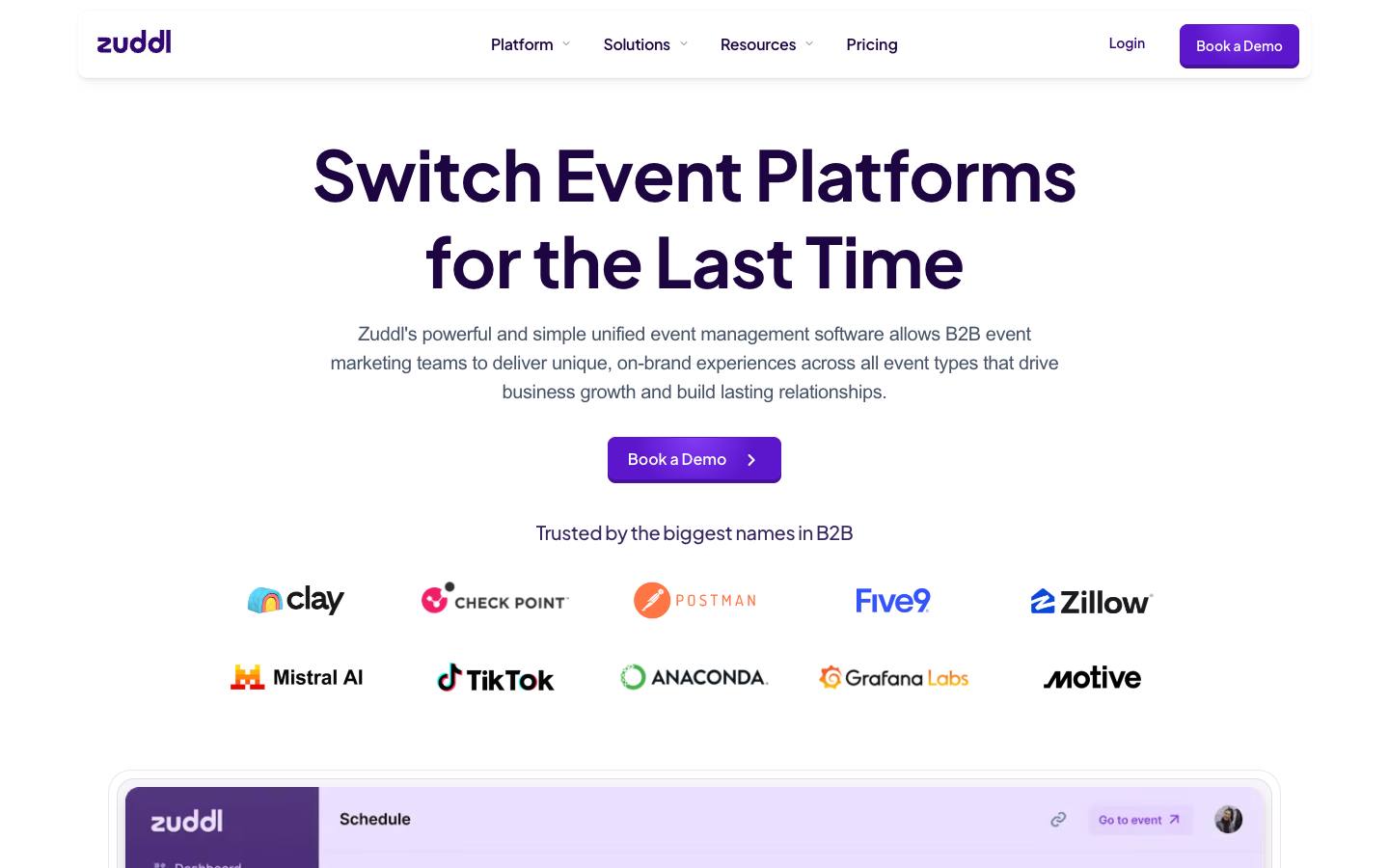
Zuddl is a modular B2B event platform covering registration and ticketing, landing pages, speaker and exhibitor portals, a mobile app, virtual and hybrid streaming, onsite check-in and lead capture. Its analytics include revenue dashboards and sales leaderboards.
More on ZuddlLess on Zuddl
Founded: 2020 · HQ: San Francisco, California · Team: 51–200 people · Formats: In-person, Virtual, Hybrid, Webinar
Two things set Zuddl apart for event marketers. Its universal lead capture works at third-party events you sponsor as well as at events you host, and its conversational AI agents help teams build and check event setups. It integrates with Salesforce, HubSpot, Marketo, Oracle Eloqua, Iterable and Mailchimp and adds an open API and webhooks. Named customers include BigCommerce, Tricentis, Motive and Fullscript.
Pricing starts at $10,000 a year for two organizer licenses, one collaborator and unlimited check-in and lead capture users, published on its pricing page and checked October 2026. Extra collaborators cost $170 a month billed annually, and a platform fee and add-ons such as the mobile app and portals come on top. There are no per-event or per-registration fees. Founded in 2020, Zuddl documents SOC 2 Type II, ISO 27001 and ISO 27701 and holds a 4.45 rating from 11 Capterra reviews. Because one license covers digital, field and conference formats, Zuddl suits teams that want to stop paying separate vendors for webinars and in-person events.
- SOC 2 Type II, ISO 27001 and ISO 27701
What stands out
- One license spans webinars, field events and conferences, with no per-event fees
- Lead capture at sponsored third-party events as well as owned events
- Published entry price of $10,000 a year
Worth checking
- Mobile app and portals are add-ons on top of the license
- Platform fee scales with account size, so total cost needs a quote
Best suited for. Zuddl fits mid-market B2B marketing teams that run a mix of webinars, field events and one or two conferences and want one system for all of them. If you run hundreds of community meetups or only sponsor other shows, a specialist tool will fit better.

6. hapily, best for HubSpot-based teams that want event registration, lead capture and deal attribution as native HubSpot records
From $417/month
- Price
- From $417/month
- Languages
- English
- Syncs with
- HubSpot
- Security
- SOC 2 Type II, DPA
- Customers include
- Duke Corporate Education, Imperial PFS, Pearagon
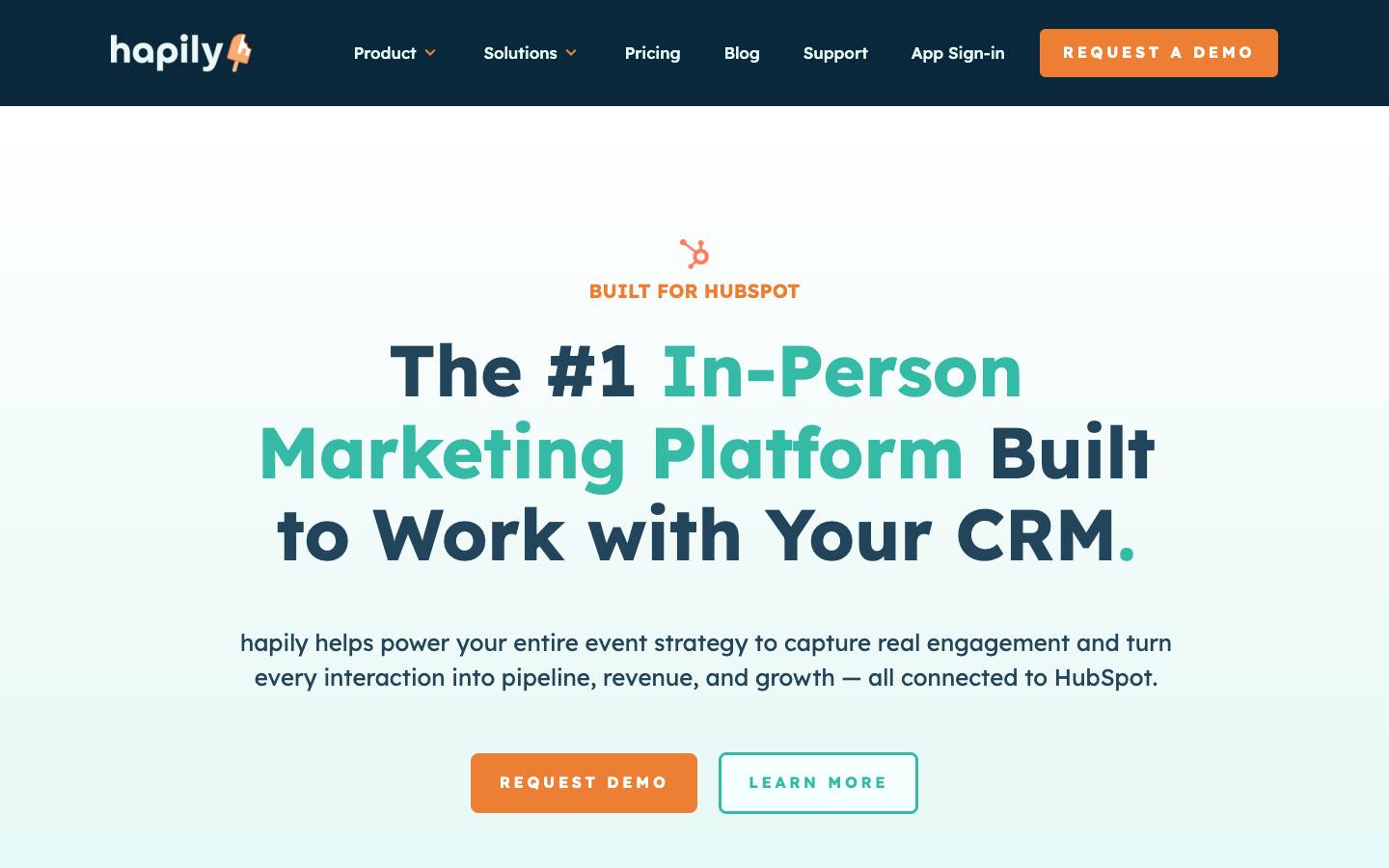
hapily is an event platform built for HubSpot. Registration, check-in, lead capture, meetings and attribution data live in the CRM as native records, so event touches appear in HubSpot reports and deal timelines without a separate sync.
More on hapilyLess on hapily
Founded: 2025 · HQ: New York, NY · Team: 11-50 people · Formats: In-person, Virtual, Hybrid, Webinar
It covers hosted event pages, invites and registration, QR check-in and badge printing, an AI-assisted mobile lead capture app for third-party shows and deal attribution dashboards in HubSpot. Follow-up messages can be drafted with AI. Named customers include Arizona State University, OUTFRONT Media, Edelman and SignalFire.
Plans are credit-based and billed annually, published on its pricing page and checked October 2026. Hosted Events or Lead Capture each cost $600 a month with 1,000 credits, the Core Bundle is $833 a month with 2,000 credits and unlimited seats and events, and meetings or paid-events add-ons are $417 a month each. One registration or one lead scan uses one credit, and 4,000 extra credits cost $2,500. hapily was founded in 2025 and lists SOC 2 Type II. The practical benefit is reporting. Because registrations, attendance and scans are HubSpot records from the start, marketers can build event influence reports with HubSpot's own tools, and sales sees event history on the contact and deal without waiting for a sync or an import.
- Published pricing from $600 a month
What stands out
- Event data stored natively in HubSpot, not synced from an outside system
- Covers hosted events and lead capture at third-party shows
- Deal attribution and ROI dashboards inside HubSpot
Worth checking
- Only works for HubSpot customers
- Annual billing required, with no free plan or trial shown
Best suited for. hapily fits startup and mid-market teams that run their go-to-market on HubSpot and want every event touch in the CRM by default. Salesforce shops should look at Vendelux, Cvent or RainFocus instead.
7. Demandbase, best for enterprise teams already running account-based marketing that want events in the same targeting and intent motion
Quote only
- Price
- Quote only
- Languages
- English
- Security
- SOC 2 Type II, ISO 27001, DPA
- Customers include
- Palo Alto Networks, SAP Concur, Thales
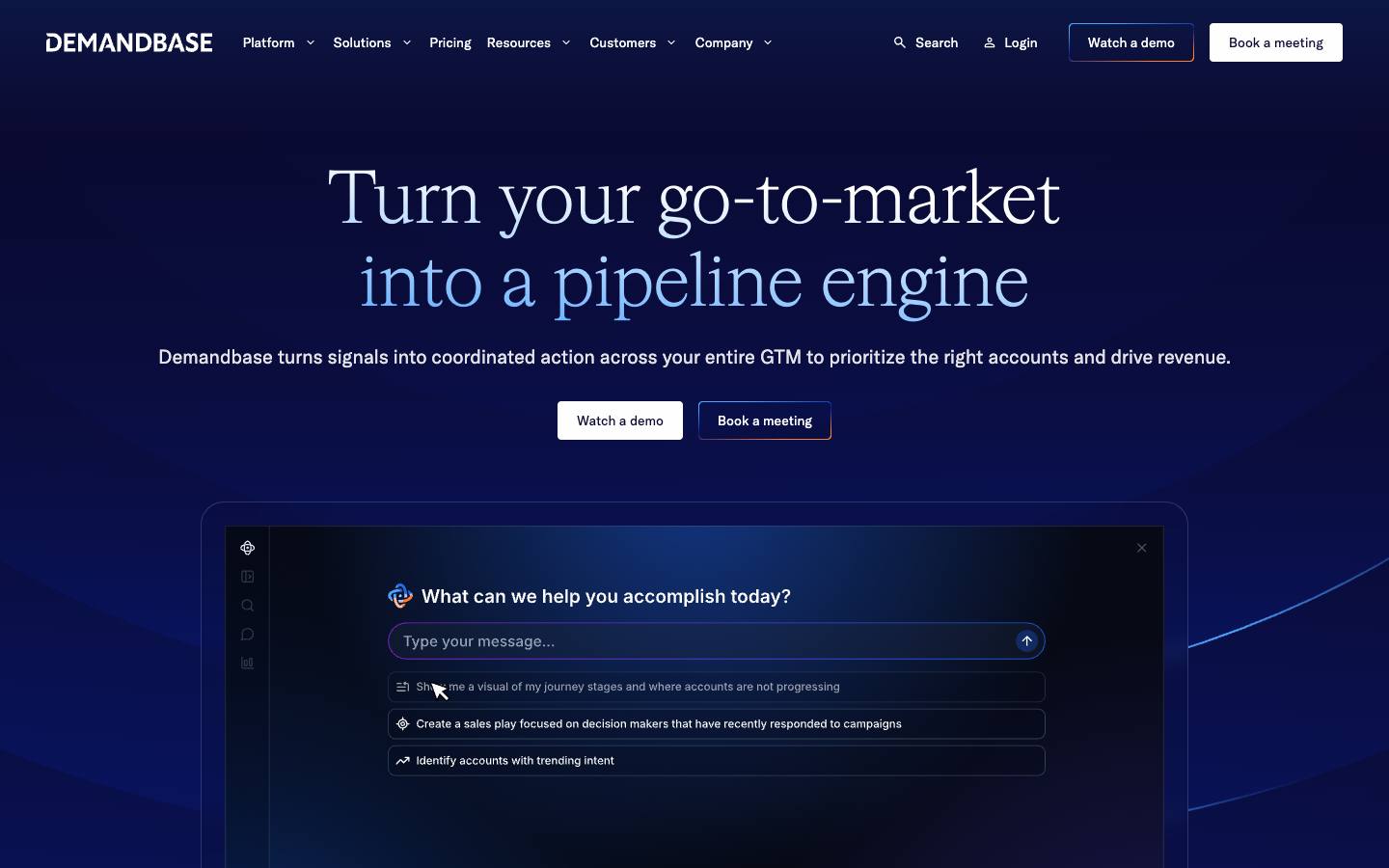
Demandbase is an account-based go-to-market platform combining account identification, intent and buying-group data, B2B advertising and sales intelligence. It isn't an event tool, but event marketers use it to choose target accounts, promote events to them and prioritize follow-up.
More on DemandbaseLess on Demandbase
Founded: 2006 · HQ: San Francisco, US · Team: 501-1,000 people · Formats: In-person
Its buying-group intelligence maps engagement across the people at an account, and account-targeted advertising can drive event registrations from named accounts. After the event, sales intelligence helps sellers focus follow-up on accounts showing intent. Demandbase AI analyzes account and buying-group signals, and the platform connects to external assistants such as Claude, Copilot and Gemini. Its marketplace lists 63 pre-built integrations.
Pricing combines a platform fee with per-user fees for marketing and sales seats; no list prices are published. Demandbase was founded in 2006, is headquartered in San Francisco and has raised $330 million according to CB Insights. It documents ISO 27001 and SOC 2 Type 2, and named customers include Adobe, IBM, Zoom, DocuSign and Thermo Fisher Scientific. In an event program, Demandbase usually sits upstream of the event platform. Marketers build the target account list and invite plan in Demandbase, run ads to those accounts, then use engagement and intent signals after the event to tell sales which accounts to call first.
- Connectors for Claude, Copilot and Gemini
What stands out
- Account intent and buying-group data that event platforms generally lack
- Account-targeted advertising to drive registrations from named accounts
- ISO 27001 and SOC 2 Type 2
Worth checking
- No registration, onsite or virtual event features, so it needs an event platform
- Enterprise-oriented contracts with no published prices
Best suited for. Demandbase fits enterprise B2B teams with an established ABM program that want events to share the same account lists, intent data and advertising. Teams without an ABM motion will get faster value from an event-specific tool such as Vendelux.

8. Snöball, best for conference and trade show organizers that want speakers, exhibitors and attendees to drive registrations
From €5,497/project
- Price
- From €5,497/project
- Syncs with
- Salesforce, HubSpot
- Security
- SOC 2 Type II, DPA
- Customers include
- Dubai World Trade Centre, Emerald, Clarion Events
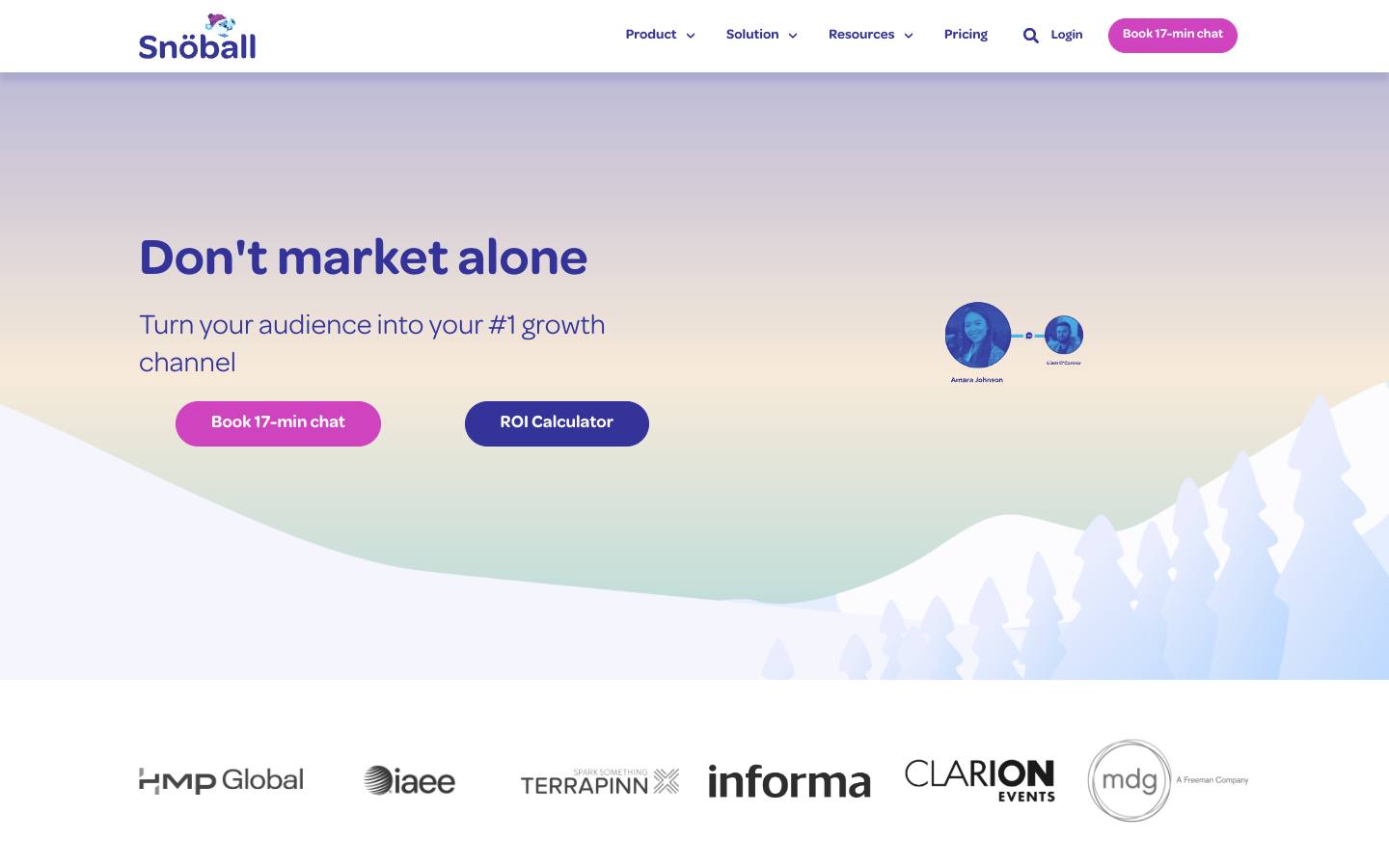
Snöball runs peer-to-peer referral campaigns for events. Speakers, exhibitors, sponsors and attendees get personalized, co-branded social cards, emails and landing pages to share with their networks, and analytics show which advocates and channels drove each registration.
More on SnöballLess on Snöball
Founded: 2017 · HQ: Montreal, Canada · Formats: In-person, Virtual, Hybrid
It connects to more than 70 platforms, 13 of them through deep API integrations, including Cvent, Bizzabo, Swoogo, RainFocus, Swapcard and HubSpot, so referrals tie back to real sign-ups. Booster emails nudge advocates to share, a social proof wall displays shares and the team can run campaigns end to end. Named customers include Informa, Clarion Events, RX, Emerald and Terrapinn.
Snöball publishes its pricing, checked October 2026: the managed Snöflake plan is €5,497 per project, the self-managed Snöstorm plan is €29,900 a year for 25 projects and up to 50,000 audience members, and Avalanche is quoted. It was founded in 2017 and documents SOC 2 Type II. Referral marketing works best for events with many natural promoters. A trade show with hundreds of exhibitors or a conference with dozens of speakers has a large network to tap, and Snöball's analytics show which advocates are worth rewarding or recruiting again next year. For organizers, that can lower paid media spend per registration.
- SOC 2 Type II
What stands out
- Co-branded advocate kits and personal landing pages for every speaker and exhibitor
- 70+ integrations, 13 of them deep API connections
- Published per-project and annual pricing
Worth checking
- Sits alongside a registration platform rather than replacing it
- Results depend on how many advocates actually share
Best suited for. Snöball fits organizers of trade shows and conferences with many exhibitors and speakers who can promote the event. Companies marketing a single field event or dinner series won't have enough advocates to justify it.

9. Gleanin, best for event marketers who want a self-serve referral tool with monthly pricing and a free trial
From $523/month
- Price
- From $523/month
- Try it
- Free trial
- Languages
- English
- Security
- ISO 27001, DPA
- Customers include
- Clarion Events, Swapcard, Event Tech Live
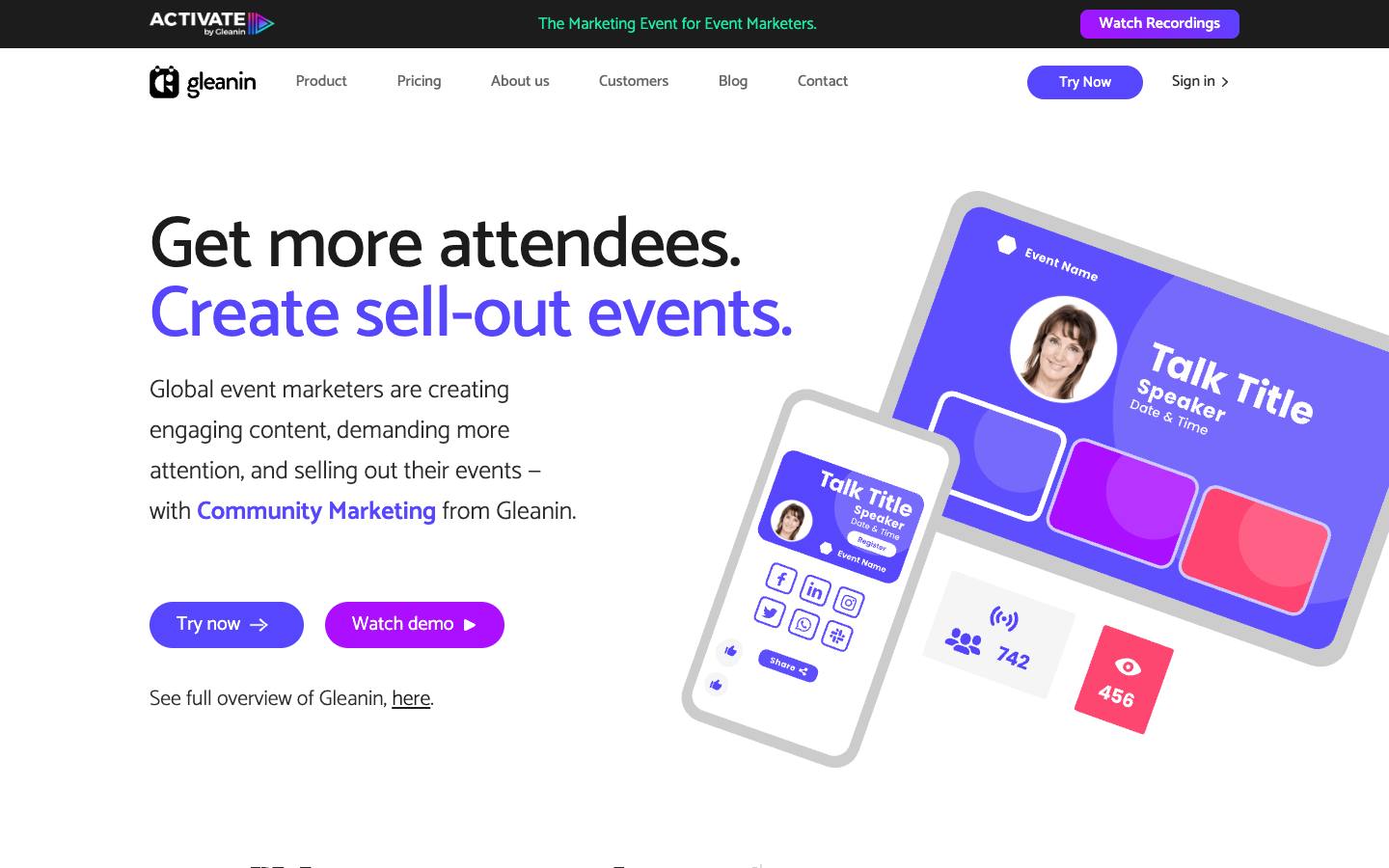
Gleanin lets event marketers build branded share kits that attendees, speakers and exhibitors post to their own networks, then reports which stakeholders and channels drive clicks and registrations. It runs in the browser without logins and doesn't store attendee data.
More on GleaninLess on Gleanin
Founded: 2011 · HQ: London, UK · Team: 11-50 people · Formats: In-person, Virtual, Hybrid
Campaign templates cover attendee, speaker and exhibitor sharing without a designer, and suggested share copy is included on every plan. Shares go to LinkedIn, Facebook, Instagram, X, WhatsApp and Slack, and campaign links sit on registration confirmation pages or in emails. Customers include CES, IMEX, Messe Frankfurt, RAI Amsterdam and The Economist.
Gleanin publishes pricing, checked October 2026: $523 a month for one user with unlimited events, or two months free when paid annually, and Gleanin Pro at $1,773 a month for five users with API access and advanced reporting. Subscriptions can be paused between events, and there's a 14-day free trial. It was founded in 2011 in London, is ISO 27001 certified and hosts data in the EU (Ireland). Gleanin is the lighter-weight option among the referral tools. Setup is self-serve, so a single event marketer can launch a speaker or exhibitor sharing campaign in a day and see which groups actually drove registrations, then pause the subscription after the event season ends.
- Unlimited events on every plan
What stands out
- Published monthly pricing with a 14-day trial and the option to pause
- No attendee data stored, which simplifies GDPR reviews
- ISO 27001 with EU data hosting
Worth checking
- No named registration or CRM integrations
- The entry plan covers one user
Best suited for. Gleanin fits event marketers who want to test referral marketing quickly without a long contract or a managed service. Organizers who need referrals written back into their registration platform should compare Snöball or InGo.

10. InGo, best for large trade show organizers that want referral tracking built into their existing registration flow
Quote only
- Price
- Quote only
- Languages
- English
- Syncs with
- HubSpot, Marketo
- Security
- SOC 2 Type II
- Customers include
- United Nations Global Compact, Atlassian, Foundry
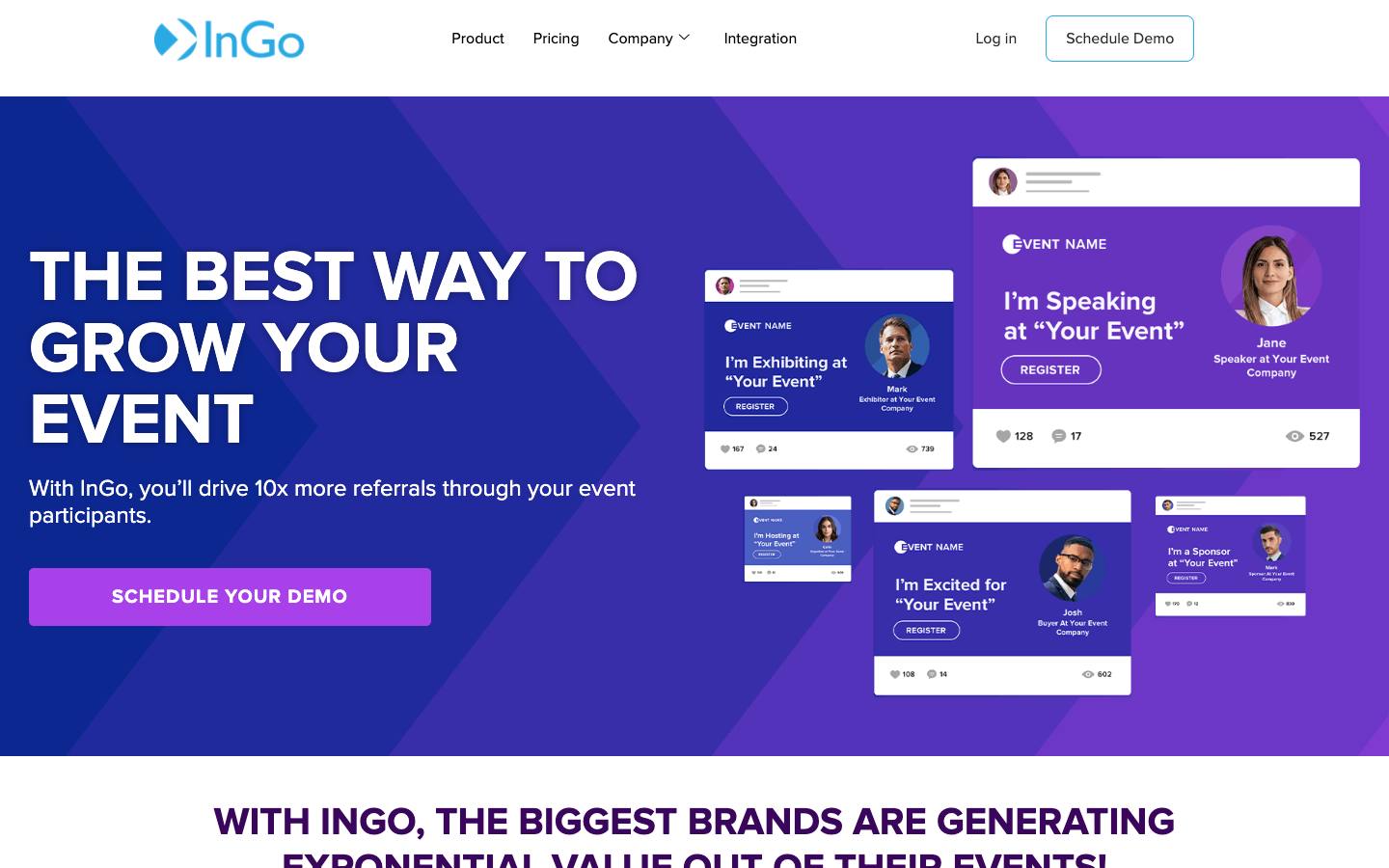
InGo plugs into an event's registration flow and confirmation emails to prompt attendees, speakers and exhibitors to invite peers, then tracks who drove each new registration. It adds networking emails, leaderboards and a report showing which companies haven't registered yet.
More on InGoLess on InGo
Founded: 2013 · HQ: Arlington, Virginia · Team: 11-50 people · Formats: In-person, Virtual
InGo integrates with registration and content platforms including Cvent, Swoogo, Bizzabo, Eventbrite, ON24, Zoom, HubSpot and Marketo, and installs without development work. Its attribution analytics track clicks, referrals and acquisitions back to each participant, and an AI-enhanced social graph surfaces likely prospects who are missing. Named customers include Informa, Questex, Money20/20, Atlassian, Greenbuild and ISC West.
Pricing is quoted on required functionality and total annual audience size, with onboarding quoted per project. InGo was founded in 2013 in Arlington, Virginia, has 11 to 50 employees and documents SOC 2 Type II and a public API. The 'who is missing' report is the feature most event marketers point to. It compares registrations against the companies and contacts you'd expect to attend, so the team can direct invitations, sales outreach or exhibitor prompts at the gaps before the event fills. Leaderboards and incentives keep participants sharing in the weeks before the show. A no-integration option exists for events whose registration platform isn't supported.
- SOC 2 Type II
What stands out
- Referral prompts embedded in existing registration and confirmation flows
- 'Who is missing' report for companies that haven't registered
- Integrations with Cvent, Swoogo, Bizzabo, Eventbrite and ON24
Worth checking
- Depends on a separate registration platform
- Pricing isn't published and scales with audience size
Best suited for. InGo fits large exhibition and conference organizers that want referral marketing woven into registration with per-participant attribution. Smaller teams that want a quick, self-serve start may prefer Gleanin.

11. Feathr, best for associations that promote annual meetings with retargeting and email and sell ad access to sponsors
Quote only
- Price
- Quote only
- Languages
- English
- Security
- SOC 2 Type II
- Customers include
- International Justice Mission, YMCA of Metropolitan Fort Worth, American Epilepsy Society
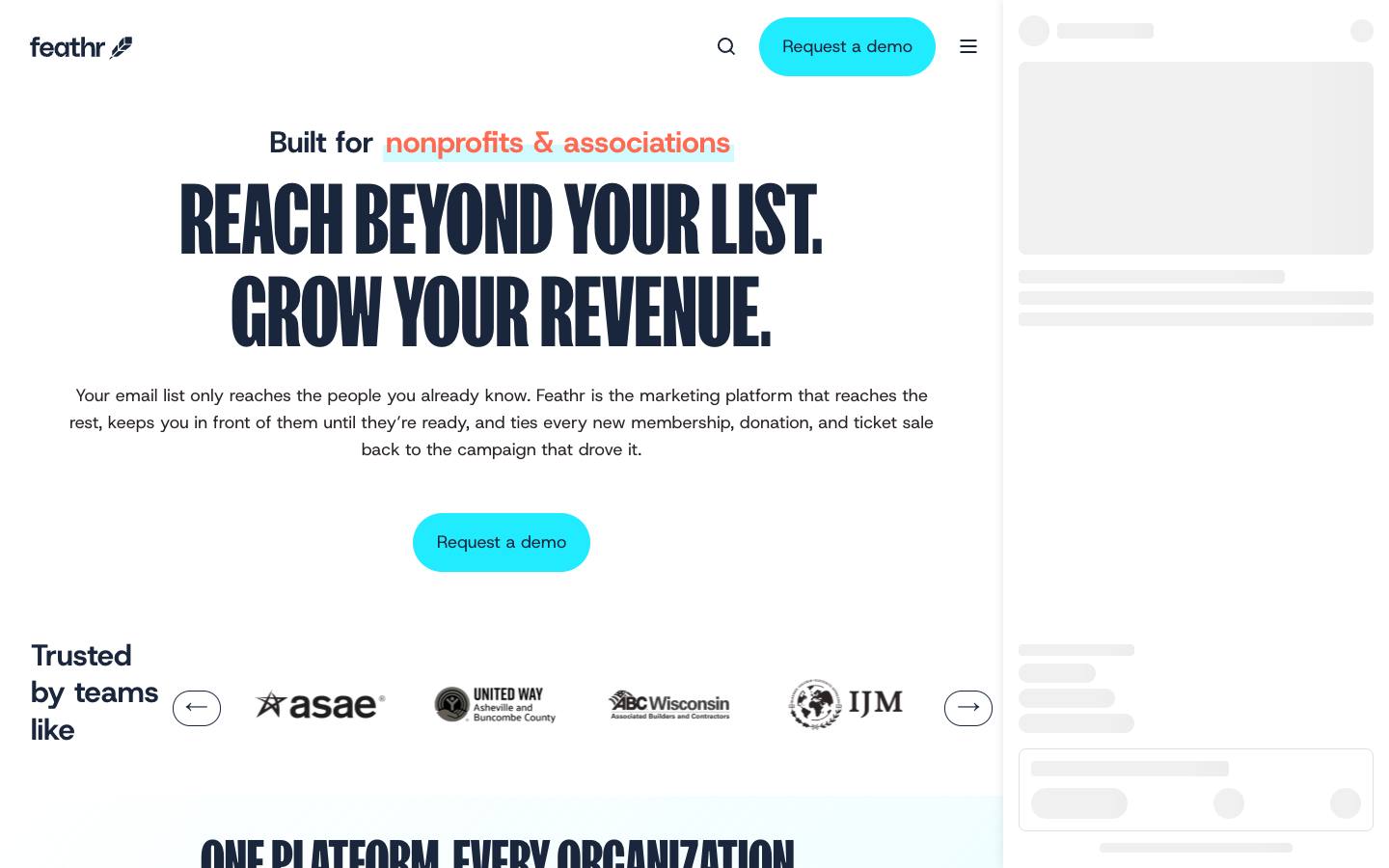
Feathr is a marketing platform for nonprofits, associations and mission-driven organizations that combines retargeting, geofencing, email automation, landing pages and conversion tracking. Associations use it to promote annual meetings and conferences and to run co-branded partner invite campaigns.
More on FeathrLess on Feathr
Founded: 2012 · HQ: Gainesville, Florida · Team: 51-200 people · Formats: In-person, Virtual
Its sponsor monetization tools let organizers sell sponsors targeted ad access to their audience, a revenue line most event platforms don't offer. Conversion tracking ties registrations and ticket sales back to campaigns, and AI features include audience segmentation, lookalike audiences and budget recommendations. It connects to iMIS, Blackbaud and other association systems, with Zapier for the rest. Named customers include ASAE, APWA and the American Association of Endodontists.
Pricing isn't published: the base license is tiered by marketing contacts, ad spend is billed separately and onboarding is a one-time fee. Feathr was founded in 2012 in Gainesville, Florida, and documents SOC 2 Type II. For associations, Feathr's appeal is that one platform can grow attendance and raise revenue at the same time. Retargeting and geofencing reach past attendees and members, partner invite campaigns let exhibitors promote the meeting, and sponsor ad packages turn the audience into an additional line of sponsorship income. Its community database keeps member and supporter records together with dynamic segments.
- Native iMIS and Blackbaud integrations
What stands out
- Retargeting, geofencing and email in one platform
- Sponsor ad packages that create new event revenue
- Registration and ticket conversion tracking by campaign
Worth checking
- Positioned mainly for nonprofits and associations, not corporate B2B marketers
- Media spend is billed on top of the license
Best suited for. Feathr fits associations and nonprofit organizers that need paid promotion and sponsor revenue for their annual meeting. Corporate B2B teams focused on target accounts will get more from Demandbase or Vendelux.

12. AddEvent, best for teams that want to raise webinar and event show-up rates with add-to-calendar links and RSVP pages
From $29/month
- Price
- From $29/month
- Try it
- Free plan
- Syncs with
- Salesforce, HubSpot, Marketo
- Security
- SOC 2 Type II, DPA
- Customers include
- Ecamm Live, ConversionWise, Sono Bello
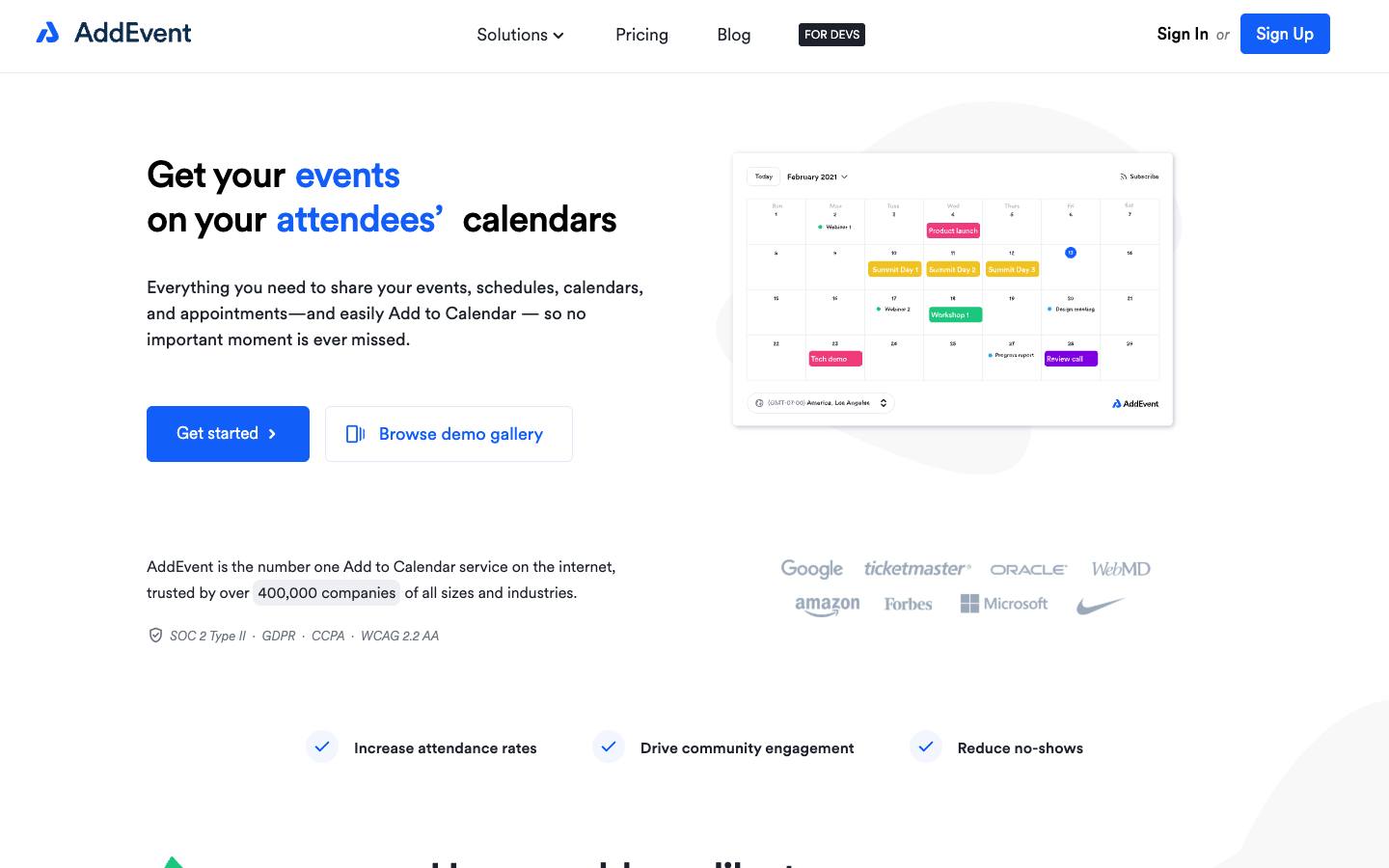
AddEvent provides add-to-calendar buttons and links for websites and emails, embeddable event calendars, RSVP forms and landing pages, and subscription calendars that keep followers' calendars up to date. Marketers use it to get sessions onto attendees' calendars and lift attendance.
More on AddEventLess on AddEvent
Founded: 2015 · Formats: In-person, Virtual, Webinar
Calendar links work inside email platforms such as Marketo, Salesforce Marketing Cloud, Braze and Constant Contact, while app connections run through Zapier and a REST API on paid plans. Reminders, follow-up emails and engagement analytics are included. Named customers include Achievers and Ticket Tailor, and AddEvent documents SOC 2 Type II.
AddEvent publishes pricing, checked October 2026. The free Hobby plan is for non-commercial use, with 100 calendar clicks and 20 RSVPs a month. Small Business is $29 a month billed annually with 2,500 clicks and 1,000 RSVPs, Professional is $99 a month with 25,000 clicks, 5,000 RSVPs and five users, and Enterprise adds dynamic add-to-calendar, a custom domain and invoicing at a custom price. The company was founded in 2015 and has offered calendar buttons since 2012. For event marketers the main use is lifting attendance. A calendar entry with the join link and reminders makes it more likely that a registrant actually shows up, which matters most for free webinars and virtual events where no-show rates run high.
- SOC 2 Type II
What stands out
- Published pricing from $29 a month
- Add-to-calendar links that work in major email platforms
- RSVP forms and landing pages for light events
Worth checking
- A promotion and RSVP layer, not a full registration platform
- Monthly caps on clicks and RSVPs push heavy senders to higher tiers
Best suited for. AddEvent fits teams running frequent webinars and events who want a cheap, quick lift in attendance from their existing emails. It won't replace registration, onsite or attribution tools for a full conference.

13. Luminik, best for Series A to C startups that sponsor trade shows and need pre-event targeting and CRM attribution on a budget
From $249/month
- Price
- From $249/month
- Syncs with
- Salesforce, HubSpot
- Security
- SAML SSO
Luminik is a sponsor-side event pipeline tool. It sources and scores third-party event attendees against your ICP, pushes priority contacts into your sales sequencer, captures booth conversations on mobile and writes sourced and influenced pipeline back to the CRM.
More on LuminikLess on Luminik
Formats: In-person
It works with what a team already pays for: enrichment runs through your own Apollo or ZoomInfo contract, and prioritized contacts go into Apollo, Salesloft, Amplemarket or Lemlist with event-specific messaging. The offline-first booth app handles badges, business cards, QR codes and voice notes, and AI extracts next steps from notes. Results are written back to Salesforce or HubSpot by event, rep and account.
Luminik publishes pricing, checked October 2026. Starter is $249 a month billed annually ($2,988 a year, or $299 month to month) for up to six events and 15,000 enriched matches a year. Growth is $665 a month for 12 events, and Scale starts at $1,665 a month for 30 events with SSO and directory sync. Case studies are anonymized, and a SOC 2 report is offered on request on the top tier. Because it reuses existing data contracts, Luminik keeps costs down for teams that already pay for Apollo or ZoomInfo, and its event-level reports give RevOps a consistent way to compare shows.
- Sourced and influenced pipeline written back to Salesforce or HubSpot
What stands out
- Published pricing from $249 a month with a month-to-month option
- Uses your existing enrichment and sequencer contracts
- Unlimited booth reps on every plan
Worth checking
- Built for attending other organizers' events, not hosting your own
- Early-stage vendor with no named customer logos
Best suited for. Luminik fits venture-backed startups that sponsor six to 30 shows a year and want a published, low entry price for pre-event targeting and attribution. Larger teams that want a bigger event database and managed meeting outreach should compare Vendelux.
Picks 6 to 13 are folded to keep the list short. Open any of them, or compare them all in the table above.
Also worth considering
Swoogo, ZoomInfo, Bevy, Add to Calendar PRO, Certain, Snapsight
The best event marketing software by use case
| If you need | Company size | Look at |
|---|---|---|
| Demand gen team sponsoring 20+ third-party conferences a year | Mid-market, Enterprise | VendeluxShows where target accounts will be and books meetings before the show |
| B2B marketer hosting a flagship conference plus field events | Mid-market, Enterprise | BizzaboRegistration, email and onsite data on one platform |
| Enterprise program spanning venues, webinars and in-person events | Enterprise | CventOne vendor across the whole program |
| HubSpot shop that wants event touches on every deal | Startup, Mid-market | hapilyEvent records live natively in HubSpot |
| Trade show organizer growing registrations through exhibitors | Mid-market, Enterprise | SnöballCo-branded advocate kits tied to real sign-ups |
| Small team testing referral marketing without a long contract | Startup, Mid-market | GleaninMonthly pricing, 14-day trial and pause option |
| Association promoting its annual meeting with paid ads | Startup, Mid-market | FeathrRetargeting plus sponsor ad revenue |
| Startup sponsoring six to 12 shows on a tight budget | Startup | LuminikPublished pricing from $249 a month |
What results look like
Figures customers report in the vendors' own published case studies. They describe one customer each, not what every buyer should expect.
60%
App adoption rate
Compass with Bizzabo · Case study
134+
Events per year
Autodesk with RainFocus · Case study
75+
Annual events
Motive with Zuddl · Case study
17%
Closed-won rate lift with buying groups
Palo Alto Networks with Demandbase · Case study
3.5%
Share of total registrations
Dubai World Trade Centre with Snöball · Case study
100%
Increase in attendee registration
Clarion Events with Gleanin · Case study
How to choose
Background on what these tools do, how we ranked them and what to check before you buy. Open any topic.
What event marketing software actually is (and what it isn't)
Event marketing software is the set of tools B2B marketers use to decide which events to run or attend, fill them with the right people and turn the conversations into pipeline. It covers event intelligence (where are my target accounts going?), event marketing platforms that build event websites, registration and email campaigns, referral and promotion tools that recruit attendees through speakers and exhibitors, and the CRM data layer that ties attendance to deals.
It isn't the same as event management software, which runs the logistics of a whole program (venues, agendas, onsite operations), though the big platforms do both. It also isn't a general marketing automation system, a webinar platform or a lead retrieval app. If your main job is registration forms and checkout, see our guide to event registration software. For proving revenue after the event, see our guide to event attribution and ROI software, and for picking which shows to attend, our guide to event intelligence platforms.
For B2B event teams the jobs are concrete: pick the shows where target accounts will be, invite those accounts to your own events and side events, grow registrations at a lower cost per attendee, book meetings before the doors open and push every touch into Salesforce or HubSpot so sales can follow up and finance can see the return.
How we ranked these event marketing software tools
We compared 13 event marketing tools on the criteria below, using each vendor's own pages, our pricing research and public review sites, checked in October 2026. Facts we couldn't confirm are left out.
1. Pipeline focus
Whether the product's own pages describe tying events to target accounts, opportunities or revenue, not just registrations.
2. Native Salesforce or HubSpot sync
Named CRM integrations on the vendor's integration pages, noting where a CRM connector is a paid add-on.
3. Published entry price
The lowest price on the vendor's pricing page and what that plan includes, checked October 2026.
4. Promotion tools
Documented email, referral, advertising or calendar features for driving registrations, from the vendor's product pages.
5. Security documentation
Whether SOC 2 or ISO 27001 is documented on the vendor's trust or security pages, from our procurement research.
6. Buyer ratings
Capterra ratings and review counts where a listing exists, shown as published.
More on our process in the methodology.
What to look for in event marketing software
Start with the job, not the feature list. If most of your budget goes to sponsoring other organizers' shows, you need event intelligence: which shows your accounts attend, who to meet and what pipeline came out of it. If you host your own events, you need registration, email and websites that feed your CRM. If attendance is the problem, you need promotion tools such as referral programs, advertising or calendar links.
Whatever the job, check three things: how data reaches Salesforce or HubSpot (native, add-on or Zapier), whether the tool works at events you host, events you attend or both, and who on your team will run it week to week.
How much event marketing software costs
Published prices in this guide range from $29 a month for AddEvent's Small Business plan to $17,999 a year for Bizzabo's entry plan. Referral tools sit in between: Gleanin starts at $523 a month and Snöball at €5,497 per managed project or €29,900 a year self-managed. Event intelligence and pipeline tools run from $249 a month for Luminik's Starter plan to quoted, credit-based contracts for Vendelux. hapily starts at $600 a month billed annually, and Zuddl at $10,000 a year.
Cvent, RainFocus, Demandbase, InGo and Feathr quote every deal. Budget for add-ons as well: CRM connectors, SSO, mobile apps, extra seats and media spend are often priced separately.
Questions to ask vendors
Ask which CRM objects the tool writes to (campaigns, campaign members, custom objects) and whether that sync is included or an add-on. Ask how it handles events you don't host, such as sponsored trade shows. Ask for the price at your real volume: events per year, registrations, seats and credits. Ask what's in the contract term and whether you can pause or cancel between seasons. Finally, ask for two customers in your industry who run a similar number of events.
Event marketing software vs event management software
Event management software runs the logistics of an event program: venues, agendas, speakers, onsite check-in and apps. Event marketing software focuses on who comes and what it's worth: picking events, targeting accounts, driving registrations and measuring pipeline. The big platforms (Cvent, Bizzabo, RainFocus, Zuddl) do both, but specialist marketing tools usually go deeper on targeting, promotion or attribution. If you need the full logistics stack, see our guide to event management software.
How to build an event marketing stack
Most B2B teams end up with three layers. A platform hosts owned events and their registration. A targeting and promotion layer, such as event intelligence, ABM or referral tools, fills those events and picks the right third-party shows. A measurement layer, often the CRM plus an attribution tool, proves the return. Start with the layer that's weakest today, and only add a second tool when you know who'll own it.
Where this fits in your event tech stack
Event marketing software sits between your event platform and your CRM. Registration and attendance data come from tools like Bizzabo, Cvent or Zuddl; targeting data comes from event intelligence and ABM tools like Vendelux and Demandbase; and everything should land in Salesforce or HubSpot as campaigns and campaign members so marketing automation, sales follow-up and attribution reports all use the same records.
FAQ
What is event marketing software?
How much does event marketing software cost?
What's the best event marketing platform for B2B?
How do event marketing tools connect to Salesforce and HubSpot?
What's the best event promotion software for getting more registrations?
How is event marketing software different from marketing automation?
Do I need event marketing software if I only exhibit at trade shows?
Get a free event marketing software shortlist
Reading reviews only gets you so far. The right pick depends on your events, your team and the systems it has to sync with.
Our shortlist finder asks a few questions and matches you with tools that fit, using the same verified data as this guide.
You'll see published prices, security documents and CRM integrations side by side, and you can save tools to compare later.
It's free, there's no sign-up, and no vendor gets your details.
Ready? Build your shortlist in two minutes, or try the free event UTM builder.
Get a free shortlistKeep reading
Ratings link to their source and are shown as published on the date of our last check. Read our methodology.