Best Call for Papers Software in 2027: The Buyer's Shortlist
By EventMarketingSoftware.com · Published October 18, 2026 · Updated October 19, 2026 · 11 tools compared
A call for papers (CFP) is how a B2B or tech conference sources talks: speakers pitch sessions, a content team reviews them, and accepted speakers move into the agenda. Sessionize is the most widely used dedicated tool, at $499 an event and free for community events. Sessionboard suits commercial producers that need a speaker CRM and deep integrations, Lineup Ninja suits exhibition organizers, and pretalx is the open-source option.
Our top picks
- 1
 SessionizeBest for tech and developer conferences that want a familiar CFP at a flat per-event priceFrom $499/event
- 2
 SessionboardBest for commercial conference producers that need a speaker CRM and connectors to their event platformQuote only
- 3
 Lineup NinjaBest for B2B exhibition organizers running multi-stream programs across many showsFrom £2,900/year
Key takeaways
- Dedicated CFP tools are cheap next to full event platforms. Sessionize is $499 an event, ProposalSpace $250 a call plus $8.50 a submission, Speaker Dream $1,499 a year and Lineup Ninja £2,900 a year, while Sessionize, Speaker Dream and self-hosted pretalx have free options (checked October 2026).
- Blind review is available but not universal. Sessionize's Anonymous mode, pretalx's anonymous review phases and Whova's single or double-blind review hide who submitted, which helps stop well-known names and big logos from swaying votes.
- The real work starts after acceptance. Chasing bios, headshots and slides and publishing the agenda take longer than reviewing, so check speaker portals, bulk messaging, deadlines and how the agenda reaches your website and app.
- Decide whether the CFP lives inside your event platform. Cvent, RainFocus, Stova, Whova and PheedLoop keep submissions on the same record as registration, while Sessionize, Sessionboard, Lineup Ninja and pretalx run beside it and push content out by embed, API or connector.
- Integrations separate the specialists. Sessionboard lists the broadest catalog, from Cvent, Bizzabo and Swoogo to Salesforce, HubSpot and iMIS, Lineup Ninja connects to event apps such as Swapcard and Grip, and Sessionize and pretalx rely on JSON feeds and APIs.
Free tool: CFP review scorer skill. A free skill for Claude, ChatGPT and any SKILL.md agent: it scores talk submissions on an anchored 1 to 5 rubric, flags product pitches and duplicates, balances tracks and drafts accept, waitlist and decline notes.
Side-by-side comparison
The same criteria for every pick: submission forms and cfp page, review and anonymity, speaker communication, agenda handoff, published pricing. A dash means the vendor doesn't publish it.
| Tool | Starting price | Free plan / trial | CRM | Capterra | App Store | Security |
|---|---|---|---|---|---|---|
| Sessionize | From $499/event | Free plan, Free trial | – | – | – | DPA |
| Sessionboard | Quote only | – | Salesforce, HubSpot | – | – | SOC 2 Type II, SAML SSO, DPA |
| Lineup Ninja | From £2,900/year | – | – | – | – | DPA |
| pretalx | From €199/event | Free plan, Free trial | – | – | – | DPA |
| Speaker Dream | From $1,499/year | Free plan | – | – | – | – |
| ProposalSpace | From $8.50/submission | – | – | – | – | – |
| RainFocus | Quote only | – | Salesforce, HubSpot, Marketo | ★ 4.0 (1) | ★ 5.0 (5) | SOC 2 Type II, ISO 27001 |
| Cvent | Quote only | – | Salesforce, HubSpot, Dynamics, Marketo | ★ 4.5 (1099) | ★ 4.8 (40,670) | SOC 2 Type II, ISO 27001, DPA |
| Stova | From $1,995 | – | Salesforce, HubSpot, Marketo | ★ 4.3 (81) | ★ 2.3 (12) | ISO 27001, SAML SSO, DPA |
| Whova | Quote only | Free trial | HubSpot | ★ 4.8 (2493) | ★ 4.8 (252,682) | SOC 2 Type II |
| PheedLoop | $950/yr (core platform) | – | – | ★ 4.7 (10) | ★ 2.1 (7) | – |
This guide covers speaker submissions for industry, user and developer conferences, where a content team picks a lineup from session pitches. If your submissions are research abstracts judged by peer reviewers, with posters, abstract books and proceedings, our abstract management software guide covers tools built for that, such as Oxford Abstracts and Fourwaves.
We compared 11 call for papers tools using vendor pricing and product pages, product documentation and our security research, all checked in October 2026.
Who this guide is for. This guide is for content, program and event marketing teams at B2B companies, commercial conference producers, developer communities and trade associations that open a call for speakers or call for proposals for a conference, user conference, summit or meetup series. It's most useful when you get more pitches than slots, several people vote, and accepted speakers then need deadlines, profiles and a published agenda.
Not sure which one fits your team?
Answer a few questions about your events, team and CRM and get a free shortlist of tools that fit, with pricing and security details side by side.
Get a free shortlistThe best call for papers software in 2027
We picked 11 call for papers tools and ordered them by fit for the main job: running speaker submissions and selection for B2B, tech and industry conferences. The first picks are dedicated CFP and speaker tools, most with published prices, followed by event platforms whose CFP sits on the same record as registration. For each, check how review works, how speakers are managed after acceptance and how the agenda reaches your other systems.
1. Sessionize, best for tech and developer conferences that want a familiar CFP at a flat per-event price
- Price
- From $499/event
- Try it
- Free plan, Free trial
- Languages
- English
- Security
- DPA
- Customers include
- The Linux Foundation, Global Azure, XDEV Software
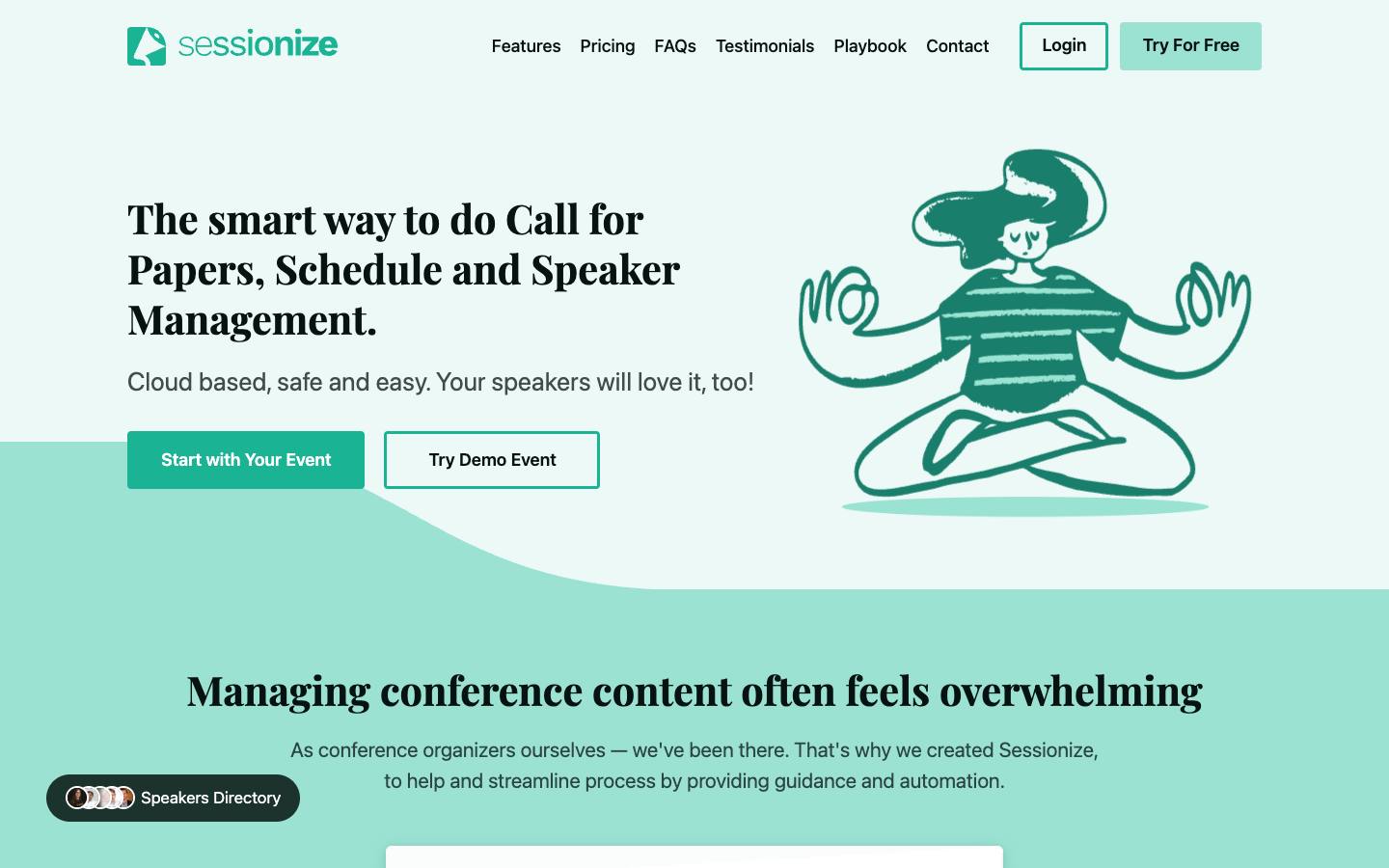
Sessionize is a Zagreb, Croatia tool, founded in 2017, that runs the call for speakers, session evaluation, speaker management and a drag-and-drop schedule builder. It says 12,200 events and 317,000 speakers have used it, with 1,195,000 sessions submitted from 137 countries, so many tech speakers already have a profile.
More on SessionizeLess on Sessionize
Founded: 2017 · HQ: Zagreb, Croatia · Team: 2-10 people · Formats: In-person, Virtual, Hybrid
Pricing is per event and published (checked October 2026): free for non-commercial community events, $499 plus tax per professional event occurrence with every feature and priority email support, and bulk activation codes quoted for organizers running five or more events a year. A fully functional test mode needs no credit card. Evaluation offers Yes/No, Comparison and Stars modes, and Anonymous mode hides speaker names, photos, bios and custom speaker fields from chosen evaluators, swapping the name for a made-up one.
After selection, organizers notify accepted and declined speakers, send unlimited mailings and surveys, and let speakers maintain their own profiles. The schedule builder publishes an embeddable agenda or a JSON and XML feed for websites and apps, plus a web and mobile schedule app for attendees, and a public directory of 87,000 speaker profiles helps with recruiting. Named users include Microsoft, JetBrains, NDC Conferences, DeveloperWeek, droidcon and Webflow. The gaps are no native CRM or marketing automation connectors, no registration or ticketing, and no security certifications listed beyond GDPR and a data processing addendum.
- Schedule embed plus JSON and XML feeds
What stands out
- $499 per professional event, free for community events
- Anonymous mode for blind evaluation
- Yes/No, Comparison and Stars voting modes
Worth checking
- No CRM or registration integrations
- No security certifications listed
Best suited for. Sessionize fits developer conferences, user groups and B2B events that want a proven CFP and schedule beside their existing registration tool. Producers running a portfolio that needs a speaker CRM and native platform connectors should look at Sessionboard.
2. Sessionboard, best for commercial conference producers that need a speaker CRM and connectors to their event platform
- Price
- Quote only
- Languages
- English, German, Spanish, French
- Syncs with
- Salesforce, HubSpot
- Security
- SOC 2 Type II, SAML SSO, DPA
- Customers include
- Diversified, Nonprofit Marketing Summit (Community Boost), Northwest Event Show
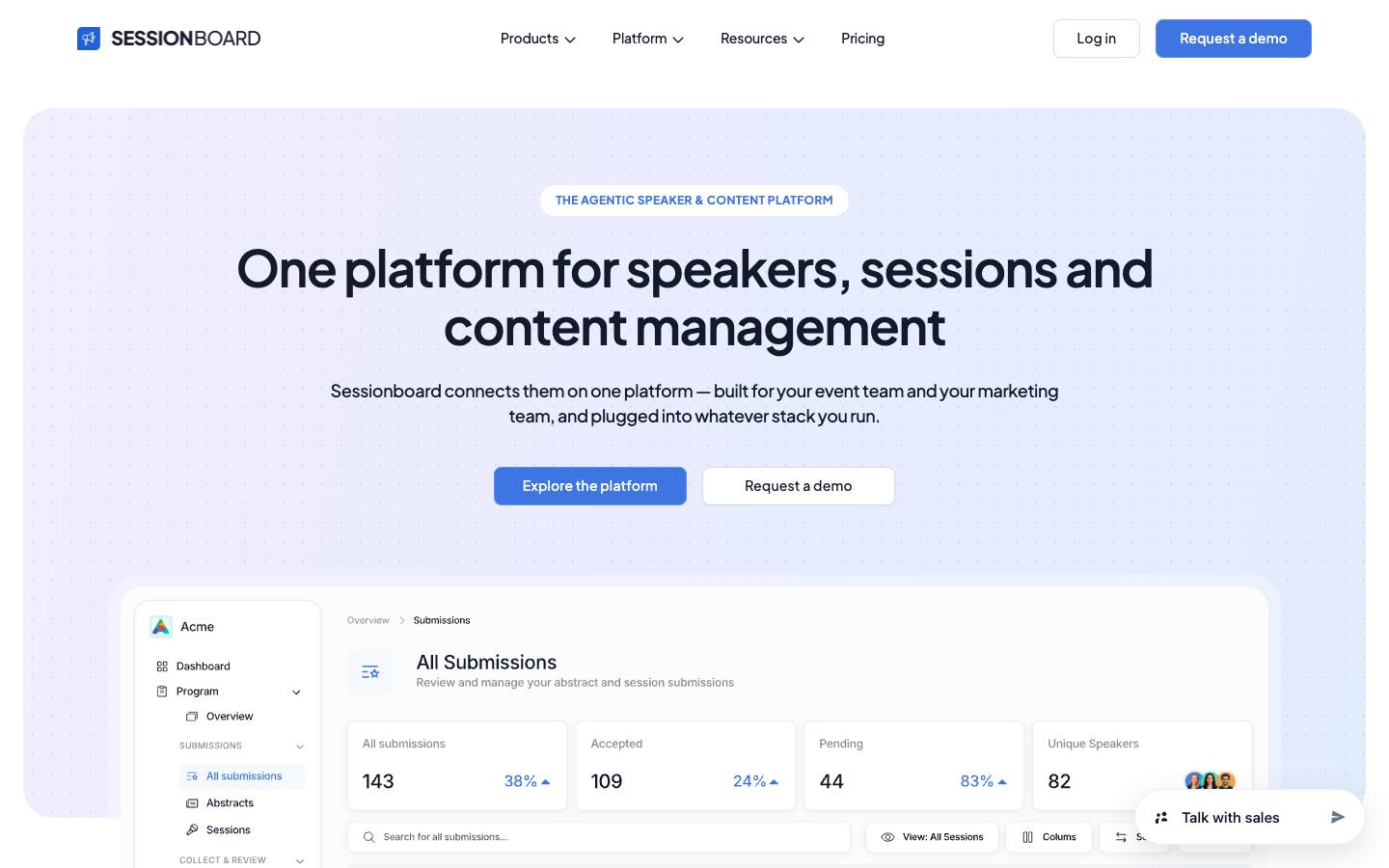
Sessionboard, founded in 2022 in Atlantic Beach, Florida, manages the content side of commercial conferences: call for papers and grading, speaker records and branded portals, agendas and awards, all on one record that links speakers to sessions and published content. It says more than 250 teams have managed over 44,000 sessions on it.
More on SessionboardLess on Sessionboard
Founded: 2022 · HQ: Atlantic Beach, Florida · Team: 11-50 people · Formats: In-person, Virtual, Hybrid, Webinar
AI agents for reviewing, scheduling and coordinating are live, including AI evaluators that help automate session selection, and a cross-event speaker CRM tracks speakers across a portfolio. Its integration catalog is the broadest among speaker tools in our data: registration platforms such as Cvent, Bizzabo, Stova, Swoogo, RainFocus and Accelevents; Salesforce and HubSpot on the Enterprise level; AMS tools including iMIS, Fonteva and Nimble AMS; ON24, Zoom and Wordly; plus Zapier, a REST API with webhooks and an MCP server.
Pricing is quoted (checked October 2026). Pro covers a single event with the speaker CRM, speaker and content management, live transcription and brand kits, and Enterprise covers a portfolio with reporting, AI agents and CRM integrations. Named customers include Google, Informa, Emerald, Questex, Clarion Events, the Financial Times, Dynatrace and AVIXA, and the interface works in English, German, Spanish and French. It isn't a registration system, so it runs beside one, and published security documentation is limited to GDPR and CCPA statements.
- REST API, webhooks and an MCP server
What stands out
- Cross-event speaker CRM
- AI agents for review, scheduling and coordination
- Connectors for Cvent, Bizzabo, Swoogo, Salesforce and iMIS
Worth checking
- No published prices
- CRM integrations sit on the Enterprise level
Best suited for. Sessionboard fits commercial producers and associations running several conferences a year on an established registration platform. A single community conference will get what it needs from Sessionize or pretalx for far less.
3. Lineup Ninja, best for B2B exhibition organizers running multi-stream programs across many shows
- Price
- From £2,900/year
- Languages
- English
- Security
- DPA
- Customers include
- Easyfairs, Association of Equipment Manufacturers (ConExpo-Con/Agg), Closerstill Media
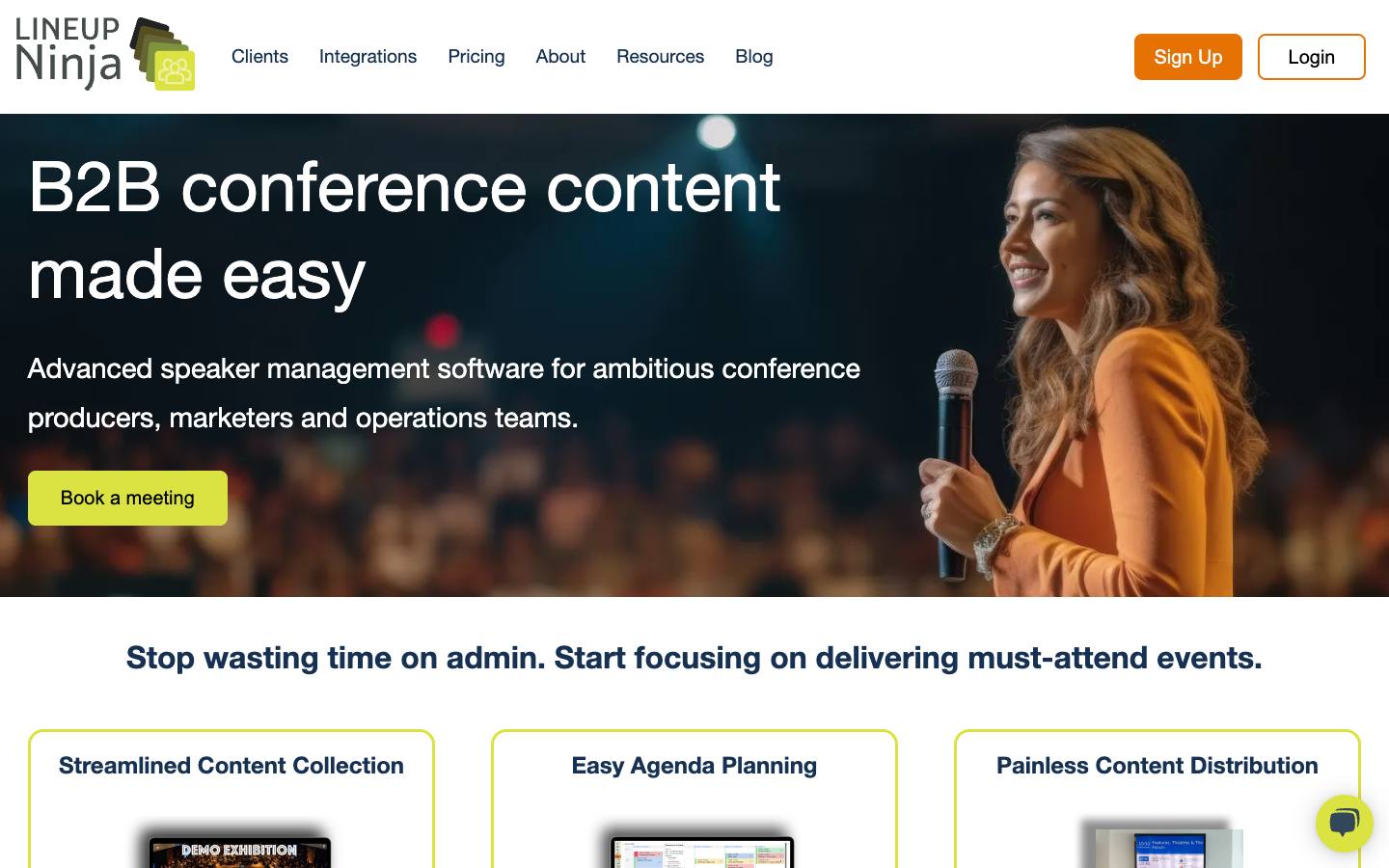
Lineup Ninja is a Leeds, UK tool, founded in 2017, for collecting speaker submissions, reviewing them and building multi-stream conference agendas, then pushing content to websites, apps and signage. It's used heavily by B2B exhibition and conference organizers such as Clarion Events, CloserStill Media, Easyfairs, Diversified Communications and Nineteen Group.
More on Lineup NinjaLess on Lineup Ninja
Founded: 2017 · HQ: Leeds, United Kingdom · Team: 2-10 people · Formats: In-person, Hybrid, Virtual
Pricing is published (checked October 2026): an annual license is £2,900 per team with unlimited events and about 100 speakers a year, and overages aren't charged but are reviewed at renewal. A submission and review only option suits awards that don't need agenda tools. Extras are priced separately: onboarding and event setup at £500, recommended for the first event, training at £500 a day, configuring an existing integration at £250, and bespoke integrations or features at £1,000 a day. Integration support and configurable review flows sit on the Professional support tier.
Connectors focus on where content goes next: event apps and platforms such as Swapcard, Grip, Guidebook, Swoogo, Entegy and ExpoPlatform, show tools such as Map Your Show and ExpoFP, and Zapier and Make for anything else. White labelling covers a custom domain for the call for papers, speaker confirmation, the agenda app and emails. There's no CRM or marketing automation connector, registration needs another platform, and no security certifications are published on the site.
- Submission and review only option for awards
What stands out
- £2,900 a year with unlimited events
- Connectors for Swapcard, Grip, Swoogo and Map Your Show
- Content pushed to websites, apps and signage
Worth checking
- Integration setup and onboarding cost extra
- No published security certifications
Best suited for. Lineup Ninja fits exhibition and conference organizers running several shows a year with multi-stream content programs. A single conference with one call will find Sessionize or Speaker Dream cheaper.
4. pretalx, best for community and developer conferences that want open-source CFP software with anonymous review
- Price
- From €199/event
- Try it
- Free plan, Free trial
- Languages
- English, German, Multi-language email templates and talk languages
- Security
- DPA
- Customers include
- JuliaCon, MozFest, PyCascades
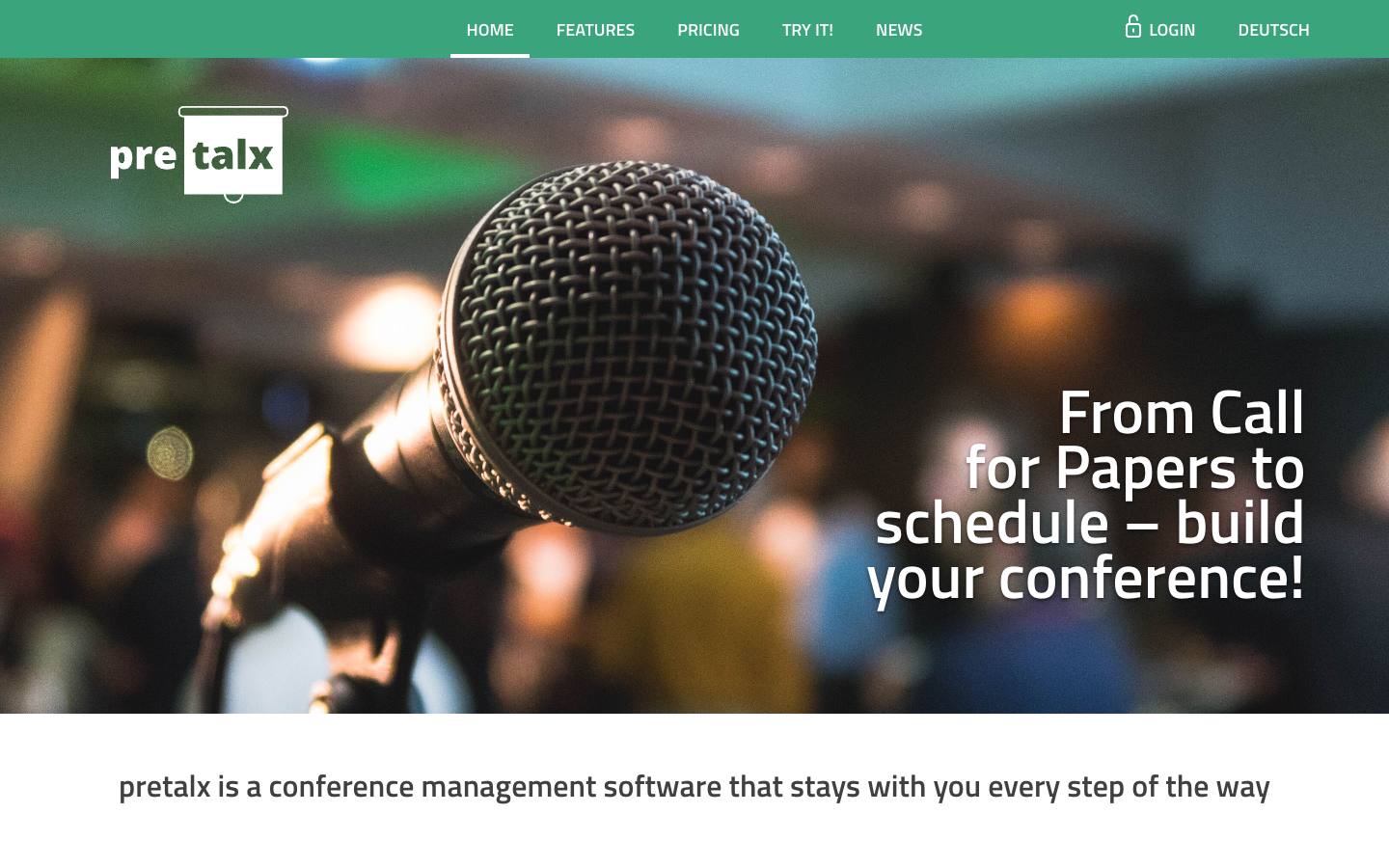
pretalx is open-source conference content software from Weinheim, Germany that handles the call for papers, review, speaker communication and schedule publishing. It can be self-hosted with no license fee or used as a hosted service at pretalx.com, and it's popular with developer and community conferences such as PyCon UK and JuliaCon.
More on pretalxLess on pretalx
HQ: Weinheim, Germany · Formats: In-person, Virtual, Hybrid
Hosted pricing is per event, calculated from expected attendees and the standard ticket price, and you only pay once the event goes public, so evaluation is free (checked October 2026). Volunteer-run non-profit events can get up to 25% off, and the fee is adjusted if attendance or ticket prices change by more than 20%. Self-hosting costs only your time and servers, with paid support contracts available.
Reviews can be anonymous, hiding submitter names and biographies from reviewers in both the interface and the API, and review phases can start blind and open up after a set date. Custom reviewer questions help sort talks by track or level and work against reviewer bias. Speaker emails use configurable templates in several languages and wait in an outbox for checking, and the scheduler warns about speaker conflicts, then publishes a schedule with an RSS feed, a public changelog and a static export. A REST API and plugins replace named connectors, so there's no CRM or Zapier link, and registration needs a separate tool. A stored XSS flaw (CVE-2026-41241) was disclosed and patched in 2026, so self-hosters should keep up with updates.
- Multilingual email templates with an outbox
What stands out
- Open source, free to self-host
- Anonymous review phases
- Pay only when the event goes public
Worth checking
- No named CRM or registration connectors
- Very small operator for enterprise procurement
Best suited for. pretalx fits developer, open-source and community conferences that want a transparent CFP and are comfortable with an API instead of connectors. Corporate teams that need vendor security paperwork and native platform links should look at Sessionboard or their event platform's CFP.

5. Speaker Dream, best for small organizers that want a free CFP and a low annual price for up to 12 events
- Price
- From $1,499/year
- Try it
- Free plan
- Languages
- English
- Customers include
- Community Week
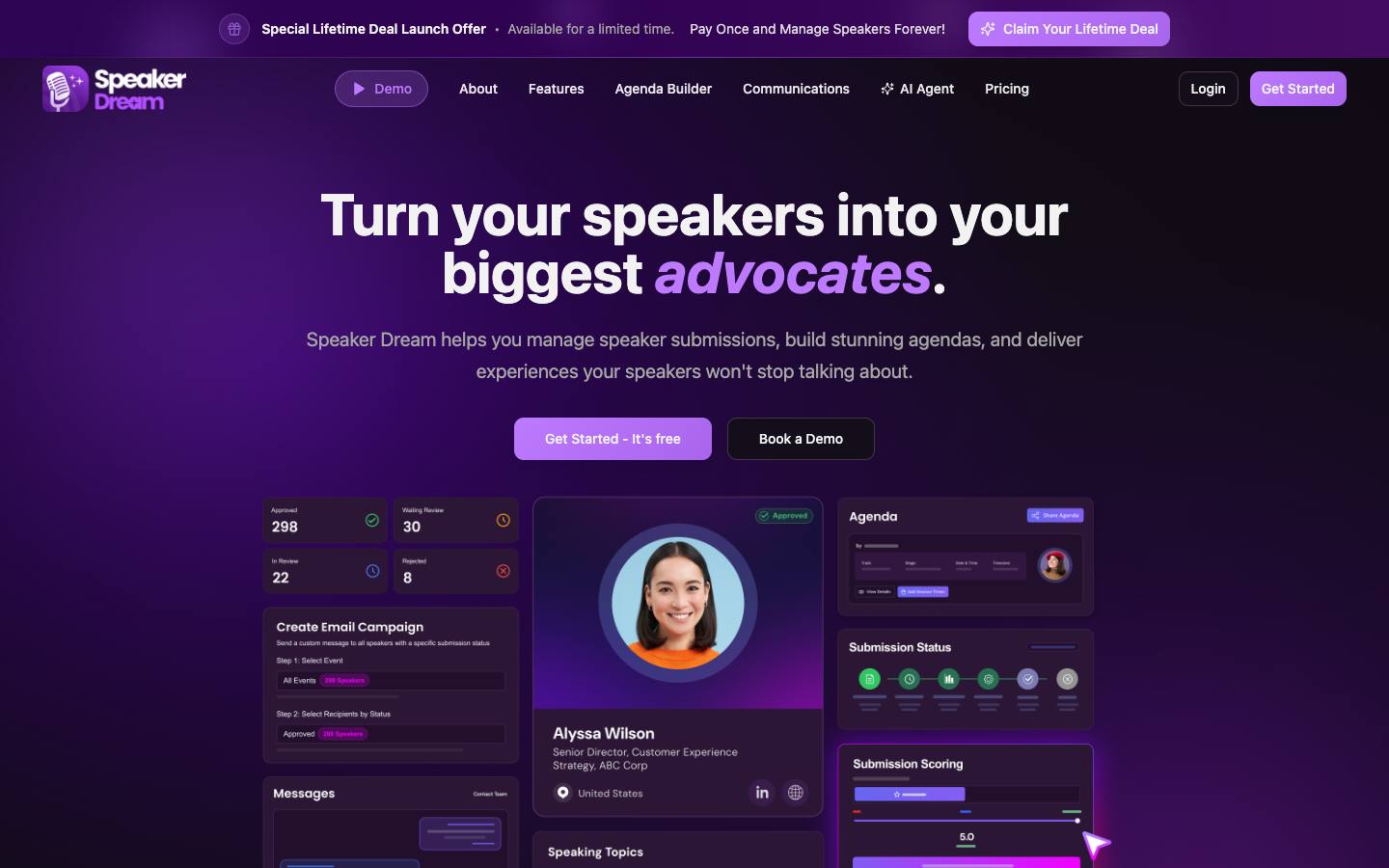
Speaker Dream is a UK speaker management platform from Norwich covering call for papers, multi-reviewer scoring, a drag-and-drop agenda builder, a speaker CRM and portal, messaging and speaker asset collection. It also includes a conversational AI agent for setting up events and agendas, and it was started by the organizer of London and Toronto Community Week.
More on Speaker DreamLess on Speaker Dream
HQ: Norwich, United Kingdom · Formats: In-person
Pricing is published in USD (checked October 2026). Starter is free for one admin and one event with call for papers, custom forms and fields, session scoring, unlimited reviewers and speakers, a basic agenda builder and 1,000 one-time email credits. Professional is $1,499 a year, or a $2,999 one-time lifetime deal, for 12 events and up to five admins, adding the drag-and-drop agenda builder, performance analytics, custom branding and domain, and 100,000 email credits a year. Enterprise starts at $10,000 with unlimited admins, a dedicated instance for data residency, custom integrations and an SLA.
The free plan is enough to run a real call for a single meetup or community conference, which makes it a low-risk way to try a dedicated CFP tool. The trade-offs are maturity and paperwork: the only named customer is the founder's own event series, no native integrations or API are listed outside Enterprise custom work, no security or GDPR documentation is on the site, and the product lists in-person events only. Support is email with a 72-hour response on Starter and chat and email within 24 hours on Professional.
- AI agent for event and agenda setup
What stands out
- Free plan with unlimited reviewers and speakers
- $1,499 a year for 12 events
- Speaker CRM, portal and asset collection
Worth checking
- Early-stage vendor with few named customers
- No integrations or security documentation outside Enterprise
Best suited for. Speaker Dream fits small teams and community organizers running a handful of events a year who want a full speaker workflow on a small budget. Teams that need connectors to registration platforms or a security review should look at Sessionboard or Lineup Ninja.

6. ProposalSpace, best for trade associations that want to pay per call and per proposal with no subscription
From $8.50/submission
- Price
- From $8.50/submission
- Languages
- English, Spanish, French
- Customers include
- American Council on Consumer Interests, American Holistic Nurses Association, Associated General Contractors
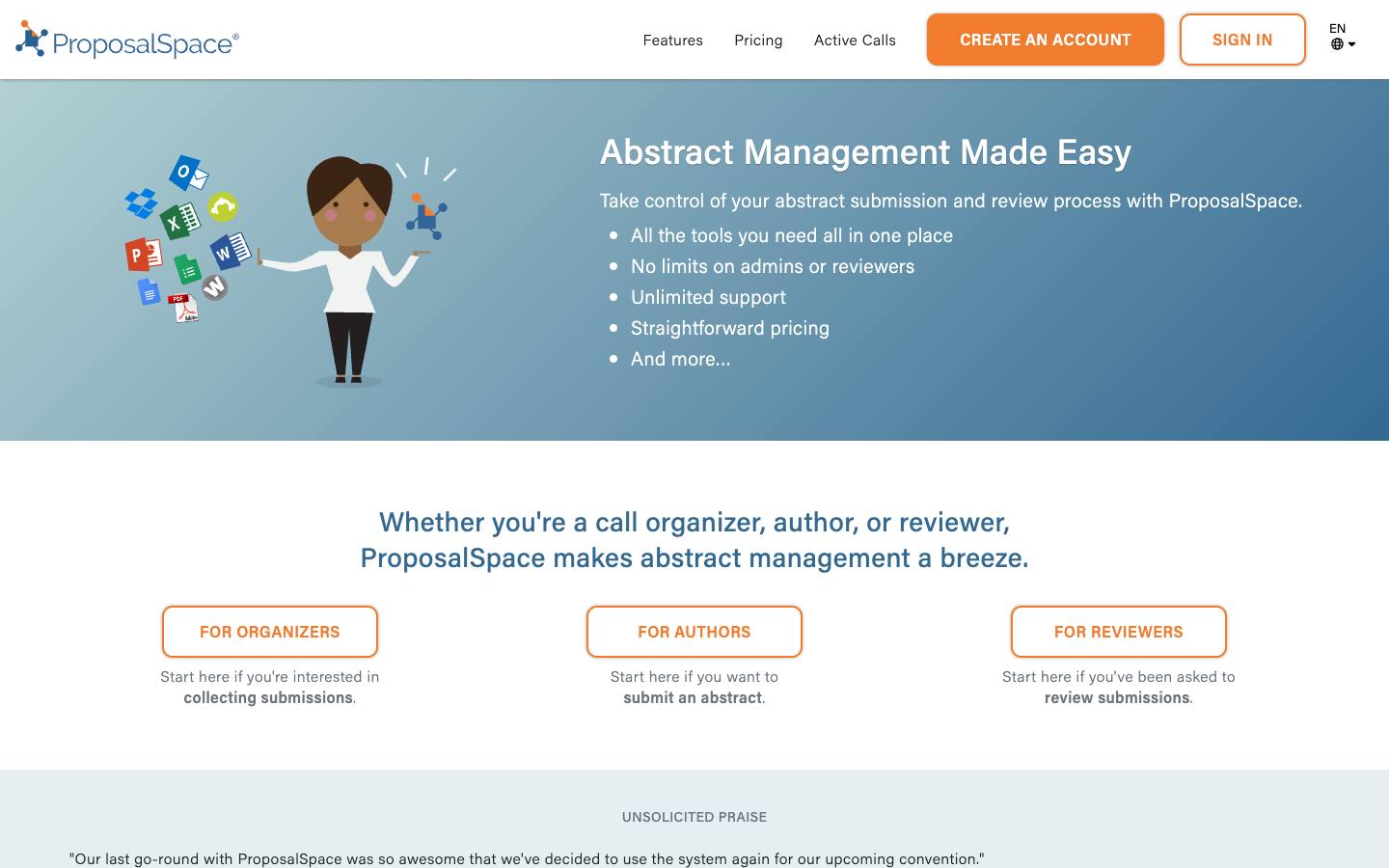
ProposalSpace is a hosted call-for-proposals tool from Austin, Texas, founded in 2008, that collects session and abstract submissions, routes them to reviewers, and supports scheduling and publishing accepted sessions. Its customers are mostly US trade associations and education conferences, such as the National Electrical Contractors Association, Associated General Contractors and the Irrigation Association.
More on ProposalSpaceLess on ProposalSpace
Founded: 2008 · HQ: Austin, TX · Formats: In-person, Virtual, Hybrid
Pricing is usage-based and published (checked October 2026). Activating a call costs $250 for one year and includes the review and messaging modules, basic scheduling, an activity tracker and a data export tool. Each submission approved for review costs $8.50, charged once, so resubmitted proposals aren't billed again. Optional modules cost $75 each per call: a custom review form, advanced scheduling, a publishing module that embeds accepted sessions on your site, and custom receipts. Authors use it free, there are no setup, maintenance or storage fees, and no discounts are offered.
The standard review form includes a conflict question, a 0 to 10 scale and comments, and organizers can build and test a call before paying. Phone and email support is unlimited, and the interface is available in English, Spanish and French. As a worked example, a 200-proposal call with two optional modules would cost $250 plus $1,700 plus $150, or $2,100. It covers proposals only, with no registration or attendee tools, and no integrations or security details are published, so data leaves through exports or the publishing embed.
- Unlimited phone and email support
What stands out
- $250 per call plus $8.50 per approved submission
- Free for authors, no setup or storage fees
- Build and test a call before paying
Worth checking
- Costs grow with submission volume
- No integrations or security details published
Best suited for. ProposalSpace fits trade and professional associations that run one education call a year and want simple, predictable pricing. Organizers who need agenda apps, speaker portals or platform connectors should compare Sessionize or Lineup Ninja.

7. RainFocus, best for enterprise tech companies running a flagship user conference with thousands of submissions
Quote only
- Price
- Quote only
- Capterra
- 4.0/5 from 1 reviews
- App Store
- 5.0/5 from 5 ratings
- Syncs with
- Salesforce, HubSpot, Marketo
- Security
- SOC 2 Type II, ISO 27001
- Customers include
- Autodesk, Trimble, Ellucian
RainFocus is a Lehi, Utah event marketing platform, founded in 2013, built for enterprise B2B companies running large flagship conferences. Its content management covers the speaker call for papers, session review and scoring, speaker enablement and an attendee-facing session experience, on the same attendee data as registration and pipeline reporting.
More on RainFocusLess on RainFocus
Founded: 2013 · HQ: Lindon, Utah · Team: 201–500 people · Formats: In-person, Virtual, Hybrid, Webinar
Session reviewers vote live to accept or reject sessions, share comments and send responses inside the platform, replacing the spreadsheets that large conferences often use for big submission volumes. Accepted content then feeds a guided attendee experience with filters, session lists and targeted agendas. RainFocus runs some of the largest tech user conferences, and named customers include Adobe, Cisco, Oracle, Red Hat, Broadcom, NetApp, ServiceNow, Zscaler and RSA Conference. It's an Adobe Platinum partner with a dedicated Salesforce app, and it lists Marketo Engage, Eloqua and HubSpot among the 40-plus connectors it cites.
Pricing isn't published and is set through sales (checked October 2026). RainFocus documents SOC 2, ISO 27001:2022, PCI DSS and a VPAT, which helps with enterprise procurement. It's backed by JMI Equity and KKR and was named a Leader in Forrester's 2026 evaluation of virtual event management platforms. The CFP is part of a full platform, so it only makes sense if you also run registration and the attendee experience on RainFocus, and it's more than smaller teams need.
- SOC 2 and ISO 27001:2022 documented
What stands out
- Live reviewer voting with comments and responses
- Same data model as registration and pipeline reporting
- Salesforce app and Marketo, Eloqua and HubSpot connectors
Worth checking
- No published prices; enterprise budgets
- Only worth it as part of the full platform
Best suited for. RainFocus fits enterprise software and technology companies whose flagship conference draws thousands of session submissions and feeds pipeline reporting. Teams that only need a CFP for one event should use Sessionize, Sessionboard or Lineup Ninja.
8. Cvent, best for teams already on Cvent that want submissions to publish straight to the agenda
Quote only
- Price
- Quote only
- Capterra
- 4.5/5 from 1,099 reviews
- App Store
- 4.8/5 from 40,670 ratings
- Languages
- Support offered in 12 languages; event sites support multiple languages via language management
- Syncs with
- Salesforce, HubSpot, Dynamics, Marketo
- Security
- SOC 2 Type II, ISO 27001, DPA
- Customers include
- 6sense, Cognizant, Purdue University
Cvent, based in Tysons Corner, Virginia, offers Abstract Management as part of its event cloud, collecting session proposals, abstracts, papers, awards, nominations and scholarships with full speaker details through custom, mobile-friendly forms. Its workflow runs in four stages, Collect, Review, Decide and Publish, and accepted submissions become sessions on the event agenda.
More on CventLess on Cvent
Founded: 1999 · HQ: Tysons Corner, Virginia · Team: 5,001-10,000 people · Formats: In-person, Virtual, Hybrid, Webinar
Reviewers get a dedicated portal to rate, comment and leave notes, with submissions assigned by track, topic or expertise and scored against planner-defined criteria, and scores, votes and comments update in real time. Planners accept or decline individually or in bulk and send decisions from configurable email templates. Accepted sessions publish to the agenda and open for registration through Cvent Event Management, and Cvent's Speaker Resource Center is used alongside it to coordinate speakers after acceptance. Cvent integrates natively with Salesforce, Marketo Engage, HubSpot, Microsoft Dynamics and Eloqua.
Pricing is quote-based (checked October 2026): products are licensed individually under a Professional tier with 15 user logins or an Enterprise tier with unlimited users, API access and SSO. Cvent's compliance portfolio is the deepest here, including SOC 2 Type II, ISO 27001, PCI DSS Level 1 and audited WCAG conformance, and Cvent Event Management holds a 4.48 rating from 1,099 Capterra reviews. It's priced and built for teams already running events on Cvent, so a standalone CFP for one conference is cheaper with a dedicated tool.
- SOC 2 Type II, ISO 27001 and PCI DSS Level 1
What stands out
- Collect, Review, Decide and Publish workflow
- Reviewer routing by track, topic or expertise
- Accepted sessions publish to the Cvent agenda
Worth checking
- Quote-based, modular licensing
- Blind review isn't described on the product page
Best suited for. Cvent fits corporate and association teams whose registration, agenda and app already run on Cvent and who want submissions on the same record. Teams on another platform will get more CFP depth per dollar from Sessionboard or Sessionize.

9. Stova, best for corporate event teams that want calls for speakers inside a platform with published package prices
From $1,995
- Price
- From $1,995
- Capterra
- 4.3/5 from 81 reviews
- App Store
- 2.3/5 from 12 ratings
- Languages
- Multi-language registration supported (languages not listed)
- Syncs with
- Salesforce, HubSpot, Marketo
- Security
- ISO 27001, SAML SSO, DPA
- Customers include
- Databricks, Villanova University, Workday
Stova, formed in 2022 from Aventri, MeetingPlay and eventcore and based in Bluffdale, Utah, is an end-to-end event platform whose session and speaker tools include abstracts and calls for speakers, speaker management and agendas. It serves corporate event teams, associations and agencies running conferences, sales kickoffs and field programs.
More on StovaLess on Stova
Founded: 2022 · HQ: Bluffdale, Utah · Team: 201-500 people · Formats: In-person, Virtual, Hybrid, Webinar
Unusually for a full platform, Stova publishes package prices (checked October 2026): Core is $1,995 plus registration fees from $3.00 each, Pro is $5,995 plus from $4.50 per registration with a branded app, broadcast studio and SSO, and Enterprise is $12,995 plus from $5.60 per registration with premium integrations and exhibitor tools. Abstracts are listed as a Core feature, so the content workflow comes with the entry package, although the base fee period isn't stated on the page.
Because submissions live in the same platform as registration, accepted speakers can flow into the agenda, app and badges without exports. Stova integrates natively with Salesforce, Marketo, HubSpot and Eloqua, plus Interprefy for interpretation and an open API with webhooks. Named customers include Disney, Cisco, DHL, HSBC, Nokia, RX and MCI, and Stova holds a 4.26 rating from 81 Capterra reviews. Per-registration fees mean cost scales with attendance, and security certifications aren't listed on its public site, so request documentation during evaluation.
- Speakers flow into agenda, app and badges
What stands out
- Published packages from $1,995 plus $3.00 per registration
- Abstracts included from the Core package
- Native Salesforce, Marketo, HubSpot and Eloqua
Worth checking
- Cost scales with registrations
- Security certifications not listed publicly
Best suited for. Stova fits corporate event teams that want the CFP, registration and app on one platform with a published starting price. If you already have a registration platform you like, a standalone tool such as Sessionboard or Sessionize is simpler.

10. Whova, best for conferences that want blind speaker review and an attendee app from the same vendor
Quote only
- Price
- Quote only
- Try it
- Free trial
- Capterra
- 4.8/5 from 2,493 reviews
- App Store
- 4.8/5 from 252,682 ratings
- Syncs with
- HubSpot
- Security
- SOC 2 Type II
- Customers include
- University of New South Wales, Sunway University, Air Force Civil Engineering Center
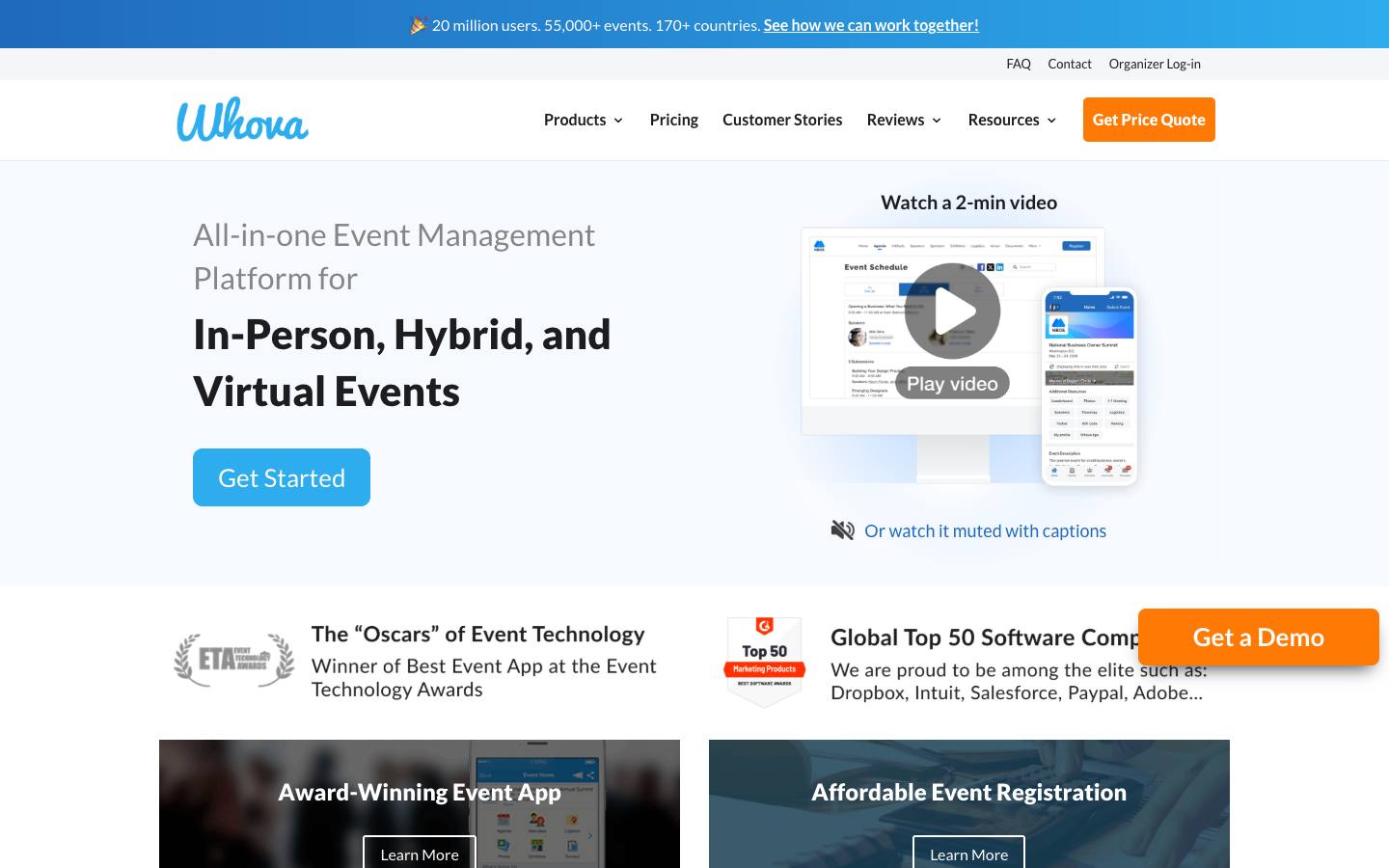
Whova, a San Diego company founded in 2012, combines an attendee app with registration, a website builder, call for speakers and abstract management, exhibitor tools, badges and virtual delivery. Its call for speakers runs on a branded submission site with custom forms, and accepted submissions turn into sessions in the event app and agenda without exports.
More on WhovaLess on Whova
Founded: 2012 · HQ: San Diego, California · Team: 51-200 people · Formats: In-person, Virtual, Hybrid
Reviewers can be assigned by topic, at random or manually, with conflict-of-interest detection, custom rubrics, ratings and comments, and the platform supports single or double-blind review. Organizers track progress, send reminders, filter with labels, and accept or reject individually or in bulk with personalized notifications, and several submission portals can run at once in one event. Accepted speakers land in the speaker management center, the app and the speaker webpage automatically, and logins with two-factor authentication protect submissions and reviews.
Pricing is quote-based, built from format, length, attendee count and events per year, with a trial after a short demo (checked October 2026). Whova holds a 4.8 rating from 2,493 Capterra reviews, and its attendee app a 4.8 from more than 250,000 App Store ratings. It documents SOC 2 Type II and PCI DSS, and named customers include Google, Microsoft, Oracle, American Express and Hilton. Integrations include HubSpot, iMIS, Zoom and Zapier, but no Salesforce or Marketo connector is listed, so check how speaker and attendee data reaches your CRM.
- 4.8 from 2,493 Capterra reviews
What stands out
- Single or double-blind review with conflict detection
- Accepted sessions flow into the app and agenda
- Several submission portals in one event
Worth checking
- No published prices
- No Salesforce or Marketo connector listed
Best suited for. Whova fits associations, academic-leaning and corporate conferences that want fair, blind speaker review plus a well-rated attendee app from one vendor. Teams keeping their current event app should use a standalone tool such as Sessionize or Sessionboard.

11. PheedLoop, best for associations and small teams that want multi-round proposal review in an affordable all-in-one platform
$950/yr (core platform)
- Price
- $950/yr (core platform)
- Capterra
- 4.7/5 from 10 reviews
- App Store
- 2.1/5 from 7 ratings
- Languages
- 14+ languages natively, including English, French and Spanish
- Customers include
- BT, Canadian Chamber of Commerce, Canadian Special Events
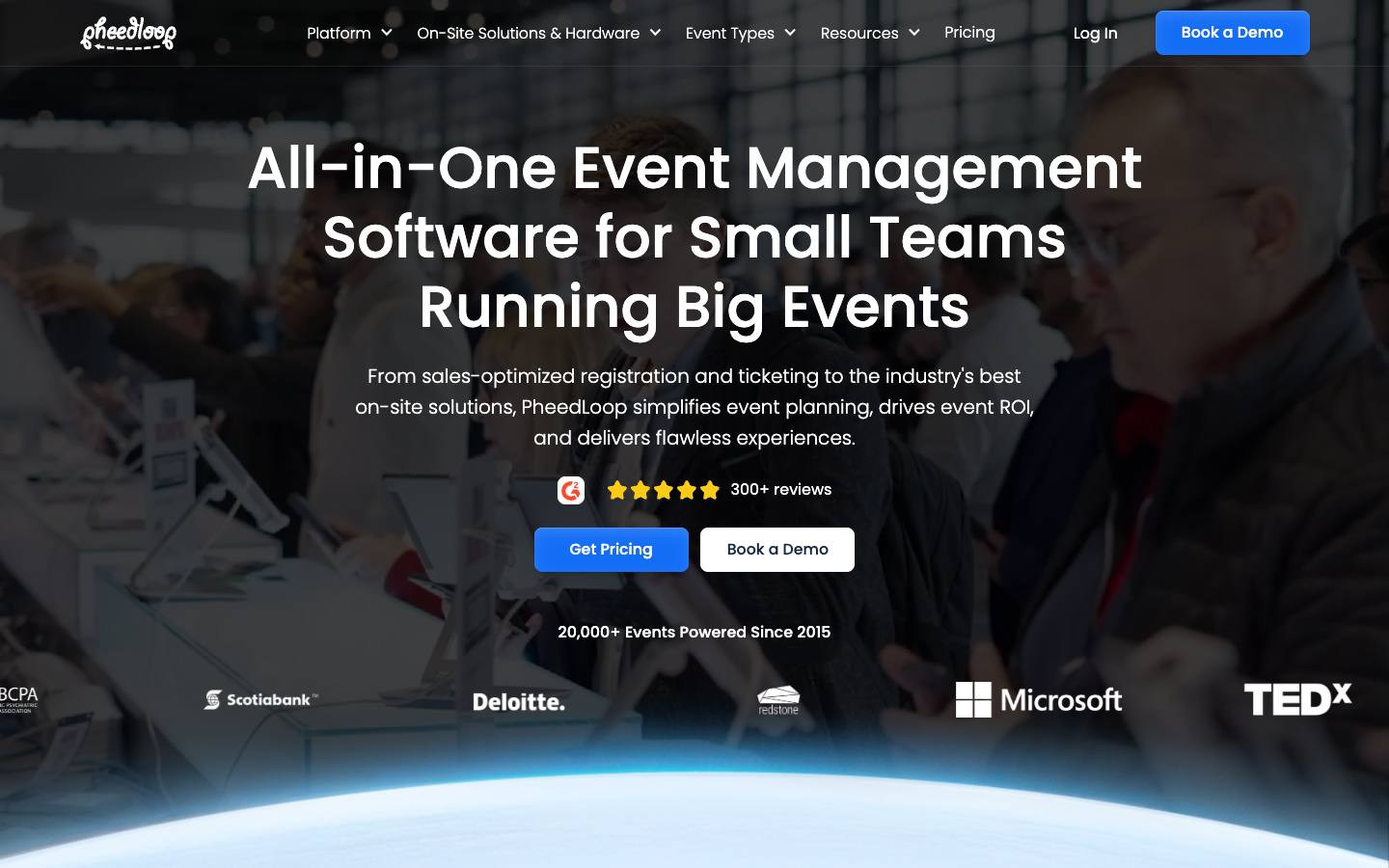
PheedLoop is a Toronto event management platform, founded in 2015, covering registration, websites, exhibitors and sponsors, speaker and abstract handling, mobile apps and onsite check-in. Its call for abstracts gives applicants private portals to update their own submissions and manage co-presenters, with speaker contracts set up in the same place.
More on PheedLoopLess on PheedLoop
Founded: 2015 · HQ: North York (Toronto), Ontario · Team: 11-50 people · Formats: In-person, Virtual, Hybrid
Review panels can be assembled with auto-assign to spread proposals evenly across reviewers, incomplete entries are tracked, and multi-round reviews let reviewers comment in real time while program chairs follow each proposal through the stages. Accepted speakers flow into the same platform's agenda, website and app, so there's no export between a CFP tool and the event platform. PheedLoop supports more than 14 languages natively, which helps bilingual Canadian and international events.
Pricing starts at $950 a year for the core platform, with additional modules from $1 per attendee and an onsite bundle of two kiosks and a printer from $600, and exact pricing depends on modules, attendee count and event type (checked October 2026). PheedLoop holds a 4.7 rating from 10 Capterra reviews, and named customers include TRREB, CSAE, SCWIST and the University of Western Ontario. Native integrations are limited to Zapier, an open API and Zoom, with no direct CRM connector, and no security certifications are listed on the public site.
- 14-plus languages natively
What stands out
- Core platform from $950 a year
- Multi-round review with auto-assign
- Private applicant portals and speaker contracts
Worth checking
- No native CRM connector
- No security certifications listed publicly
Best suited for. PheedLoop fits associations, nonprofits and lean corporate teams that want calls for speakers, registration and an app on one affordable platform. Large B2B producers needing Salesforce or HubSpot sync should look at Stova, Cvent or Sessionboard.
Picks 6 to 11 are folded to keep the list short. Open any of them, or compare them all in the table above.
Also worth considering
Zealous, Reviewr, SpeakerStacks, Grenadine, EventsAir, OpenConf, Oxford Abstracts
The best call for papers software by use case
| If you need | Company size | Look at |
|---|---|---|
| Developer conference with 600 talk pitches and a volunteer committee | Startup, Mid-market | Sessionize$499 an event with Anonymous mode |
| Media company running 20 industry conferences on Cvent and Bizzabo | Mid-market, Enterprise | Sessionboardspeaker CRM and native platform connectors |
| Exhibition organizer pushing content to Swapcard and signage | Mid-market, Enterprise | Lineup Ninja£2,900 a year, unlimited events |
| Open-source community conference that wants to self-host | Startup | pretalxfree to self-host, anonymous review |
| Trade association running one education session call a year | Startup, Mid-market | ProposalSpace$250 a call plus $8.50 a proposal |
| Software company flagship conference tied to Salesforce pipeline | Enterprise | RainFocusCFP on the same data as registration |
| Association conference that wants blind review and an attendee app | Startup, Mid-market | Whovasingle or double-blind review feeds the app |
| Corporate team already running registration on Cvent | Mid-market, Enterprise | Cventaccepted sessions publish to the agenda |
What results look like
Figures customers report in the vendors' own published case studies. They describe one customer each, not what every buyer should expect.
2,600
KubeCon Europe 2024 submissions
The Linux Foundation with Sessionize · Case study
13
Conferences run
Diversified with Sessionboard · Case study
134+
Events per year
Autodesk with RainFocus · Case study
3,000+
App downloads
Databricks with Stova · Case study
90%
App adoption rate
University of New South Wales with Whova · Case study
1,100+
Physical attendees
BT with PheedLoop · Case study
How to choose
Background on what these tools do, how we ranked them and what to check before you buy. Open any topic.
What call for papers software actually is (and what it isn't)
Call for papers software runs the speaker side of a conference program. It publishes a CFP page with a submission form, collects session titles, abstracts, formats, levels and speaker details, and lets a content team review, vote or score, often with speaker identities hidden. It then handles decisions and speaker emails, collects profiles, headshots and slides against deadlines, and publishes the accepted sessions as an agenda, an embed or a data feed for the event website and app. Most tools call the same thing a call for speakers or call for proposals.
It isn't abstract management software, which is built for formal peer review of research, with blind review rules, conflict-of-interest checks, posters, abstract books and proceedings for academic, medical and association meetings. It isn't an agenda builder either, although many CFP tools include one, and it's not registration or ticketing, which usually sits in a separate event platform. Awards and grants platforms use similar judging workflows but for entries, not talks.
For B2B event teams, it does four jobs: attract enough strong session pitches, help a content committee pick a fair and balanced lineup without spreadsheets, keep accepted speakers on schedule, and get the program onto the website and app quickly.
How we ranked these call for papers software tools
We checked each tool against the jobs a conference content team needs from a call for papers, using vendor pricing and product pages, documentation and our security research, checked in October 2026.
1. Submission forms and CFP page
Custom fields, multiple submission types or deadlines, co-speakers and a branded or embeddable CFP page, from vendor feature pages.
2. Review and anonymity
Voting or scoring modes, multiple review rounds and whether speaker identity can be hidden from reviewers, from product pages and documentation.
3. Speaker communication
Decision emails, bulk messaging, speaker portals or profiles and deadline tracking for bios, photos and slides, from vendor pages.
4. Agenda handoff
Whether accepted sessions publish to an agenda, embed, API feed or native connector for event apps and registration platforms.
5. Published pricing
Whether a price is published and what it includes, such as events, speakers or submissions, from vendor pricing pages.
More on our process in the methodology.
What to look for in call for papers software
Start with the submission side: a branded CFP page or embed, custom fields for format, level, track and audience, co-speakers, and more than one deadline or submission type. Then check review: voting modes, scoring rubrics, multiple rounds and whether you can hide speaker identity from reviewers, as Sessionize's Anonymous mode, pretalx and Whova do.
After acceptance, look at speaker management: decision emails, bulk messaging, a portal or profile where speakers update bios and headshots, deadline tracking for slides, and travel or contract details if you need them. Finally, check the agenda handoff: does the tool publish a schedule embed, a JSON or API feed, or a native connector to your registration platform and event app?
What call for papers software costs
Dedicated tools publish prices more often than platforms (checked October 2026). Sessionize is free for community events and $499 per professional event. ProposalSpace charges $250 per call plus $8.50 per approved submission and $75 per optional module. Speaker Dream is free for one event, then $1,499 a year for 12 events, and Lineup Ninja is £2,900 a year per team with unlimited events plus £500 onboarding. pretalx hosting is priced per event from attendees and ticket price and is free to self-host.
Platforms bundle the CFP with registration: Stova starts at $1,995 plus $3.00 per registration with abstracts included, and PheedLoop's core platform starts at $950 a year. Sessionboard, RainFocus, Cvent and Whova quote. Watch for per-submission fees on big calls, paid integration setup and speaker caps.
Call for papers software vs abstract management software
Both collect submissions and run review, but they serve different programs. Call for papers software is built for B2B, tech and industry conferences choosing speakers from session pitches: fast voting, speaker profiles, deadlines, agenda publishing and connectors to event apps. Abstract management software, covered in our abstract management software guide, is built for peer-reviewed research at academic, medical and association meetings: formal blind review, conflict-of-interest rules, revise-and-resubmit, posters, abstract books and proceedings.
If you're picking talks for a user conference or industry summit, stay with the tools here. If reviewers are judging research and you need an abstract book or CE credits, Oxford Abstracts, Fourwaves, Cadmium or X-CD fit better.
Questions to ask call for papers vendors
Can reviewers score blind, and can we reveal speakers in a later round? Which voting or scoring modes are available, and can we weight scores by reviewer? How do we handle co-speakers, panels and speakers who submit several talks? What does the speaker see after acceptance, and can we track bios, headshots and slides against deadlines? How does the agenda reach our website, app and registration platform, by embed, API or native connector? Is pricing per event, per call, per submission or per year, and are there caps on speakers? What security and privacy documents can you share?
How to run a fair call for papers
Publish clear criteria before the call opens, such as audience relevance, originality, practical takeaways and speaker experience, and use a short scoring rubric with anchored scores. Hide speaker names and companies in the first round where your tool allows it, then reveal them to balance the lineup by track, level, industry and diversity. Flag thinly veiled product pitches early, give every reviewer a manageable load, and send decline emails with a short reason. Our free CFP review scorer skill can draft a rubric and reviewer packets to start from.
Where this fits in your event tech stack
Call for papers software sits between your content team and your event platform. Upstream, it collects pitches from a CFP page linked from the event website and promoted through email and social channels. Downstream, accepted sessions and speaker profiles flow to the registration platform (Cvent, Bizzabo, Swoogo or Stova), the event app (Swapcard, Grip or Whova) and the website agenda, either natively, as with Sessionboard and Lineup Ninja connectors, or through embeds and JSON feeds, as with Sessionize and pretalx. Speaker records can also sync to a CRM such as Salesforce or HubSpot, which matters when speakers are customers or prospects.
FAQ
What is a call for papers?
What does CFP mean?
How do you run a call for papers for a conference?
How much does call for papers software cost?
What's the difference between call for papers software and abstract management software?
How do you make CFP review blind?
Is there free call for papers software?
How does call for papers software connect to the event app and registration?
Pick the CFP tool that fits your program
Count how many pitches and events you run a year.
Decide whether review should be blind.
Check how the agenda reaches your website and app.
Compare the per-event, per-call and annual prices.
Then run a test call with your content team.
Ready? Build your shortlist in two minutes, or try the free cFP review scorer skill.
Get a free shortlistKeep reading
How-to guides
Key terms in this guide
Ratings link to their source and are shown as published on the date of our last check. Read our methodology.