Best Event Agenda Builder Software in 2027: The Buyer's Shortlist
By EventMarketingSoftware.com · Published October 18, 2026 · 12 tools compared
The best event agenda builder depends on how you run content. Sessionboard and Lineup Ninja suit B2B conference teams managing large speaker programs beside a separate registration platform. Sched is the agenda-first option with personal schedules built in. RainFocus, Cvent, Swoogo and Bizzabo cover agendas inside a full event platform, while Sessionize and pretalx keep costs low.
Our top picks
- 1
 SessionboardBest for B2B conference teams that want speakers, sessions and agenda on one record beside their registration platformQuote only
- 2
 Lineup NinjaBest for multi-stream B2B conference and exhibition programs that need auto-scheduling and a published annual priceFrom £2,900/year
- 3
 SchedBest for agenda-first conferences that want personal attendee schedules, a web and mobile app and registration in one toolFrom $50/month
Key takeaways
- Dedicated agenda tools sit beside your registration platform rather than replacing it. Sessionboard lists native connectors to Cvent, Bizzabo, Swoogo, RainFocus and dozens of other systems, and Lineup Ninja feeds Swoogo, Swapcard, Grip and Map Your Show.
- Eight of the 12 picks publish a price, checked October 2026. Sessionize charges $499 per professional event, pretalx's hosted service was €199 per event at default calculator inputs, Speaker Dream's Professional plan is $1,499 a year and Lineup Ninja's license is £2,900 a year per team. At the platform end, Swoogo starts at $11,800 a year, Bizzabo at $499 per user a month with a 3-user minimum, Sched's Launch plan lists at $100 a month billed annually (shown at $50 in a 50%-off promotion, checked October 2026) and Joi starts at A$50 a month.
- Free options exist but rarely fit marketing events. Sessionize is free only for non-commercial community events, Speaker Dream's free Starter covers one event, and pretalx is open source and free to self-host.
- Auto-scheduling is still rare. Lineup Ninja drafts an agenda from rules and Sessionboard lists AI scheduling agents, while most tools flag clashes and speaker availability as you place sessions by hand.
- Publishing matters as much as building. Sessionboard and Sessionize embed on your website, Sessionize and Joi offer data feeds, Lineup Ninja pushes to a web app and digital signage, and pretalx has a REST API, so a late change updates everywhere without copying.
Free tool: Run of show builder. Build a minute-by-minute run of show that re-times itself when you move or resize a segment, then export it as CSV or print it.
Side-by-side comparison
The same criteria for every pick: scheduling grid and clash checks, call for papers and review, speaker self-service, publishing options, registration platform connectors, published pricing. A dash means the vendor doesn't publish it.
| Tool | Starting price | Free plan / trial | CRM | Capterra | App Store | Security |
|---|---|---|---|---|---|---|
| Sessionboard | Quote only | – | Salesforce, HubSpot | – | – | SOC 2 Type II, SAML SSO, DPA |
| Lineup Ninja | From £2,900/year | – | – | – | – | DPA |
| Sched | From $50/month | Free trial | – | – | ★ 4.8 (4,309) | SOC 2 Type II, DPA |
| RainFocus | Quote only | – | Salesforce, HubSpot, Marketo | ★ 4.0 (1) | ★ 5.0 (5) | SOC 2 Type II, ISO 27001 |
| Cvent | Quote only | – | Salesforce, HubSpot, Dynamics, Marketo | ★ 4.5 (1099) | ★ 4.8 (40,670) | SOC 2 Type II, ISO 27001, DPA |
| Swoogo | From $11,800/year | – | Salesforce, HubSpot, Marketo | ★ 4.7 (82) | ★ 2.7 (75) | ISO 27001, SAML SSO, DPA |
| Bizzabo | From $499/user | – | Salesforce, HubSpot, Marketo | ★ 4.4 (171) | ★ 4.6 (14) | SOC 2 Type II, ISO 27001 |
| Sessionize | From $499/event | Free plan, Free trial | – | – | – | DPA |
| Grenadine | Quote only | Free trial | – | – | ★ 3.7 (3) | – |
| Speaker Dream | From $1,499/year | Free plan | – | – | – | – |
| pretalx | From €199/event | Free plan, Free trial | – | – | – | DPA |
| Joi | From AUD 50/month | Free trial | – | – | – | – |
An agenda builder is where a conference program gets made: sessions go into tracks, rooms and time slots, speakers get attached, clashes get caught, and the finished schedule is published to the event website, the attendee app and often onsite signage. The better tools also run the work around the grid, such as speaker portals that collect bios, headshots and slides, and attendee-facing agendas where people bookmark sessions to build their own schedule. This guide compares 12 products across three groups: dedicated speaker and agenda tools that sit next to your registration system, full event platforms with agenda modules, and low-cost tools for community and developer events. Every detail comes from our vendor profiles and the vendors' own pages, checked in October 2026.
Who this guide is for. This guide is for B2B event marketers, content and program managers, and conference producers who build multi-track agendas for user conferences, industry events, roadshows and trade show education programs. It's most useful if you manage dozens or hundreds of sessions, need speakers to supply their own content, and want one agenda that feeds your website, event app and registration platform without copying and pasting. If you only need a simple one-page agenda for an internal meeting, a template will do; the tools here are for programs where the schedule changes often and many people touch it.
Not sure which one fits your team?
Answer a few questions about your events, team and CRM and get a free shortlist of tools that fit, with pricing and security details side by side.
Get a free shortlistThe best agenda builder software in 2027
We compare 12 agenda builders, ordered by fit for the main job of B2B conference teams: building and publishing a multi-track program with many speakers. Dedicated speaker and agenda tools that sit beside your registration platform come first, then full event platforms with agenda modules, then lower-cost tools for community, developer and agency programs. For each pick, look at clash checks, how speakers supply content and how the agenda reaches your website, app and registration.
1. Sessionboard, best for B2B conference teams that want speakers, sessions and agenda on one record beside their registration platform
- Price
- Quote only
- Languages
- English, German, Spanish, French
- Syncs with
- Salesforce, HubSpot
- Security
- SOC 2 Type II, SAML SSO, DPA
- Customers include
- Diversified, Nonprofit Marketing Summit (Community Boost), Northwest Event Show
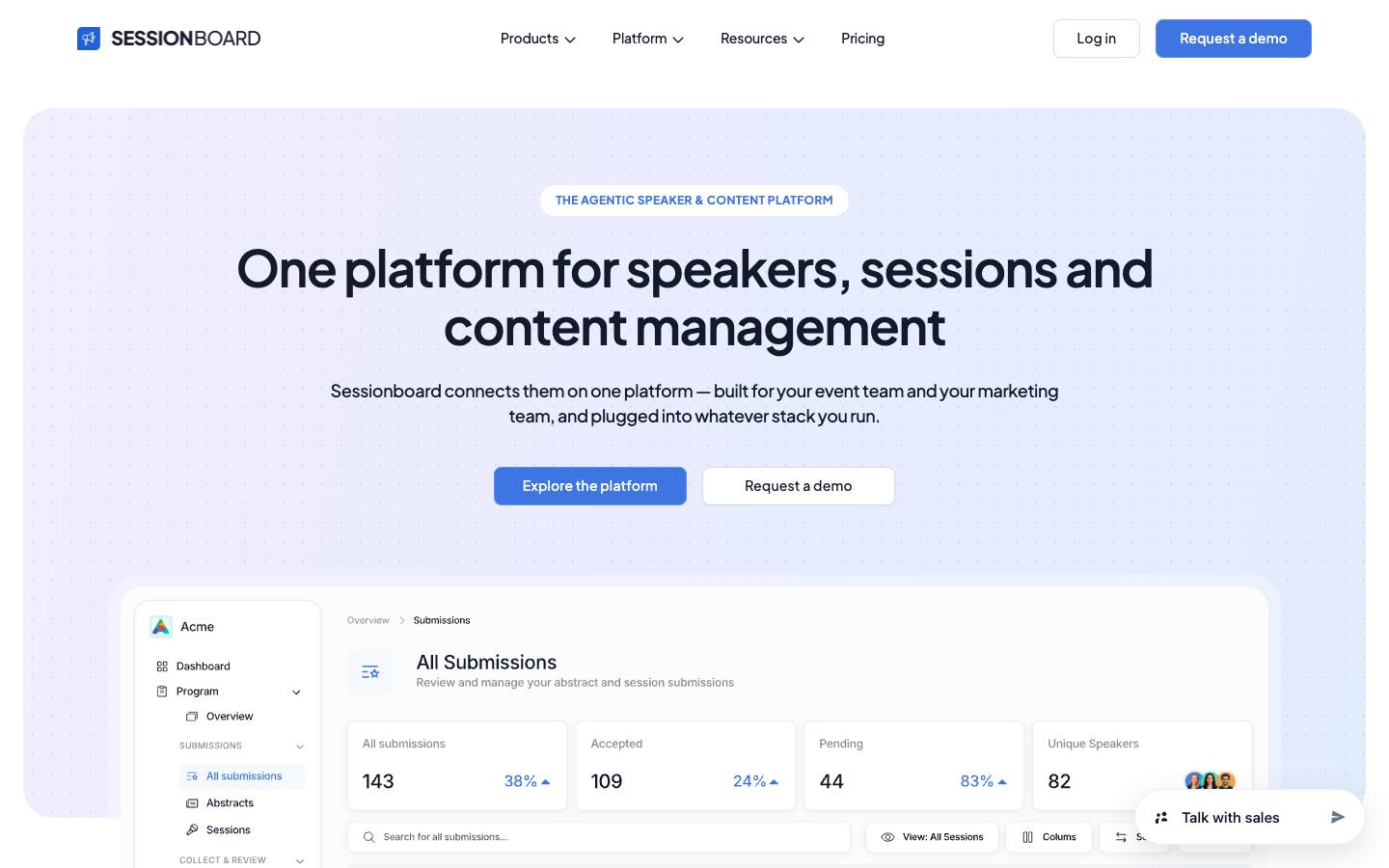
Sessionboard manages the content side of an event: call for papers and grading, speaker records and portals, an agenda builder, and session and speaker embeds for the event website. Everything sits on a speaker CRM that links speakers to sessions across events. It doesn't run registration, so it connects to platforms such as Cvent, Bizzabo, Swoogo and RainFocus instead.
More on SessionboardLess on Sessionboard
Founded: 2022 · HQ: Atlantic Beach, Florida · Team: 11-50 people · Formats: In-person, Virtual, Hybrid, Webinar
Sessionboard was founded in 2022 and is based in Atlantic Beach, Florida, with 11 to 50 employees. Pro covers a single event and Enterprise covers a portfolio with a cross-event CRM, AI agents and CRM integrations, but neither has a published price. Customers include Google, Informa, Emerald, Questex, Clarion Events, the Financial Times, Dynatrace and AVIXA, and the product works in English, German, Spanish and French.
Its integration catalog is one of the broadest among speaker tools, with native connectors to registration platforms such as Cvent, Bizzabo, Stova, Swoogo, RainFocus and Fuzion by Freeman, association systems such as iMIS, Fonteva and Personify360, and video platforms such as ON24, Goldcast, Kaltura and Vimeo, plus Salesforce and HubSpot on Enterprise. A REST API, webhooks and an MCP server cover custom builds. AI agents help review, schedule and coordinate, and sessions can be transcribed and turned into clips and articles. Its security policy says it achieved SOC 2 Type II with a report on request, data can sit in US or EU regions, and SAML, OIDC and OAuth2 sign-in is available.
- Live transcription and repurposing tools that turn sessions into clips and articles
What stands out
- Agenda builder with session and speaker embeds that publish to the event website
- Integrations with a long list of registration, event app, virtual and association systems, plus Salesforce and HubSpot
- AI agents for reviewing, scheduling and coordinating the program, and MCP access to program data
Worth checking
- Not a registration or ticketing system, so you'll pay for a separate event platform
- Pricing isn't published; Pro covers one event and Enterprise covers a portfolio with cross-event CRM and CRM integrations
Best suited for. Sessionboard fits mid-market and enterprise conference teams that run large speaker programs across several events and keep registration on a separate platform. If you run one or two small events a year, Sessionize or Speaker Dream will cost far less.
2. Lineup Ninja, best for multi-stream B2B conference and exhibition programs that need auto-scheduling and a published annual price
- Price
- From £2,900/year
- Languages
- English
- Security
- DPA
- Customers include
- Easyfairs, Association of Equipment Manufacturers (ConExpo-Con/Agg), Closerstill Media
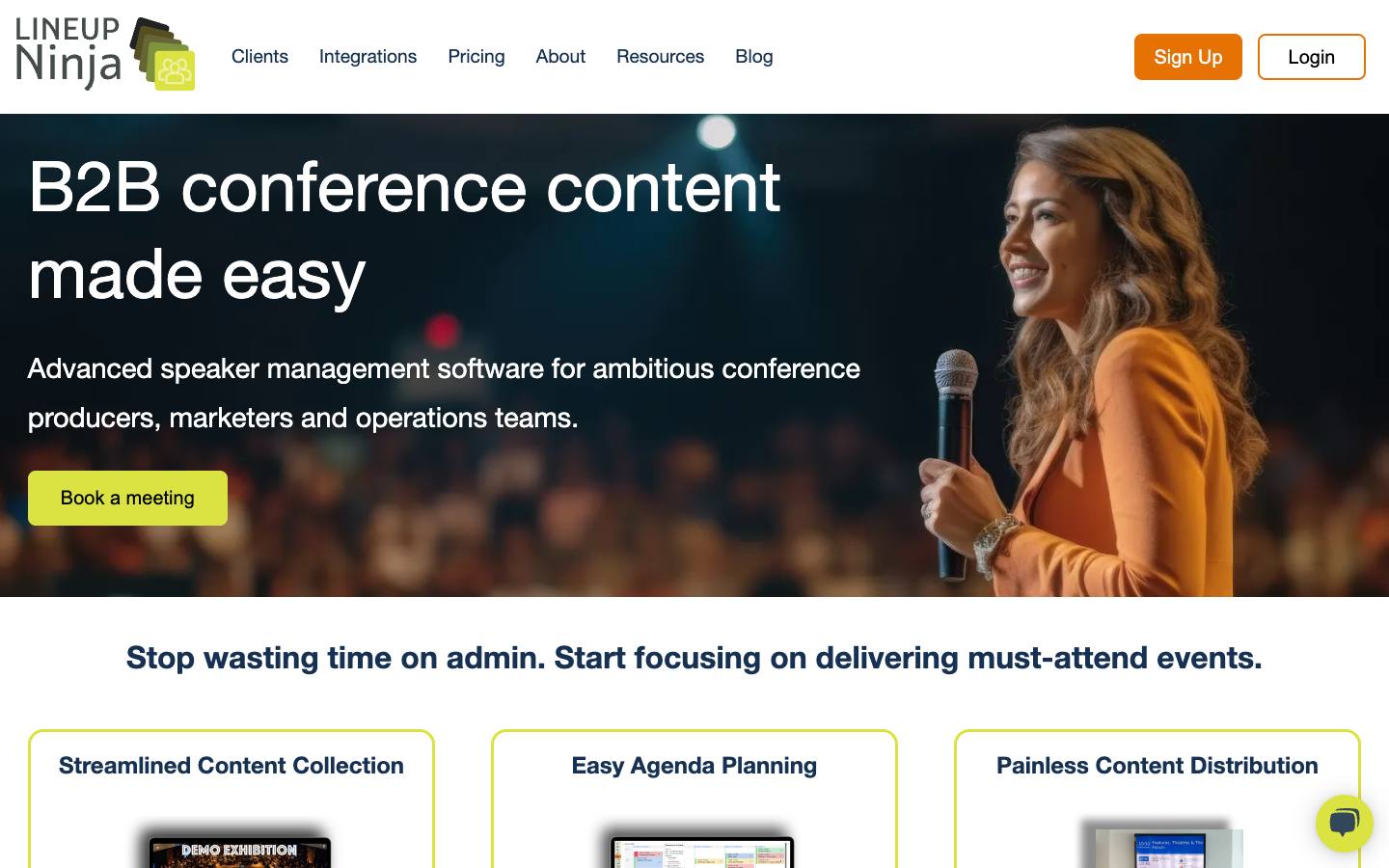
Lineup Ninja is a UK tool for collecting speaker content, reviewing submissions and building the agenda, then pushing it to websites, a no-install web app, digital signage and the AV team. It's widely used by B2B exhibition organizers with many content streams. Its scheduler checks clashes and speaker availability and can build a draft agenda from rules.
More on Lineup NinjaLess on Lineup Ninja
Founded: 2017 · HQ: Leeds, United Kingdom · Team: 2-10 people · Formats: In-person, Hybrid, Virtual
Lineup Ninja was founded in 2017 in Leeds, UK, with a team of 2 to 10. It publishes its price: an annual license of £2,900 per team with unlimited events and about 100 speakers a year (pricing page, checked October 2026). Onboarding and event setup is a recommended £500 flat fee, training costs £500 a day, configuring an existing integration is £250 and bespoke integrations are £1,000 a day, and integrations need the Professional support tier. Customers include Clarion Events, CloserStill Media, Easyfairs, Diversified Communications, NHS Confederation and ConExpo-Con/Agg.
Its scheduler checks clashes and availability as you drag sessions, and rule-based auto-scheduling can draft an agenda from session requirements and constraints. Configurable submission and awards flows support reviewer scoring, and diversity reporting shows the make-up of the speaker lineup. Content goes to the event website, a no-install web app, digital signage and AV teams' slide pulls, and connectors cover Swoogo, Swapcard, Grip, ExpoPlatform, Map Your Show and Snöball, with Zapier and Make for the rest. Hosting is in the EEA, but no CRM connectors or security certifications are published.
- Annual license per team with unlimited events, listed at £2,900 a year for about 100 speakers on its pricing page (checked October 2026)
What stands out
- Drag-and-drop scheduler with clash and availability checks plus rule-based auto-scheduling
- Publishes one agenda to the website, a web app, digital signage and AV slide pulls
- Speaker portal with automated reminders and diversity reporting on the lineup
Worth checking
- Integrations, configurable review flows and digital signage need the paid Professional support tier
- Registration and ticketing need another platform
Best suited for. Lineup Ninja fits B2B exhibition and conference organizers running many content streams who want auto-scheduling and a predictable annual price. If you need the agenda inside the same platform as registration, Swoogo or Cvent will mean fewer moving parts.
3. Sched, best for agenda-first conferences that want personal attendee schedules, a web and mobile app and registration in one tool
- Price
- From $50/month
- Try it
- Free trial
- App Store
- 4.8/5 from 4,309 ratings
- Languages
- English
- Security
- SOC 2 Type II, DPA
- Customers include
- Belton ISD, CAUDLeading the Way, DCMO BOCES
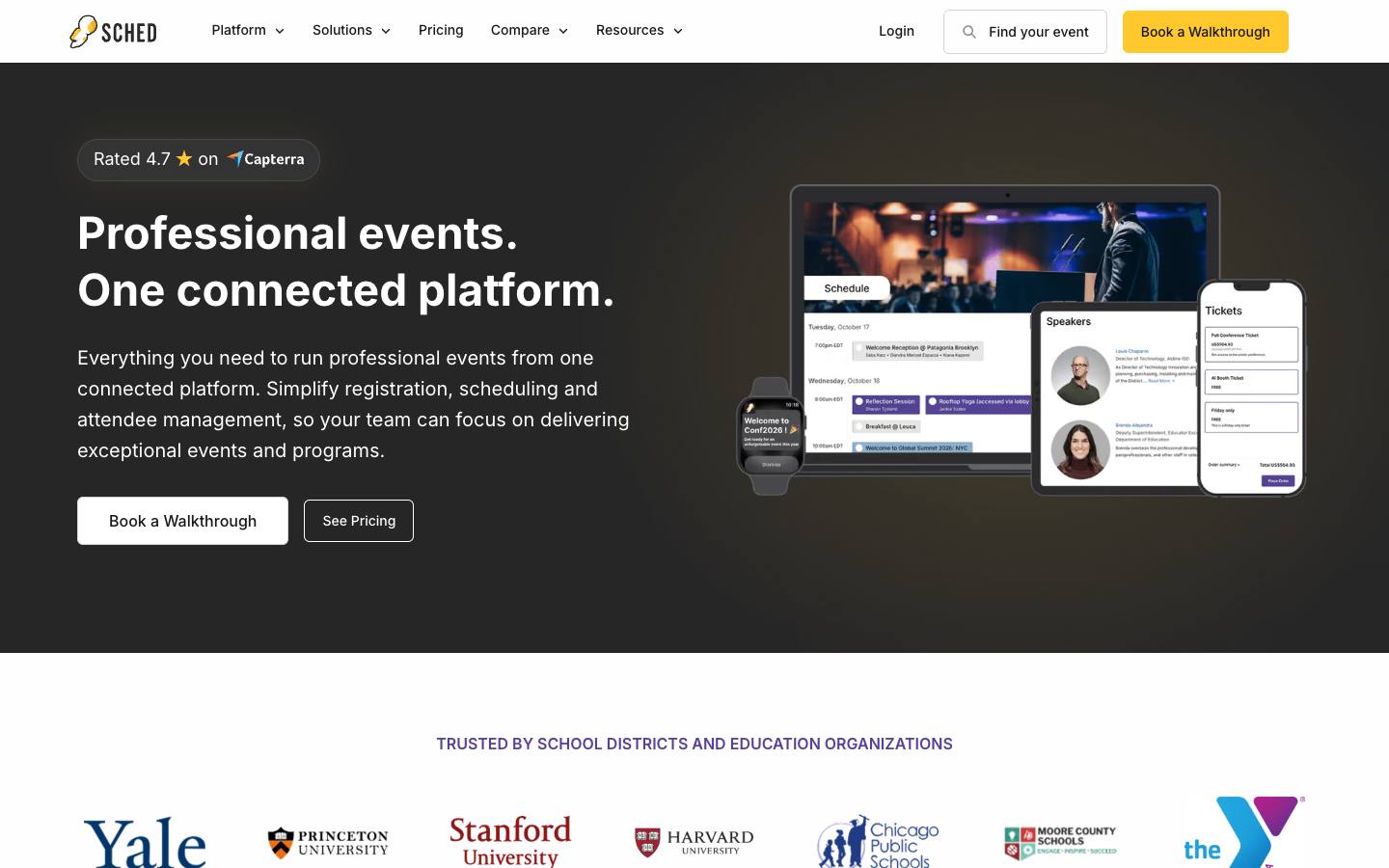
Sched started as a schedule and app builder and now adds call for papers, registration, websites, check-in and sponsor tools. Attendees browse the multi-track agenda and build personalized schedules on web or mobile. Plans are annual with unlimited events, and events under 50 attendees are free within a plan.
More on SchedLess on Sched
Founded: 2008 · HQ: Los Angeles, United States · Formats: In-person, Virtual, Hybrid
Sched was founded in 2008 and is based in Los Angeles. Plans are annual with unlimited events and start at 250 attendees: Launch lists at $100 a month billed annually, Boost at $250 and Ultra at $376, each shown at half price in a promotion at our October 2026 check, and Enterprise is quoted. Events under 50 attendees are free within a plan, there's a 60-day money-back guarantee, and nonprofit, education and government discounts apply. The Sched app holds 4.79 from 4,309 App Store ratings.
Boost adds networking, check-in, badges and lead retrieval, and Ultra adds onboarding, priority support, custom reporting and lower ticketing fees. Professional development tracking issues attendance certificates, which helps explain its footprint with Yale, Princeton, Stanford, Harvard and Chicago Public Schools. Native connectors cover Eventbrite, Stripe, Zoom, Vimeo, ClassLink, Google, Apple and Outlook calendars and WordPress, with API access on every plan, but no CRM or marketing automation connectors are listed. Its homepage cites SOC 2 Type II, while SAML SSO and ISO 27001 were still marked coming soon or pending.
- Published discounts for nonprofits, education, government and start-ups, plus a 60-day money-back guarantee
What stands out
- Schedule builder with speaker profiles and personalized attendee agendas on every plan
- Web and mobile app included, with branded native apps as an add-on
- Launch plan listed at $100 a month billed annually for 250 attendees (shown at half price during a promotion when checked in October 2026)
Worth checking
- Few native CRM or marketing automation integrations, which matters for B2B pipeline reporting
- Strongest footprint is in education and professional development; confirm B2B features such as lead retrieval sit on the tier you need
Best suited for. Sched fits conferences, universities and professional development programs that want an attendee-facing agenda, app and registration in one affordable tool. B2B marketing teams that need CRM sync for session attendance should look at Swoogo, Bizzabo or RainFocus.

4. RainFocus, best for enterprise user conferences with thousands of sessions and personalized agendas tied to attendee data
- Price
- Quote only
- Capterra
- 4.0/5 from 1 reviews
- App Store
- 5.0/5 from 5 ratings
- Syncs with
- Salesforce, HubSpot, Marketo
- Security
- SOC 2 Type II, ISO 27001
- Customers include
- Autodesk, Trimble, Ellucian
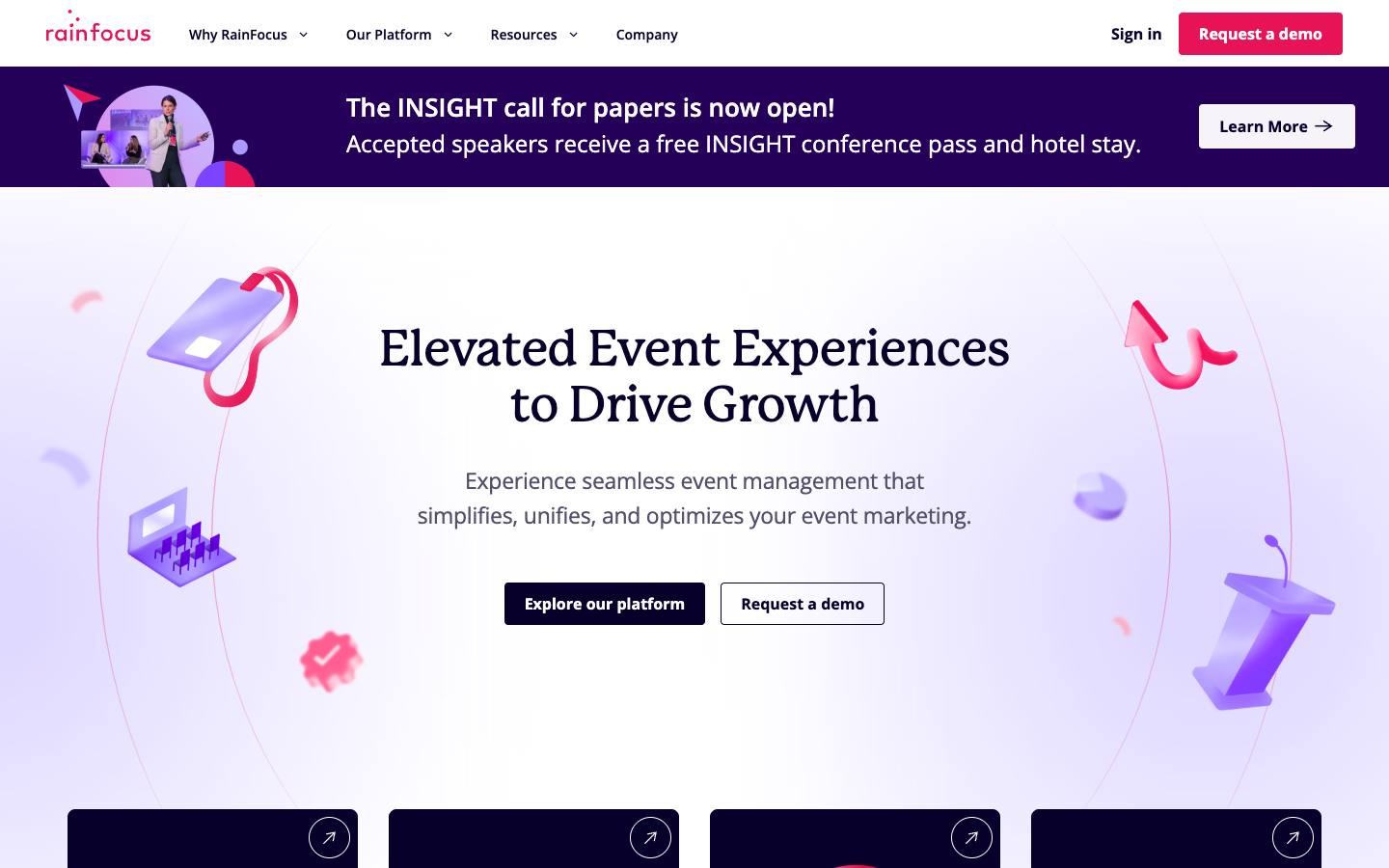
RainFocus is an enterprise event marketing platform that runs registration, call for papers, speaker logistics, sponsor tools, meetings and a branded app on one attendee data model. It powers large tech user conferences, where attendees build personal agendas from very large session catalogs. Event data feeds CRM and marketing automation for pipeline reporting.
More on RainFocusLess on RainFocus
Founded: 2013 · HQ: Lindon, Utah · Team: 201–500 people · Formats: In-person, Virtual, Hybrid, Webinar
RainFocus was founded in 2013 in Lehi, Utah, has 201 to 500 employees and $104 million raised, and is backed by JMI Equity and KKR. It powers some of the largest tech user conferences, including Cisco Live and Oracle's flagship event, and customers include Adobe, Red Hat, ServiceNow, RSA Conference and PCMA. Pricing isn't published and is aimed at enterprise budgets. Forrester named it a Leader in its 2026 evaluation of virtual event management platforms.
Call for papers, review and speaker logistics run on the same attendee data model as registration, so session choices, meetings and sponsor activity sit on one record, and attendees build personal agendas from large session catalogs in the branded app. A Base module for small, repeatable events arrived in December 2025 and RainFocus Nexus AI agents in January 2026. Named connectors include Salesforce through a dedicated app, Marketo Engage, Oracle Eloqua and HubSpot, and the vendor cites 40+ connectors overall. It holds ISO 27001:2022, offers a SOC 2 Type 2 report on request and showed no status-page incidents in the 90 days to October 18, 2026.
- SOC 2, ISO 27001:2022 and PCI DSS listed on its security page
What stands out
- Call for papers and speaker enablement in the same platform as registration
- Personalized agendas in a branded event app
- Integrations with Salesforce, Adobe Marketo Engage, Oracle Eloqua and HubSpot
Worth checking
- Pricing isn't published and is aimed at enterprise budgets
- More platform than a team needs if it only wants an agenda tool
Best suited for. RainFocus fits enterprise teams running user conferences with thousands of sessions where agenda choices need to feed attendee data and pipeline reporting. Teams with simpler programs will find Sched, Swoogo or a dedicated tool such as Lineup Ninja easier and cheaper.
5. Cvent, best for enterprise event teams that want speaker, abstract and agenda workflows inside the same suite as registration
- Price
- Quote only
- Capterra
- 4.5/5 from 1,099 reviews
- App Store
- 4.8/5 from 40,670 ratings
- Languages
- Support offered in 12 languages; event sites support multiple languages via language management
- Syncs with
- Salesforce, HubSpot, Dynamics, Marketo
- Security
- SOC 2 Type II, ISO 27001, DPA
- Customers include
- 6sense, Cognizant, Purdue University
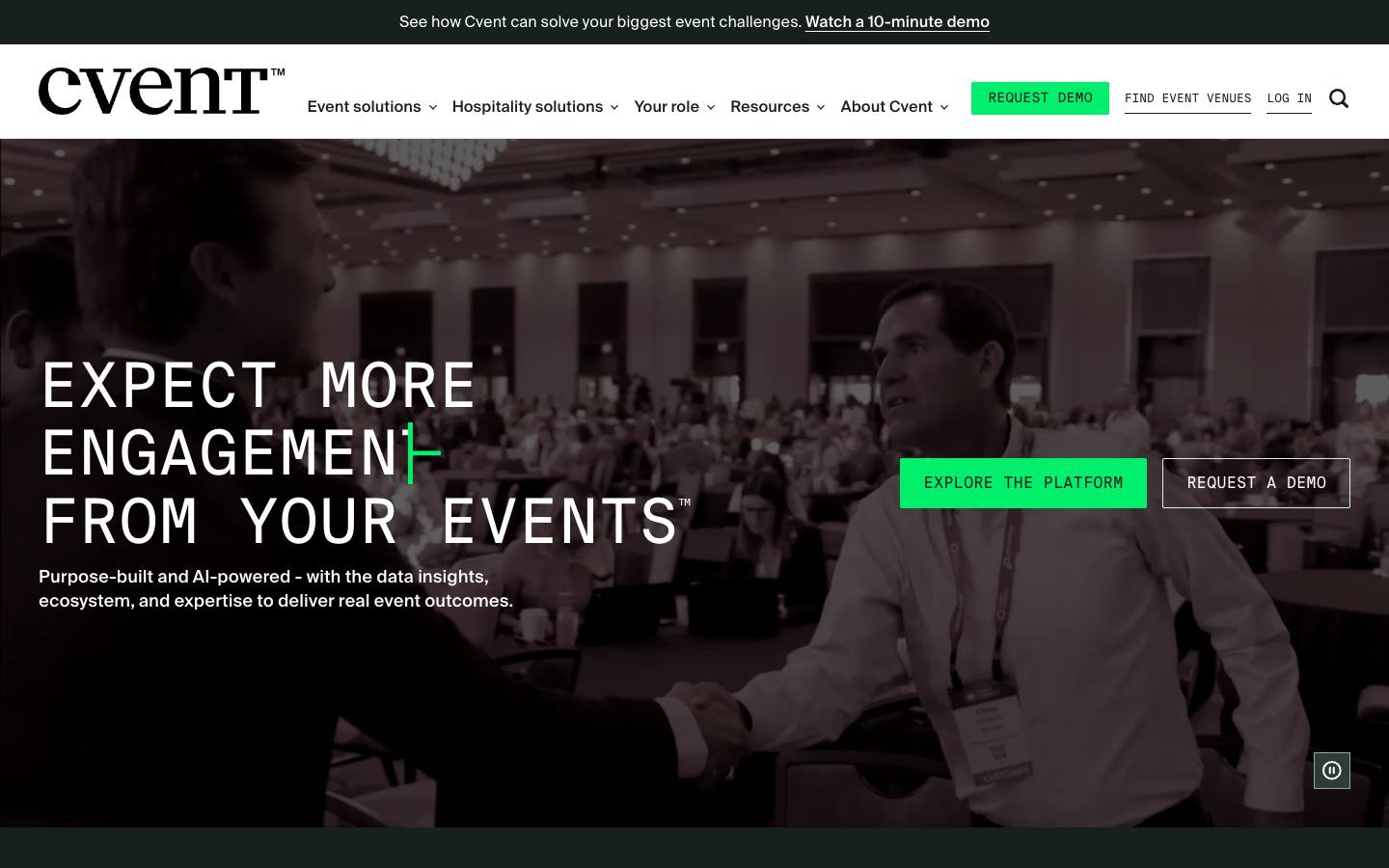
Cvent's event cloud includes speaker and call-for-papers workflows alongside registration, the Attendee Hub app, onsite check-in and reporting. Agendas built in the platform appear in Attendee Hub, where attendees see sessions across in-person, hybrid and virtual formats. It's the broadest suite in the category, so the agenda is one module among many.
More on CventLess on Cvent
Founded: 1999 · HQ: Tysons Corner, Virginia · Team: 5,001-10,000 people · Formats: In-person, Virtual, Hybrid, Webinar
Cvent was founded in 1999, is headquartered in Tysons Corner, Virginia, and has been owned by Blackstone since a reported $4.6 billion take-private in 2023. Capterra shows 4.48 from 1,099 reviews and the Cvent Events app 4.85 from 40,670 App Store ratings (checked October 2026). Pricing isn't published; products are licensed individually under Professional (15 users) or Enterprise (unlimited users, API and SSO) tiers, so confirm speaker and abstract management is in your contract.
Speaker, abstract and budget workflows sit alongside registration, venue sourcing, OnArrival check-in and webinars, and agendas reach attendees through Attendee Hub across in-person, hybrid and virtual formats. CventIQ AI includes content repurposing that turns sessions into derivative content. Native connectors cover Salesforce, Marketo Engage, HubSpot, Microsoft Dynamics and Oracle Eloqua, plus a REST API and webhooks, and Sessionboard lists a Cvent integration for teams that want a dedicated content tool. Compliance includes SOC 1, SOC 2 Type II, ISO 27001 and 27701 and PCI DSS Level 1, and support runs 24/7 in 12 languages.
- Extensive compliance list including SOC 2 Type II and ISO 27001
What stands out
- Speaker, abstract and approval workflows in the same system as registration and the app
- Attendee Hub delivers agendas, networking and engagement across formats
- Native integrations with Salesforce, Marketo Engage, HubSpot, Microsoft Dynamics and Oracle Eloqua
Worth checking
- No published pricing, and modules are licensed separately, so total cost depends on scope
- Breadth can mean longer setup and admin training than a dedicated agenda tool
Best suited for. Cvent fits enterprise and association teams that want speaker, abstract and agenda workflows in the same suite as registration and the attendee app. Teams reviewing hundreds of submissions across events often add Sessionboard or Lineup Ninja on top.

6. Swoogo, best for marketing teams that want agendas and session registration inside a rules-heavy registration platform
From $11,800/year
- Price
- From $11,800/year
- Capterra
- 4.7/5 from 82 reviews
- App Store
- 2.7/5 from 75 ratings
- Syncs with
- Salesforce, HubSpot, Marketo
- Security
- ISO 27001, SAML SSO, DPA
- Customers include
- Australian Catholic University, Trimble, Atlassian
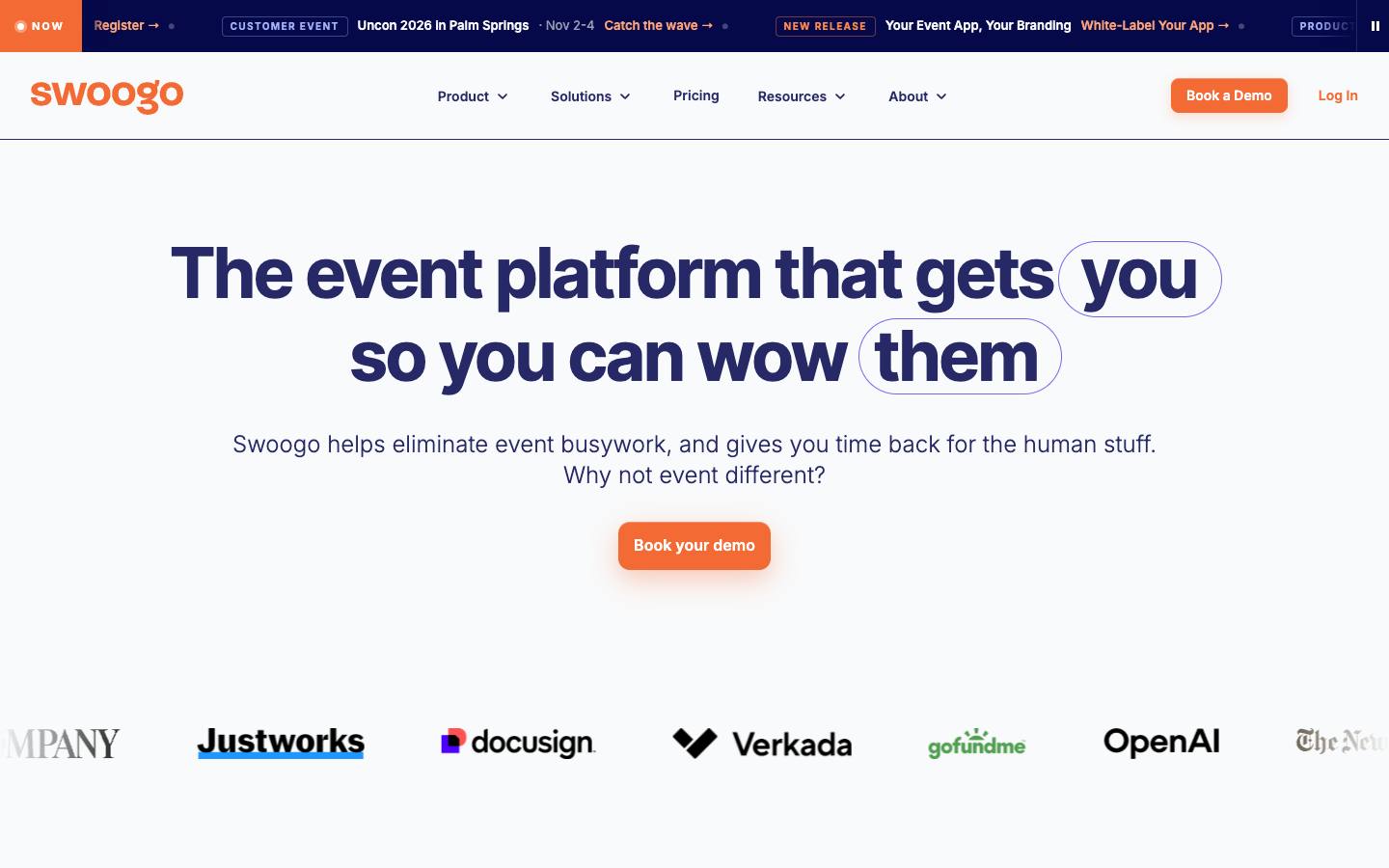
Swoogo is a registration-first event platform with event websites, attendee communications, onsite check-in and an optional app. Its speaker and session management builds agendas, with an optional call-for-speakers module, and sessions connect to its registration logic. Teams that want a dedicated content tool can connect Sessionboard.
More on SwoogoLess on Swoogo
Founded: 2015 · HQ: Los Angeles, US · Team: 51-200 people · Formats: In-person, Virtual, Hybrid, Webinar
Swoogo was founded in 2015 in Los Angeles, with offices in Sydney and London, 51 to 200 employees and about $20 million raised. Its Professional plan is $11,800 a year for one full user with unlimited events and registrations, a check-in app and 30+ integrations at no extra fee, and Enterprise is quoted (pricing page, checked October 2026). Extra seats, SSO, the Go Attend app and Go Onsite Pro cost more. Capterra shows 4.72 from 82 reviews, and customers include Atlassian, DocuSign, Twilio, OpenAI and The New York Times.
Speaker and session management builds the agenda, with an optional call-for-speakers module, and sessions tie into registration logic, so attendees pick sessions as they register and capacity rules apply. Native connectors include Salesforce, HubSpot and Marketo, plus Sessionboard, Brella, EventMobi and SpotMe for teams that want a dedicated content tool or app. A REST API, outbound webhooks and, since April 2026, an MCP server expose event data. Security documentation includes ISO 27001 and 27701, SOC 2 and PCI DSS Level 1, and support promises a first response within 15 minutes during business hours.
- Integrations with Salesforce, HubSpot, Marketo and Sessionboard, plus an MCP server for AI assistants
What stands out
- Speaker and session management with an optional call-for-speakers module
- Agenda data sits next to complex, conditional registration flows and a global attendee record
- Published Professional plan at $11,800 a year with unlimited events and registrations (pricing page, checked October 2026)
Worth checking
- The base plan includes one full user; the mobile app, SSO and advanced onsite tools are add-ons
- No advertised free trial; evaluation runs through a sales demo
Best suited for. Swoogo fits marketing teams running many events a year that want session selection tied to rules-heavy registration at a published price. If your program depends on a large call for papers and speaker portal, pair it with Sessionboard or choose Lineup Ninja.
7. Bizzabo, best for B2B event teams that want a no-code agenda and website editor inside an annual event platform
From $499/user
- Price
- From $499/user
- Capterra
- 4.4/5 from 171 reviews
- App Store
- 4.6/5 from 14 ratings
- Languages
- English
- Syncs with
- Salesforce, HubSpot, Marketo
- Security
- SOC 2 Type II, ISO 27001
- Customers include
- Compass, DJI, HubSpot
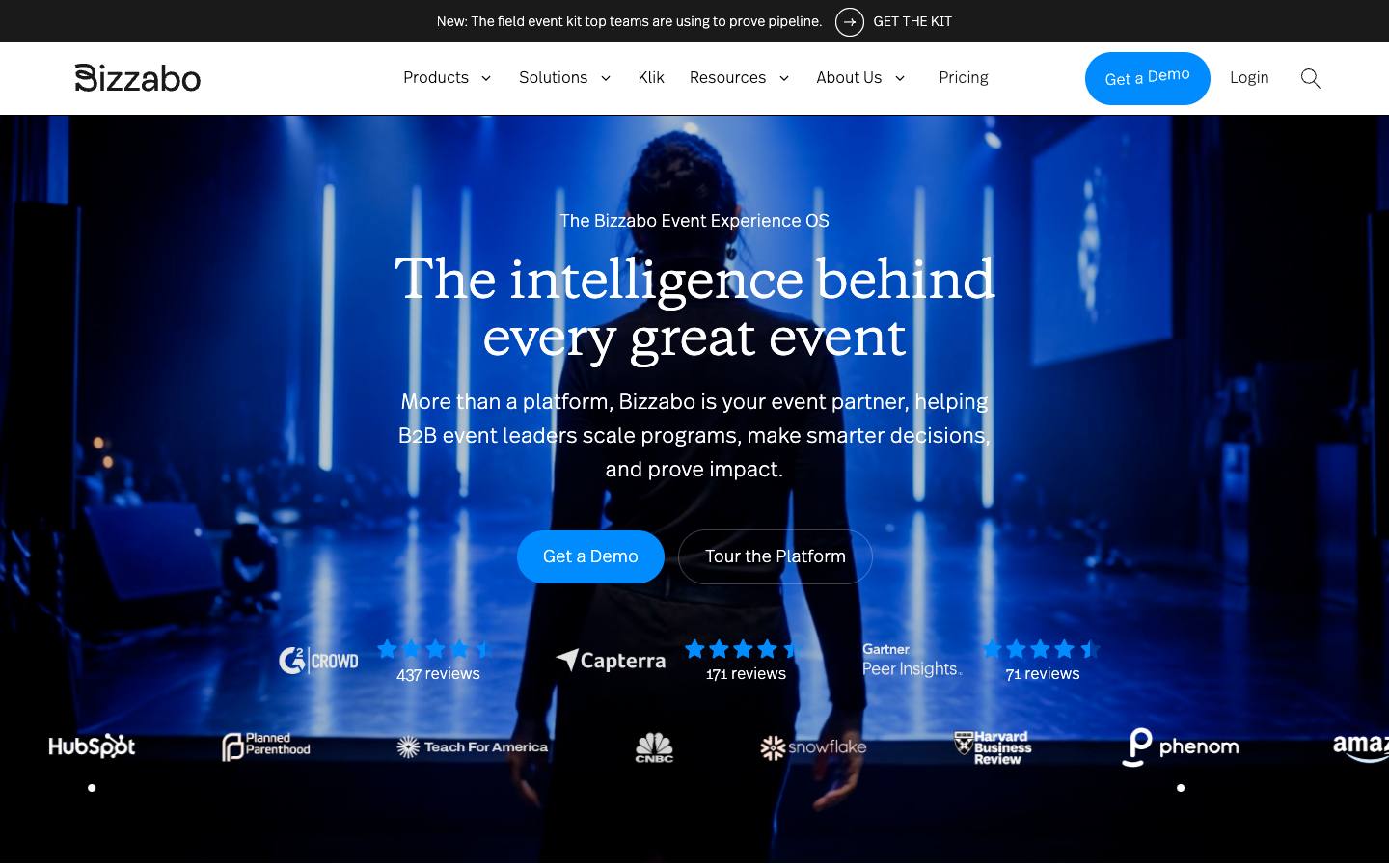
Bizzabo is an event platform for B2B corporate, agency and association teams, with registration, a no-code website and agenda editor, email, a mobile app with networking, and reporting. Speaker and sponsor portals are sold as premium add-ons. It's built for teams running a steady calendar of conferences and field events on one annual license.
More on BizzaboLess on Bizzabo
Founded: 2011 · HQ: New York, United States · Formats: In-person, Virtual, Hybrid, Webinar
Bizzabo was founded in 2011 in New York and has raised $194 million through a Series E according to CB Insights. List pricing is $499 per user a month billed annually with a 3-user minimum, or from $17,999 a year, with unlimited events and registrations, and Capterra shows 4.37 from 171 reviews (checked October 2026). Speaker and sponsor portals, CRM integrations, API access and SSO are premium add-ons, and there's no single-event option.
The no-code website and agenda editor builds event sites and session schedules without a developer, and the mobile app shows attendees the agenda with networking and engagement features; a custom-branded app costs extra. Bizzy, an AI copilot for attendees, launched in March 2026, and an agentic operating system for events was in preview in October 2026. Native connectors cover Salesforce, HubSpot, Marketo, Pardot and Oracle Eloqua. Security documentation includes a SOC 2 Type 2 report under NDA, ISO 27001 and PCI DSS SAQ D v4, support runs 24/7/365, and customers include HubSpot for INBOUND, Phenom and Inductive Automation.
- Unlimited events and registrations, with plans from $17,999 a year per our profile (checked October 2026)
What stands out
- Website and agenda editor that doesn't need code
- Agenda flows into the attendee app alongside networking and engagement
- CRM integrations with Salesforce, HubSpot, Marketo and Oracle Eloqua
Worth checking
- Speaker portals, CRM integrations, SSO and API access are premium add-ons
- Annual subscription only, with per-seat pricing ($499 per user a month billed annually, three-user minimum, per our profile)
Best suited for. Bizzabo fits B2B teams running a steady calendar of conferences and field events who want agenda, website, registration and app on one annual license. If speaker submissions and review are a big part of your work, check the cost of the speaker portal add-on or compare Sessionboard.

8. Sessionize, best for tech and developer conferences that want a call for speakers and schedule builder at a flat per-event price
From $499/event
- Price
- From $499/event
- Try it
- Free plan, Free trial
- Languages
- English
- Security
- DPA
- Customers include
- The Linux Foundation, Global Azure, XDEV Software
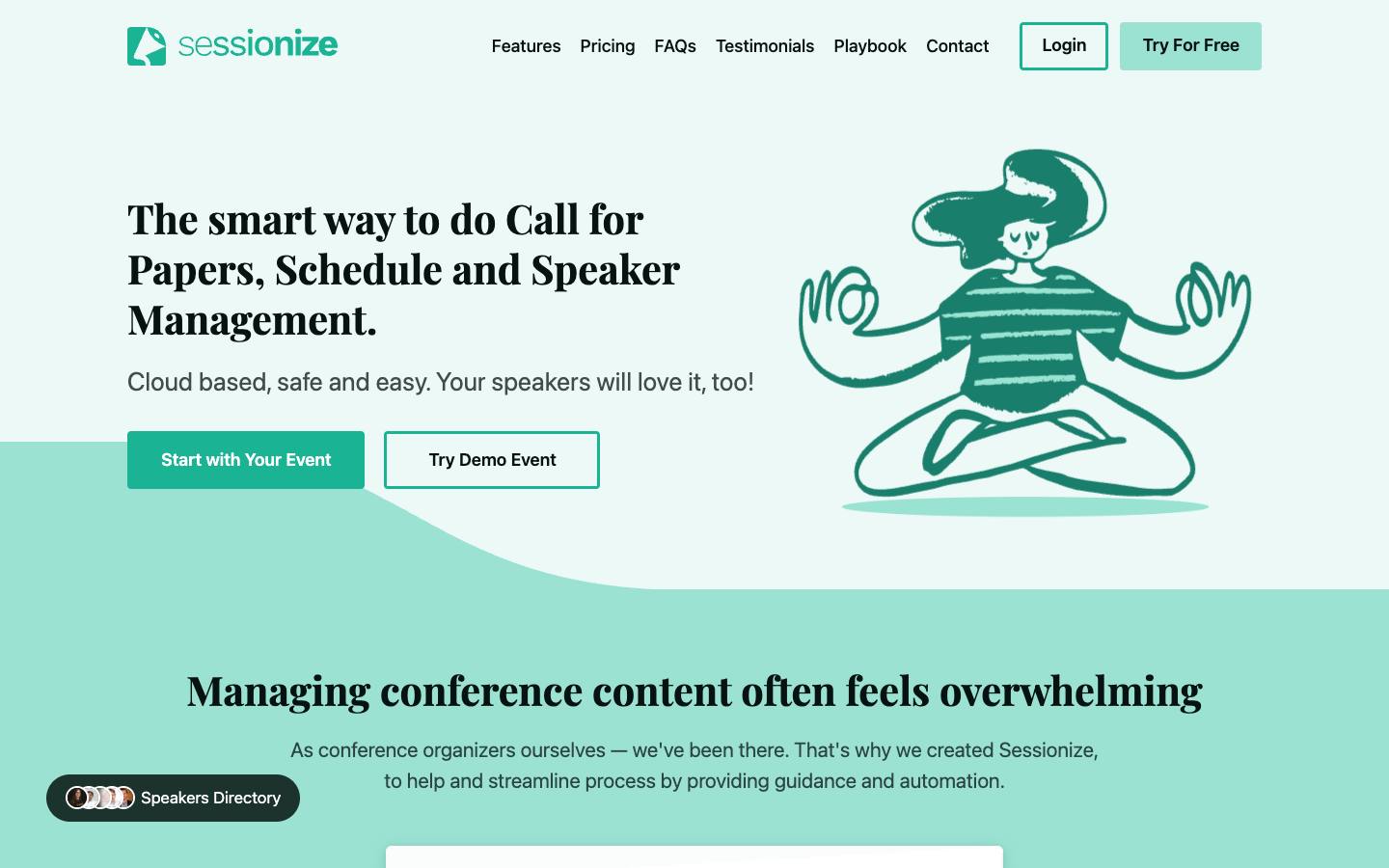
Sessionize runs the call for speakers, collaborative session evaluation, speaker management and a drag-and-drop schedule builder. The schedule can be embedded on your site or pulled as JSON or XML, and attendees get a web and mobile schedule app. It's common at developer conferences, partly because many speakers already have Sessionize profiles.
More on SessionizeLess on Sessionize
Founded: 2017 · HQ: Zagreb, Croatia · Team: 2-10 people · Formats: In-person, Virtual, Hybrid
Sessionize was founded in 2017 in Zagreb, Croatia, and is run by Web-ideja Ltd. with a team of 2 to 10. It's free for non-commercial community events and costs $499 plus tax per professional event, with all features and priority email support included, and bulk activation codes are quoted for 5+ events a year (pricing page, checked October 2026). A full test mode needs no credit card. Customers include Microsoft, JetBrains, NDC Conferences, DeveloperWeek, Google Developer Groups and the Linux Foundation.
Content team members vote on and compare submissions, accepted speakers maintain their own profiles, and the public speaker directory helps with recruiting. The drag-and-drop schedule embeds on WordPress or any site and exports as JSON, XML or iCalendar through a read-only API, and attendees get a web and mobile app to favorite sessions. Hosting runs on Azure and AWS in Ireland and the Netherlands, with a public DPA, subprocessor page and status page. There are no native CRM or marketing automation connectors, and registration and ticketing need another tool.
- Public speaker directory that helps with sourcing speakers
What stands out
- $499 per professional event on its pricing page (checked October 2026), free for non-commercial community events
- Fully working test mode with no credit card
- Schedule embeds plus JSON, XML and iCalendar exports for your own site or app
Worth checking
- Content and agenda only; registration and marketing need other tools
- The free tier excludes internal, promotional and marketing events, so most B2B company events pay
Best suited for. Sessionize fits tech, developer and community conferences that want a call for speakers and schedule builder at a flat, low per-event price. Marketing teams that need session data in a CRM or registration platform should look at Sessionboard or Swoogo.

9. Grenadine, best for conventions and organizations with many event owners that need dense multi-track programs
Quote only
- Price
- Quote only
- Try it
- Free trial
- App Store
- 3.7/5 from 3 ratings
- Languages
- English, French
- Customers include
- Twitch, National Association of Basketball Coaches, International Documentary Association
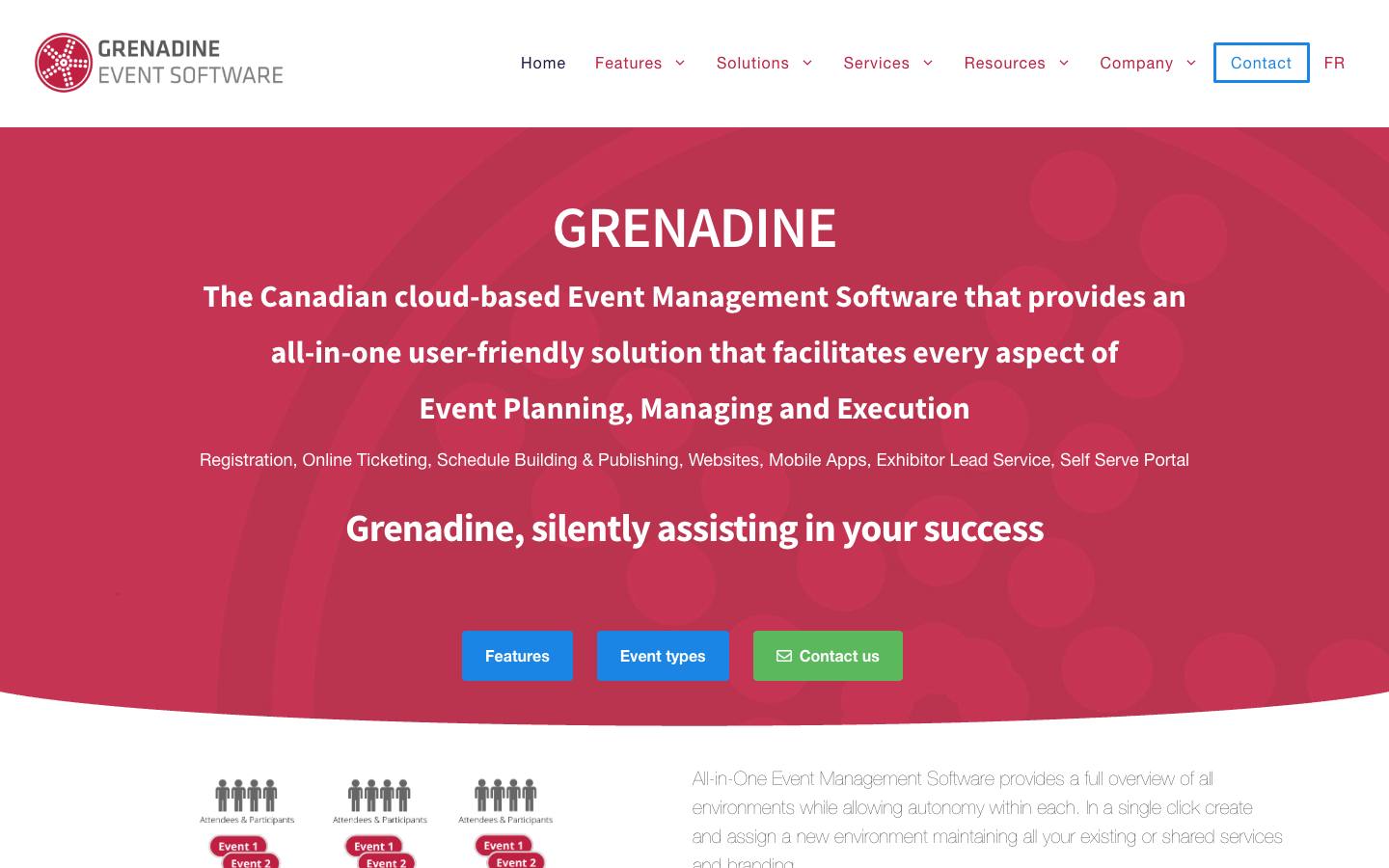
Grenadine is a Canadian event platform that grew out of software for large fan conventions. It builds and publishes complex multi-track programs and feeds them to event micro-sites and a guide app, alongside registration, abstract management, badging and lead retrieval. An admin console lets many departments run their own events under shared branding.
More on GrenadineLess on Grenadine
Founded: 2010 · HQ: Montréal, Canada · Formats: In-person, Virtual, Hybrid
Grenadine was founded in 2010 and is based in Montreal, Canada, working in English and French. It began as open-source software for science fiction conventions and now serves associations, conventions, universities and corporate and consumer shows. Pricing isn't published; a free trial and demo are offered. Customers include Twitch, the National Association of Basketball Coaches, the International Documentary Association, UQAM and the Calgary City Teachers' Convention.
The schedule builder handles dense multi-track programs and feeds event micro-sites and a mobile guide app from the same data, alongside registration and ticketing, abstract management, badging, check-in, lead retrieval and a virtual conference center. Its enterprise admin console lets many departments run their own events under shared branding, which suits institutions with decentralized event owners. Integration runs mainly through a two-way JSON API documented in Swagger, with embedded Zoom; no CRM, marketing automation or Zapier connectors are listed. The guide app holds 3.67 from 3 App Store ratings, its release notes page was last updated in December 2022, and no security certifications are published.
- Bilingual English and French product with a free trial
What stands out
- Schedule builder designed for dense, multi-track programs
- One dataset feeds the event site and the mobile guide app
- Enterprise console for decentralized organizations with many organizers
Worth checking
- Few named integrations; connections rely on its REST API
- Pricing isn't published
Best suited for. Grenadine fits conventions, universities and associations with many event owners who need dense programs, registration and a guide app from one bilingual vendor. Corporate marketing teams that need CRM sync should compare Swoogo or Bizzabo.
10. Speaker Dream, best for smaller conference teams that want a free starting tier for call for papers and agenda building
From $1,499/year
- Price
- From $1,499/year
- Try it
- Free plan
- Languages
- English
- Customers include
- Community Week
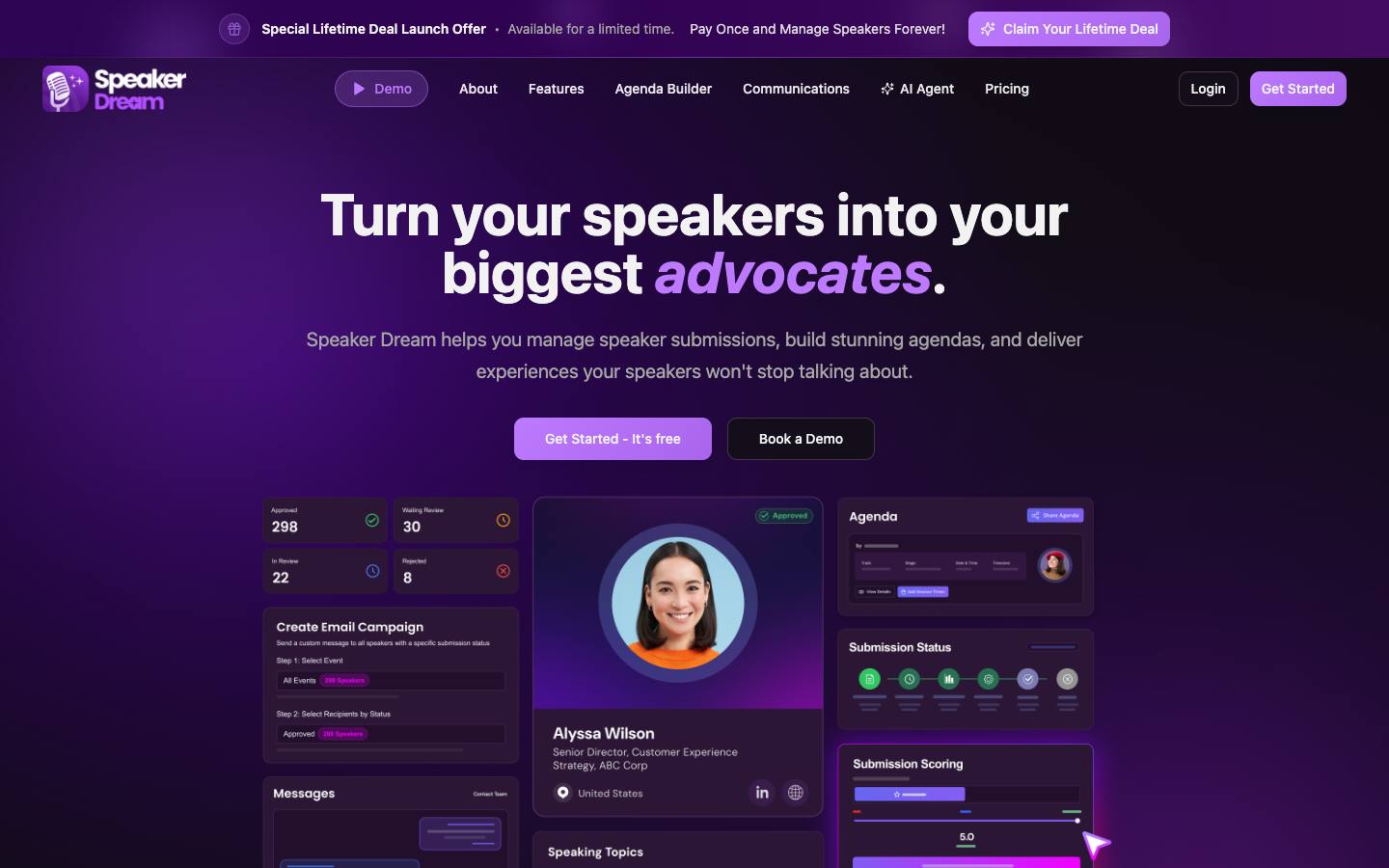
Speaker Dream covers call for papers with multi-reviewer scoring, a drag-and-drop agenda builder across days and tracks, a speaker CRM and portal, messaging and speaker asset collection. A conversational AI agent can create events, review submissions and build agendas. It's a young UK vendor aimed at conference and community organizers.
More on Speaker DreamLess on Speaker Dream
HQ: Norwich, United Kingdom · Formats: In-person
Speaker Dream is a trading name of Becreative Marketing Limited in Norwich, UK, and was founded by the organizer of London and Toronto Community Week. Its free Starter plan covers one event with one admin, unlimited speakers and reviewers and 1,000 one-time email credits. Professional is $1,499 a year, or $2,999 one-time as a limited lifetime deal, for 12 events a year, up to 5 admins, the drag-and-drop agenda builder and 100,000 email credits, and Enterprise starts at $10,000 with a dedicated instance and custom integrations (pricing page, checked October 2026).
Call for papers forms support multi-reviewer scoring and automated accept and reject flows, and the agenda builder works across days and tracks with time-conflict detection and one-click publishing. A speaker CRM reuses profiles across events, a speaker kit collects bios, headshots, slides and videos with version control, and a unified inbox handles bulk email with templates. A conversational AI agent can create events, review submissions and build agendas. It's an early-stage vendor: the one named customer is run by its founder, and there are no native integrations, API or security documentation outside Enterprise.
What stands out
- Free Starter plan for one event; Professional is $1,499 a year (pricing per our profile, checked October 2026)
- Agenda builder with time-conflict detection and one-click publishing
- Speaker database reused across events, with version-controlled bios, headshots and slides
Worth checking
- Early-stage vendor with few named customers
- No native integrations listed outside Enterprise custom work
Best suited for. Speaker Dream fits smaller conference and community teams that want a free or low-cost call for papers and agenda builder with modern speaker workflows. If you need registration integrations or an established vendor for procurement, Lineup Ninja or Sessionboard is the safer choice.
11. pretalx, best for community and developer conferences that want open-source scheduling they can self-host
From €199/event
- Price
- From €199/event
- Try it
- Free plan, Free trial
- Languages
- English, German, Multi-language email templates and talk languages
- Security
- DPA
- Customers include
- JuliaCon, MozFest, PyCascades
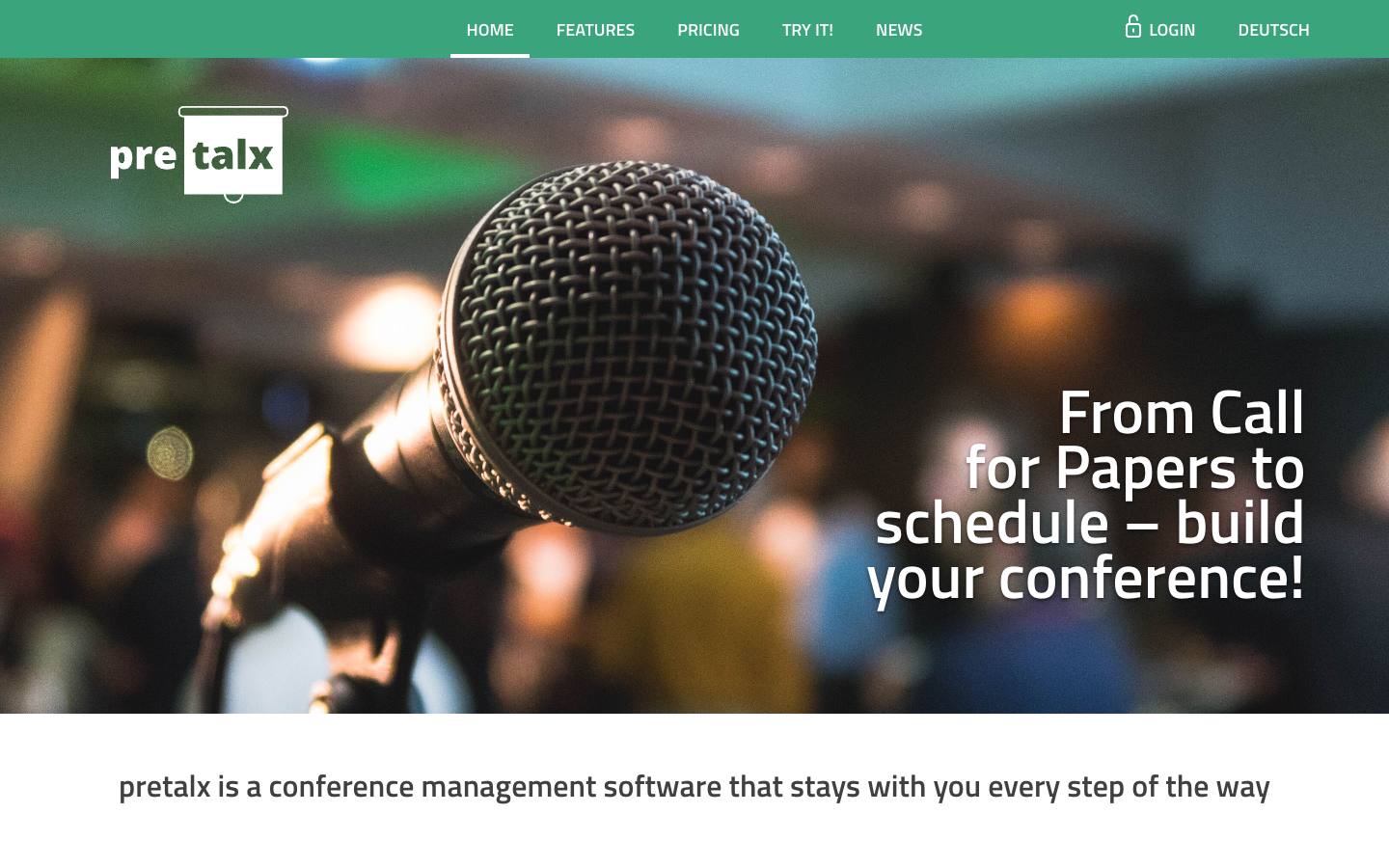
pretalx is open-source software for the call for papers, review, speaker communication and schedule publishing. The schedule editor works around speaker availability and announces changes automatically. You can self-host it with no license fee or use the hosted service, priced per event from expected attendance and ticket price.
More on pretalxLess on pretalx
HQ: Weinheim, Germany · Formats: In-person, Virtual, Hybrid
pretalx is run by rixx.de Software (Tobias Kunze) in Weinheim, Germany. The code is open source and free to self-host, and the hosted service at pretalx.com is priced per event from expected attendance and ticket price, at €199 for the calculator's default inputs, with up to 25% off for volunteer-run non-profit events (pricing page, checked October 2026). Hosted events are free until they're made public, and paid support contracts with response guarantees are available for self-hosters. Users include PyCon, JuliaCon, MozFest and PyCascades.
Review can be anonymous or open with organizer-defined scoring, and templated emails to filtered speaker groups go through an outbox you check before sending. The schedule editor works around speaker availability, and changes are announced automatically, including through an RSS feed. A full REST API and a plugin system cover custom needs, and hosted data stays on servers in Germany. In 2026 a critical stored XSS flaw (CVE-2026-41241) was disclosed and patched in release 2026.1.0, so self-hosters should keep up with updates. Registration and ticketing need a separate tool.
What stands out
- Open source with a full self-hosting option and a REST API
- Hosted version is free to test and charged only when the event goes public
- Schedule editor that respects speaker availability and publishes change notices
Worth checking
- Covers content and speakers only; registration needs a separate tool
- Run by a very small team, and a stored XSS flaw disclosed in 2026 was patched in release 2026.1.0, so self-hosters need to keep current
Best suited for. pretalx fits developer and community conferences that want open-source scheduling they can self-host or rent per event. Corporate teams that need native registration, CRM or app connectors should look at Lineup Ninja or Sessionboard.
12. Joi, best for agencies and production teams that build programs and run-sheets for many events at once
From AUD 50/month
- Price
- From AUD 50/month
- Try it
- Free trial
- Languages
- English
- Customers include
- VPP
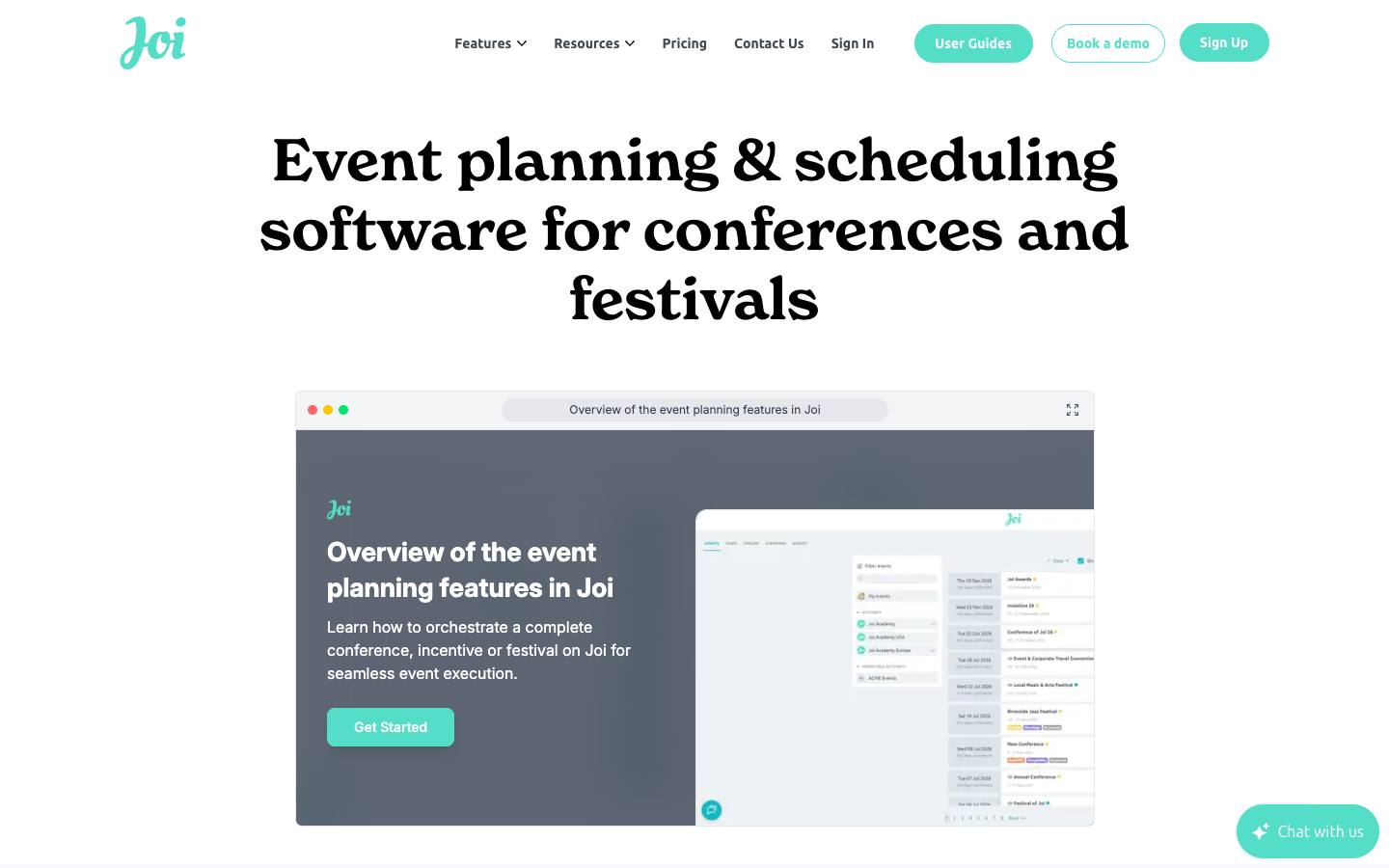
Joi replaces spreadsheets for building conference and festival programs, planning logistics and tracking budgets. One program feeds event microsites, embeds, JSON feeds, a simple app and delivery schedules, so a change shows up everywhere. It's priced by active events with unlimited users.
More on JoiLess on Joi
HQ: Sydney, Australia · Formats: In-person
Joi is made by Joi Pty Ltd in Sydney, Australia. It's priced by active events rather than seats, starting at A$50 a month for up to 10 active events with every feature and unlimited users, and closed events don't count toward the total (pricing page, checked October 2026). Billing is monthly with no lock-in, a 7-day trial needs no card, and USD, GBP and EUR pricing is available.
The program builder is the core: one program feeds a hosted microsite, an embed code or a JSON feed, a simple attendee app with agenda, notifications and feedback, and the team's delivery schedules, so a change made once shows up everywhere. Collaborative planning tools cover logistics and cue documents for the production team. Event budgeting handles revenue, costs, currencies, taxes, markups and quotes with role-based access, which suits agencies pricing events for clients. Joi doesn't describe registration, ticketing or check-in, names no third-party integrations and publishes no customer logos, so ask for references before committing a large program.
What stands out
- Single program that publishes to a hosted microsite, embed code or JSON feed
- Cue documents and logistics planning for the production team alongside the attendee-facing agenda
- Priced by number of active events, not seats or attendees, from A$50 a month (per our profile, checked October 2026)
Worth checking
- No registration, ticketing or check-in
- No named third-party integrations or published customers
Best suited for. Joi fits agencies and production teams that build programs, run-sheets and budgets for many events at once and want unlimited users at a low monthly price. If attendees need to register and pick sessions, pair it with a registration tool or choose Sched or Swoogo.
Picks 6 to 12 are folded to keep the list short. Open any of them, or compare them all in the table above.
Also worth considering
AgendaForge, BusyConf, Whova, Conference Compass (Floq), Cadmium (Eventscribe), EventMobi, Stova, hapily
The best agenda builder software by use case
| If you need | Company size | Look at |
|---|---|---|
| Conference team reviewing hundreds of submissions with registration on Cvent or Bizzabo | Mid-market, Enterprise | Sessionboardspeaker CRM and native registration connectors |
| Exhibition organizer running ten content theaters at one show | Mid-market, Enterprise | Lineup Ninjaauto-scheduling and unlimited events for £2,900 a year |
| University or professional development conference | Startup, Mid-market | Schedpersonal agendas, registration and attendance certificates |
| Enterprise user conference with thousands of sessions | Enterprise | RainFocusagenda choices sit on one attendee data model |
| Marketing team that wants session selection during registration | Mid-market, Enterprise | Swoogosessions tie into registration logic |
| Developer conference on a tight budget | Startup, Mid-market | Sessionize$499 per event with a public speaker directory |
| Open-source community event that wants to self-host | Startup | pretalxopen source with no license fee |
| Agency producing programs and run-sheets for many clients | Startup, Mid-market | Joipriced by active events with unlimited users |
What results look like
Figures customers report in the vendors' own published case studies. They describe one customer each, not what every buyer should expect.
13
Conferences run
Diversified with Sessionboard · Case study
2,200
Attendees
Belton ISD with Sched · Case study
134+
Events per year
Autodesk with RainFocus · Case study
393% ahead
Lead generation vs KPI
Australian Catholic University with Swoogo · Case study
60%
App adoption rate
Compass with Bizzabo · Case study
2,600
KubeCon Europe 2024 submissions
The Linux Foundation with Sessionize · Case study
How to choose
Background on what these tools do, how we ranked them and what to check before you buy. Open any topic.
What agenda builder software actually is (and what it isn't)
Agenda builder software is where a conference program gets made. Organizers place sessions into days, tracks, rooms and time slots, attach speakers, catch clashes and capacity problems, and publish the finished schedule to the event website, the attendee app, onsite signage and the AV team. The better tools also run the work around the grid: a call for papers with reviewer scoring, speaker portals that collect bios, headshots and slides, and attendee-facing agendas where people bookmark sessions to build their own day.
It isn't abstract management software, which focuses on collecting and peer-reviewing submissions for scientific and association meetings, though many agenda builders include a lighter call for papers. It isn't an event app either, which focuses on the attendee experience and usually displays an agenda built elsewhere. Event registration software and all-in-one platforms such as Cvent, Bizzabo and Swoogo include agenda modules, and event matchmaking software schedules meetings between people rather than sessions.
For B2B event teams, the jobs are recruiting and selecting speakers, building a clash-free program across tracks, keeping one source of truth when sessions move late, feeding session data to registration so attendees can pick sessions, and reusing speaker records across a portfolio of events so nobody fills in the same form twice.
How we ranked these agenda builder software tools
We ordered these tools by fit for B2B teams building and publishing multi-track programs with many speakers. Each criterion can be checked on the vendor's own pages or in our research files.
1. Scheduling grid and clash checks
We checked product pages for drag-and-drop scheduling across days, tracks and rooms with speaker clash and availability warnings.
2. Call for papers and review
We checked whether the tool collects submissions and supports reviewer scoring, as described on the vendor's site.
3. Speaker self-service
We checked for portals where speakers maintain profiles and upload content themselves.
4. Publishing options
We recorded the documented ways the agenda leaves the tool: website embeds, hosted pages, JSON or XML feeds, apps and APIs.
5. Registration platform connectors
We recorded named connectors to registration platforms and event apps on each vendor's integrations page.
6. Published pricing
We recorded prices from each vendor's pricing page in October 2026 and marked the rest as quote-only.
More on our process in the methodology.
What to look for in an event agenda builder
Start with the scheduling grid itself. You want drag-and-drop placement across days, tracks and rooms, with warnings when a speaker is double-booked, a room is over capacity or a session clashes with a speaker's stated availability. Lineup Ninja, Speaker Dream, pretalx and AgendaForge all describe clash or availability checks, and Lineup Ninja can draft a schedule from rules. Next, check the speaker side: a self-service portal where speakers update bios, headshots and slides saves the content team weeks of email. Then look at publishing. The agenda should flow to the event website through embeds or an API, to the attendee app, and ideally to signage and the AV team, so one change updates everywhere. Finally, decide whether attendees need personal agendas, where they bookmark sessions and reserve seats. Sched, RainFocus, Cvent and Bizzabo handle this inside their own apps; dedicated content tools usually hand that job to your event app.
Dedicated agenda tool or your event platform's agenda module?
Most full event platforms, including Cvent, Bizzabo, Swoogo and RainFocus, include speaker and session management, so the first question is whether that module is good enough. It usually is when one team owns the agenda, the program has a few tracks and speakers don't submit content through a call for papers. A dedicated tool such as Sessionboard or Lineup Ninja earns its cost when you run large calls for content, review hundreds of submissions, manage speakers across several events a year, or publish one program to several systems. The trade-off is an extra contract and an integration to maintain. Check that the dedicated tool has a working connector to your registration platform and app before you buy; Sessionboard lists connectors for Cvent, Bizzabo, Swoogo, RainFocus and Stova, while Lineup Ninja lists Swoogo, Swapcard, Grip and Guidebook among others.
Questions to ask vendors
Ask each vendor to build a sample day of your real program in the demo, with three tracks and a speaker who appears twice. Then ask: How do you flag clashes and room capacity? Can speakers edit their own profiles and upload slides, and can we lock content after a deadline? How does the agenda reach our website, our event app and our registration platform, and is that a native connector, an embed or a custom integration we pay for? How quickly does a change in the builder show up in the app? Can attendees build a personal agenda and reserve seats in capacity-limited sessions? Can we reuse speaker records across events? Who owns the data if we leave, and can we export everything? For enterprise buyers, add questions on SSO, security certifications and whether integrations need a higher support tier, as they do at Lineup Ninja.
How much does event agenda software cost?
Published prices range from free to five figures a year, checked October 2026. At the low end, Sessionize is free for non-commercial community events and $499 per professional event, pretalx is free to self-host with hosted pricing per event based on attendance and ticket price, and Speaker Dream has a free one-event tier and a $1,499 annual plan. Dedicated tools for professional organizers sit higher: Lineup Ninja lists £2,900 a year per team for about 100 speakers, and AgendaForge charges $2,000 per event for its Core plan. Agenda-first platforms like Sched list annual plans from $100 a month (checked October 2026). Full event platforms bundle agendas with registration: Swoogo's Professional plan is $11,800 a year and Bizzabo starts around $17,999 a year, while Cvent, RainFocus and Sessionboard quote on request. Budget extra for onboarding, branded apps and integration setup.
Publishing the agenda to your website, app and attendees
An agenda that lives only in the planning tool doesn't help anyone. Before you choose, map every place the schedule needs to appear: the event website, the registration path (for session selection), the attendee app, onsite screens and the AV team's run of show. Sessionboard and Sessionize offer website embeds, Sessionize and Joi also expose JSON feeds, and pretalx has a REST API and change feed. Platforms with their own app, such as Sched, Cvent, RainFocus and Bizzabo, show the agenda in that app without extra work. If your app comes from a different vendor, confirm the connector exists and how often it syncs. Late room changes and speaker swaps are normal, so test how a change made the morning of the event reaches attendees' phones.
How agenda builders differ from abstract management and event apps
Agenda builders overlap with two neighboring categories. Abstract management and call-for-papers software focuses on collecting and peer-reviewing submissions, often for scientific and association meetings, and the schedule is a later step. Event apps focus on the attendee experience: networking, engagement and the personal agenda on the phone. An agenda builder sits between them and owns the program itself, meaning which session runs when, where and with whom. Several tools here span more than one category, which is why Sessionboard, Lineup Ninja and Sessionize also run calls for papers, and Sched includes its own app. If your main pain is reviewing hundreds of academic abstracts, an abstract management tool may fit better. If it's attendee engagement, look at event apps first.
Where this fits in your event tech stack
The agenda builder is the source of truth for your program, and the rest of the stack reads from it. Upstream, it often receives speaker submissions from a call for papers, which tools like Sessionboard, Lineup Ninja, Sessionize and pretalx handle themselves. Downstream, sessions need to reach the registration platform (for session selection and capacity), the event website, the attendee app and onsite signage. All-in-one platforms such as Cvent, RainFocus, Swoogo and Bizzabo keep this inside one system. If you pair a dedicated agenda tool with a separate registration platform, check the connector both ways: Sessionboard lists Cvent, Bizzabo, Swoogo, RainFocus and Stova, and Lineup Ninja lists Swoogo, Swapcard, Grip and Guidebook. For B2B marketers, session attendance should end up in the CRM too, so confirm whether that comes from the agenda tool or from your registration and app vendor.
FAQ
What is an agenda builder for events?
What is a personal agenda builder at a conference?
What free agenda builders are there for conferences?
How much does event agenda software cost?
What does Cvent offer for building agendas?
How do I decide between a separate agenda tool and my event platform's module?
How does automatic session scheduling work?
How do I publish a conference agenda to my website?
Get a free agenda builder software shortlist
Reading reviews only gets you so far. The right pick depends on your events, your team and the systems it has to sync with.
Our shortlist finder asks a few questions and matches you with tools that fit, using the same verified data as this guide.
You'll see published prices, security documents and CRM integrations side by side, and you can save tools to compare later.
It's free, there's no sign-up, and no vendor gets your details.
Ready? Build your shortlist in two minutes, or try the free run of show builder.
Get a free shortlistKeep reading
Ratings link to their source and are shown as published on the date of our last check. Read our methodology.